
Chef Juliette
Smelt (Éperlans)
Tiny éperlans, lightly floured and fried until their tails stand crisp, arrive in a generous heap on a napkin with fried parsley and grooved lemon, a weeknight lesson in heat and restraint.
A cooking platform built around craft, culture, and the stories behind what we eat.
Created by Chef Juliette
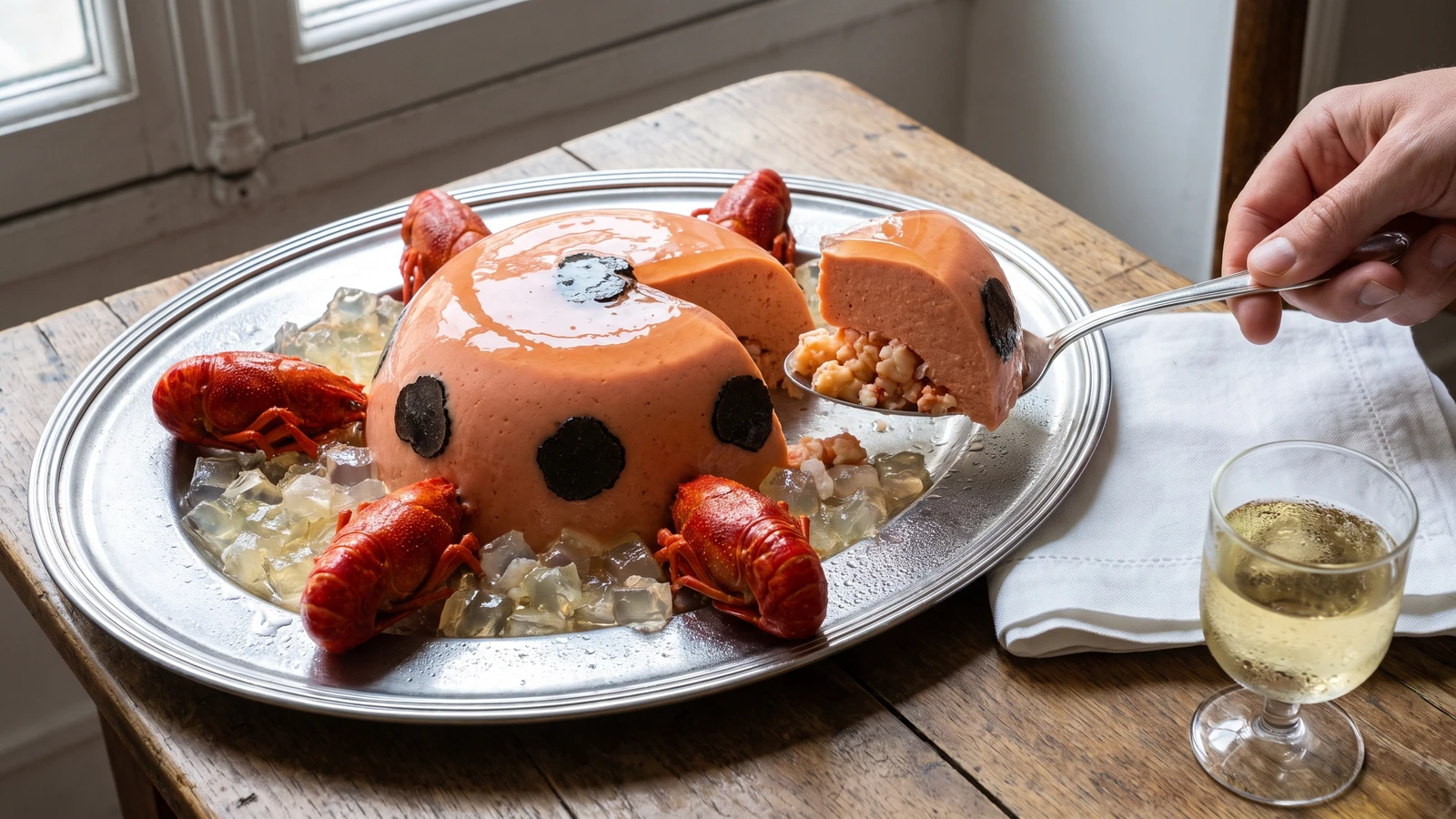
Based on No. 976, Mousse d’Écrevisses, from Le Guide Culinaire (1907) by Auguste Escoffier
Shells become colour, flavour, and structure in this cold crayfish mousse, where fish velouté and jelly meet half-whipped cream over ice for a smooth coral set.
Mousse d’Écrevisses (cold crayfish mousse) teaches the governing principle of every cold shellfish mousse: temperature is structure. The shell purée, fish velouté, jelly, and cream must meet while cool enough to hold an emulsion but still fluid enough to blend without lumps. Keep that balance and the mousse sets smooth, coral-pink, and light on the tongue rather than rubbery or greasy.
The original assumed a saucier on staff, fish velouté and fish jelly waiting beside a stockpot never off the fire, a heavy tamis, a Charlotte mould, and broken ice by the barrowful. A salamander has no work in this cold preparation. At home, a sturdy mortar or powerful blender, a fine sieve, two nested bowls, and an ordinary refrigerator do the same work. Thirty crayfish become twelve, with the original proportions rounded only to measures a home spoon can hold. One cook, one stove, one evening.
The rice cushion, carved block of ice, and towering border of jelly were service scaffolding, so they can go. Pounding the shells with their Mirepoix (No. 228), rubbing the purée through a tamis, using Red Colouring Butter (No. 142), half-whipping the cream, and working the mixture over ice are the dish itself, so they stay. The moment that matters is the final fold: the base must be cold and beginning to thicken, never already set.
Mousse d’Écrevisses belongs to the cold entrée repertoire of the formal Parisian table, where river crayfish shells supplied colour and depth while fish velouté, aspic, and cream gave the preparation its moulded structure. In classical vocabulary, mousses are a broad family of light, moulded fish, meat, poultry, game, and sweet preparations, not merely bowls of whipped purée. Crayfish are central to the cooking around Lyon and Nantua too, but this is not sauce Nantua: its velouté and jelly place it in the national grand-kitchen repertoire carried onto bourgeois special-occasion tables.
Quantity
12 medium (about 1½ lb / 680 g total)
dispatched and rinsed
Quantity
½ cup (120 ml / 90 g) Mirepoix (No. 228)
Quantity
1¼ teaspoons (6 ml / 6 g)
cool and pliable
Quantity
2½ teaspoons (12 ml / 11 g) Red Colouring Butter (No. 142)
cool and pliable
Quantity
¼ cup (60 ml / 60 g)
Quantity
2 tablespoons plus 1 teaspoon (35 ml / 35 g)
cooled until fluid
Quantity
⅓ cup (80 ml / 80 g)
melted and cooled
Quantity
⅔ cup plus 2 teaspoons (170 ml / 170 g)
thoroughly chilled
Quantity
1 (about ½ oz / 15 g)
cut into 12 very thin rounds
Quantity
Up to ¼ teaspoon (1.25 ml / 1.5 g)
Quantity
6 cups (1.4 L / 1.3 kg)
divided, for cooling
| Ingredient | Quantity |
|---|---|
| whole raw crayfishdispatched and rinsed | 12 medium (about 1½ lb / 680 g total) |
| prepared Mirepoix | ½ cup (120 ml / 90 g) Mirepoix (No. 228) |
| unsalted buttercool and pliable | 1¼ teaspoons (6 ml / 6 g) |
| Red Colouring Buttercool and pliable | 2½ teaspoons (12 ml / 11 g) Red Colouring Butter (No. 142) |
| cold fish velouté | ¼ cup (60 ml / 60 g) |
| melted fish jelly for the moussecooled until fluid | 2 tablespoons plus 1 teaspoon (35 ml / 35 g) |
| fish jelly for the mould and garnishmelted and cooled | ⅓ cup (80 ml / 80 g) |
| heavy creamthoroughly chilled | ⅔ cup plus 2 teaspoons (170 ml / 170 g) |
| small black trufflecut into 12 very thin rounds | 1 (about ½ oz / 15 g) |
| fine sea salt (optional) | Up to ¼ teaspoon (1.25 ml / 1.5 g) |
| icedivided, for cooling | 6 cups (1.4 L / 1.3 kg) |
Set a smooth 1½-cup (360 ml) Charlotte mould or bowl over ice. For the book’s transparent finish, clothe the mould with about 2 tablespoons of the garnish jelly, rocking it over the ice until a thin, even film sets. This is the method carried in Another Method of Preparing Aspics de Filets de Soles (No. 916) and Mousse de Homard Moulée (No. 957). Dip four truffle rounds in fluid jelly and fix them against the coated sides. For a simpler release, line the mould closely with food-safe plastic wrap and set all the garnish jelly aside for chopping.
Spread the Mirepoix (No. 228) across a broad, lidded sauté pan and arrange the crayfish over it. Cover and cook over medium-high heat for 6 to 8 minutes, shaking the pan frequently, until the shells are scarlet and the tail flesh is pearly opaque and reaches 145°F (63°C). If the mirepoix threatens to catch before the crayfish are cooked, add 1 tablespoon (15 ml) cold water, cover again, and let that small amount cook away. Transfer everything to a tray and cool only until the shells can be handled.
Twist off the tails, peel them, remove the dark intestinal threads, and pick any meat from the claws. Cut all the meat into fine dice and refrigerate it immediately. Reserve the four finest body carapaces, trim their uneven undersides with kitchen shears, rinse away any loose matter, and dry them well. From the remaining heads remove the gritty stomach sacs and feathery gills, then crush the cleaned shells inside a folded kitchen towel with a rolling pin.
Put the crushed shells and all the cooked mirepoix into a sturdy mortar or powerful blender. Pound or pulse them to a fine, damp rubble before adding the unsalted butter, Red Colouring Butter (No. 142), cold fish velouté, and the 2 tablespoons plus 1 teaspoon of fluid fish jelly. Continue until the mixture becomes a thick coral paste. Work in short pulses if using a machine, and stop if its motor labours; crush the shells more finely by hand before continuing.
Rub the paste firmly through a tamis (fine-mesh sieve), scraping the smooth purée from its underside as you work. Pass it a second time through the clean sieve or damp muslin. This cannot be shortened: one sharp fleck of shell ruins the mousse, so discard the dry grit rather than forcing it through. Transfer the perfectly smooth purée to a chilled metal bowl, taste it, and add only as much salt as it needs.
Nest the bowl of purée in a larger bowl of ice and stir continuously for 2 to 3 minutes. Stop when the mixture feels thoroughly cold and the whisk leaves a fleeting trace, while the purée still flows from a spoon. If jelly begins setting around the edge in threads or little lumps, lift the bowl from the ice and whisk it briefly over barely warm water until smooth, then return it to the ice. Ça se rattrape.
Reserve 1 tablespoon (15 ml) of the liquid cream. Whip the remainder only until it falls from the whisk in soft, lazy folds without holding a peak. This is half-beaten cream, not stiff cream. If it turns grainy, whisk in the reserved liquid cream to smooth it; otherwise stir that reserved cream into the cold shellfish base. Fold one-third of the whipped cream into the base to lighten it, then fold in the remainder and the diced crayfish tails. Keep the bowl over ice, but lift it away if the edges begin setting before the tails are evenly distributed. If the finished mousse remains loose, stir it gently over ice for another minute.
Reserve about ¼ cup (60 ml) of mousse and divide it among the four cleaned carapaces. Fill the prepared mould with the remainder, smooth the top, and tap it once against a folded towel to release large air pockets. Dip four truffle rounds in fluid jelly and place one on each filled carapace. Cover both mould and shells, then refrigerate at 40°F (4°C) or colder for at least 3 hours. Pour the remaining garnish jelly into a shallow dish and chill it until firm.
Dip a jelly-clothed mould in warm water for 2 seconds, dry its outside, and invert it onto a chilled serving dish. If it refuses to release, repeat for 1 second rather than warming it continuously. For a lined mould, invert and peel away the wrap. Should the mousse soften or slump, return it to the mould and chill it for 30 minutes before trying again. Chop the set garnish jelly, arrange it around the base, and stand the four filled carapaces almost upright in it. Dip the remaining truffle rounds in fluid jelly and set them in a small crown on top. Serve cold with small plates and spoons. À table!
1 serving (about 100g)
Culinary guides, cultural storytelling, and the editorial depth that makes cooking meaningful.
Discover Culinary ExplorerChef Juliette
Tiny éperlans, lightly floured and fried until their tails stand crisp, arrive in a generous heap on a napkin with fried parsley and grooved lemon, a weeknight lesson in heat and restraint.

Chef Juliette
Brandade de Morue turns salt cod, warm olive oil, and milk into a pale, silky emulsion: keep everything warm and add the oil slowly, then crown the generous dome with butter-fried bread.

Chef Juliette
Salt cod worked warm with cream, one patient spoonful at a time, until the rough flakes become a glossy Nîmes paste, domed generously and ringed with butter-fried croutons for the table.

Chef Juliette
Wine-poached char packed in its earthenware crock beneath butter gold: a make-ahead first course that turns careful cooling, thorough boning, and one unbroken seal into quiet abundance.