
Chef Juliette
Smelt (Éperlans)
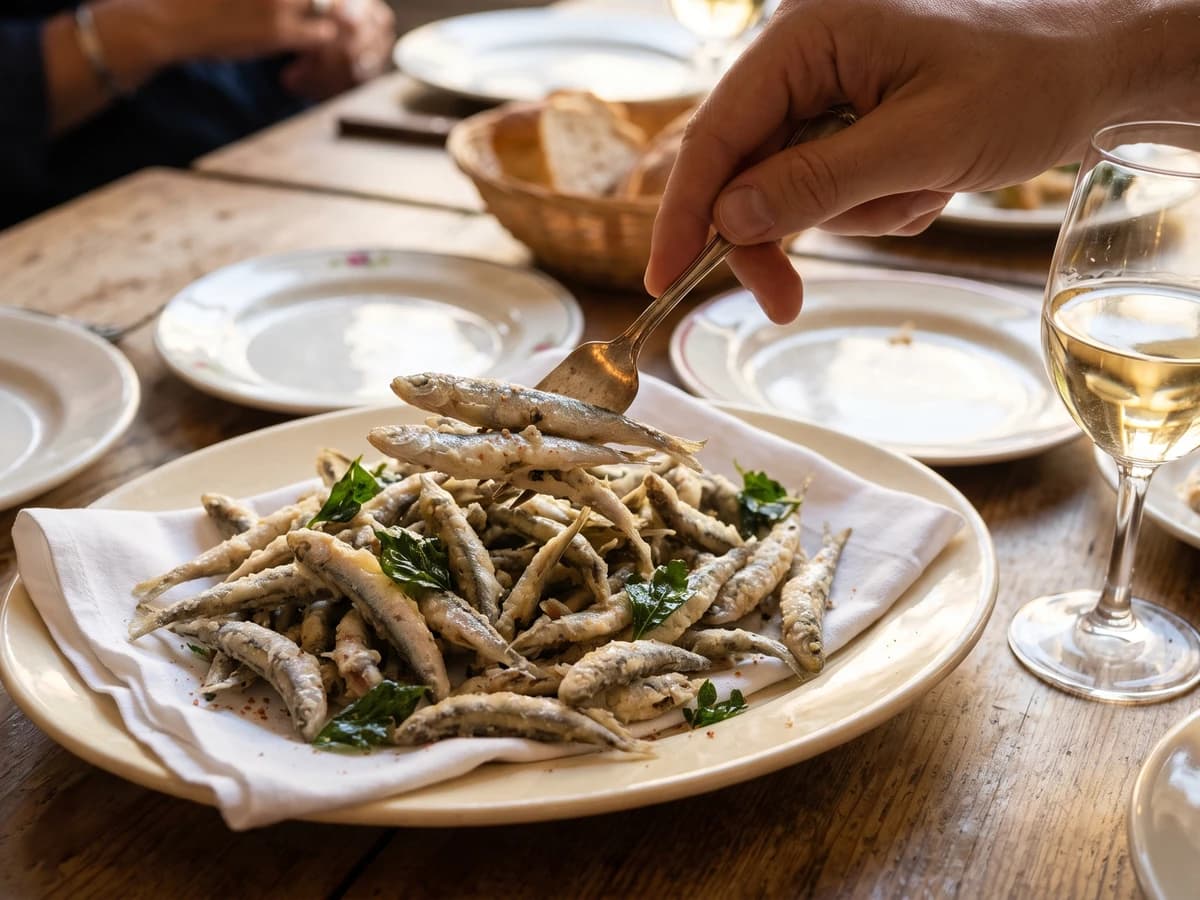
Tiny éperlans, lightly floured and fried until their tails stand crisp, arrive in a generous heap on a napkin with fried parsley and grooved lemon, a weeknight lesson in heat and restraint.
A cooking platform built around craft, culture, and the stories behind what we eat.

Created by Chef Juliette
Based on No. 1028, Brandade de Morue à la Crème, from Le Guide Culinaire (1907) by Auguste Escoffier
Salt cod worked warm with cream, one patient spoonful at a time, until the rough flakes become a glossy Nîmes paste, domed generously and ringed with butter-fried croutons for the table.
Brandade de Morue à la Crème (salt cod creamed into a silky paste) teaches one true thing: brandade is an emulsion, not mashed fish. The morue must stay warm while hot cream enters by patient spoonfuls, each addition disappearing before the next. Rush that rhythm and you get fish swimming in cream; keep it and rough flakes turn pale, supple, and glossy.
The classical formula assumed morue already soaked, a cook free to stand beside the range, and a saucepan held at the gentle edge of the fire while another hand kept the cream hot. A small heavy pan over the lowest burner is the honest home equivalent. The source's two-thirds pint is scaled to 250 ml cream for 300 g fish, enough for four generous appetizer portions, with the fish-to-cream proportion intact. The brigade's spare hands are scaffolding and can go; continuous working and spoonful-by-spoonful cream are the dish and must stay. One cook, one stove, one evening.
The brandade should arrive domed, its spoon marks catching the light, with butter-fried bread triangles around it. Keep the heat gentle during the emulsion, and if cream begins to pool, stop pouring before you do anything else. That's the moment that matters; ça se rattrape if it slips.
Brandade belongs above all to Nîmes in Languedoc, where morue arriving through southern trade was worked with local olive oil, milk, and garlic into a warm, pale emulsion. From household tables it entered the classical repertoire, where Brandade de Morue à la Crème became a distinct enrichment: cream replaces both oil and milk and must still be incorporated gradually. Potato appears in many family versions, but it is not part of this formula; the source rests entirely on salt cod, cream, and controlled working.
Quantity
300 g / 10 1/2 oz
preferably a thick center cut
Quantity
as needed
for soaking and poaching
Quantity
1 small clove
crushed to a smooth paste
Quantity
1 cup plus 2 teaspoons (250 ml / 248 g)
Quantity
2 teaspoons (10 ml / 10 g)
Quantity
1/8 teaspoon (0.6 ml / 0.25 g)
Quantity
1/4 teaspoon (1.25 ml / 0.6 g)
Quantity
as needed after tasting
Quantity
4 slices (about 100 g / 3 1/2 oz)
crusts removed and cut diagonally into 8 triangles
Quantity
3 tablespoons (45 ml / 42 g)
for frying
| Ingredient | Quantity |
|---|---|
| dried salt cod (morue)preferably a thick center cut | 300 g / 10 1/2 oz |
| cold waterfor soaking and poaching | as needed |
| garliccrushed to a smooth paste | 1 small clove |
| heavy cream, at least 35% fat | 1 cup plus 2 teaspoons (250 ml / 248 g) |
| fresh lemon juice | 2 teaspoons (10 ml / 10 g) |
| freshly grated nutmeg | 1/8 teaspoon (0.6 ml / 0.25 g) |
| ground white pepper | 1/4 teaspoon (1.25 ml / 0.6 g) |
| fine salt (optional) | as needed after tasting |
| firm white breadcrusts removed and cut diagonally into 8 triangles | 4 slices (about 100 g / 3 1/2 oz) |
| unsalted butterfor frying | 3 tablespoons (45 ml / 42 g) |
Rinse the morue under cold running water, brushing away any loose surface salt. Put it in a nonreactive bowl, cover it generously with cold water, and refrigerate for 24 to 36 hours, changing the water three or four times. After 24 hours, poach a small shaving for a minute and taste it: the fish should remain distinctly seasoned but no longer taste fiercely salty. If it does, give it another change of water and several more hours.
Drain the soaked morue and place it in a 2-quart heavy saucepan. Cover it with fresh cold water by 1 inch (2.5 cm), then bring it slowly to just below a simmer. Lower the heat and poach for 8 to 10 minutes, until the flesh is opaque, separates readily into flakes, and reaches 145°F (63°C) at the thickest part. Never boil it; hard heat tightens the fibers before you ask them to become a paste. Drain well, remove every scrap of skin and bone while the fish is warm, then press the flakes briefly in a clean towel to remove surface water.
Melt half the butter in a 9-inch skillet over medium heat. Add the bread triangles without crowding and fry until deep butter-gold underneath, about 1 to 2 minutes, then turn them and add the remaining butter as the pan dries. Fry the second side until crisp and evenly colored. Transfer the croutons to a rack and leave them uncovered; enclosing warm fried bread softens the crust.
Pour the cream into a small saucepan and warm it over low heat until fluid and hot but nowhere near boiling, about 150°F (65°C). A few tiny bubbles may gather at the rim, but the surface should remain still. Hot cream joins warm fish willingly; cold cream seizes the paste, while boiling cream encourages the fat to separate.
Return the picked morue to the dry heavy saucepan with the garlic and set it over the lowest heat. Press, smear, and beat it firmly with a wooden spoon for 3 to 5 minutes, until the flakes break into a fibrous paste without taking any color. Add the hot cream one tablespoon at a time, beating until each spoonful disappears completely before adding the next. Keep the pan warm, never hot, and continue until all the cream is incorporated and the brandade is glossy, supple, and thick enough to hold a soft mound. If cream begins to pool or the paste turns grainy, stop adding it and remove the pan from the heat. Beat firmly for 30 seconds. If it still refuses to come together, take one compact spoonful from beneath the pooled cream and beat it smooth in a warm bowl, then feed the loose mixture back into that base one teaspoon at a time. Ça se rattrape.
Take the pan off the heat and beat in the lemon juice, nutmeg, and white pepper. Taste before reaching for salt, because properly soaked morue usually carries enough of its own. Rinse a shallow serving platter with hot water and dry it, then spoon the brandade into the center and shape it into a generous dome with the back of the spoon. Arrange the butter-fried croutons around it and serve at once, while the paste is warm and yielding. À table!
1 serving (about 220g)
Culinary guides, cultural storytelling, and the editorial depth that makes cooking meaningful.
Discover Culinary ExplorerChef Juliette
Tiny éperlans, lightly floured and fried until their tails stand crisp, arrive in a generous heap on a napkin with fried parsley and grooved lemon, a weeknight lesson in heat and restraint.

Chef Juliette
Brandade de Morue turns salt cod, warm olive oil, and milk into a pale, silky emulsion: keep everything warm and add the oil slowly, then crown the generous dome with butter-fried bread.

Chef Juliette
Wine-poached char packed in its earthenware crock beneath butter gold: a make-ahead first course that turns careful cooling, thorough boning, and one unbroken seal into quiet abundance.
Chef Juliette
Friture de blanchaille is a lesson in hot fat and restraint: flour shaken nearly bare, minute-long batches, a snap of salt and cayenne, and fried parsley still vivid green.