
Chef Juliette
Smelt (Éperlans)
Tiny éperlans, lightly floured and fried until their tails stand crisp, arrive in a generous heap on a napkin with fried parsley and grooved lemon, a weeknight lesson in heat and restraint.
A cooking platform built around craft, culture, and the stories behind what we eat.
Created by Chef Juliette
Based on No. 978, Petits Soufflés Froids d’Écrevisses, from Le Guide Culinaire (1907) by Auguste Escoffier
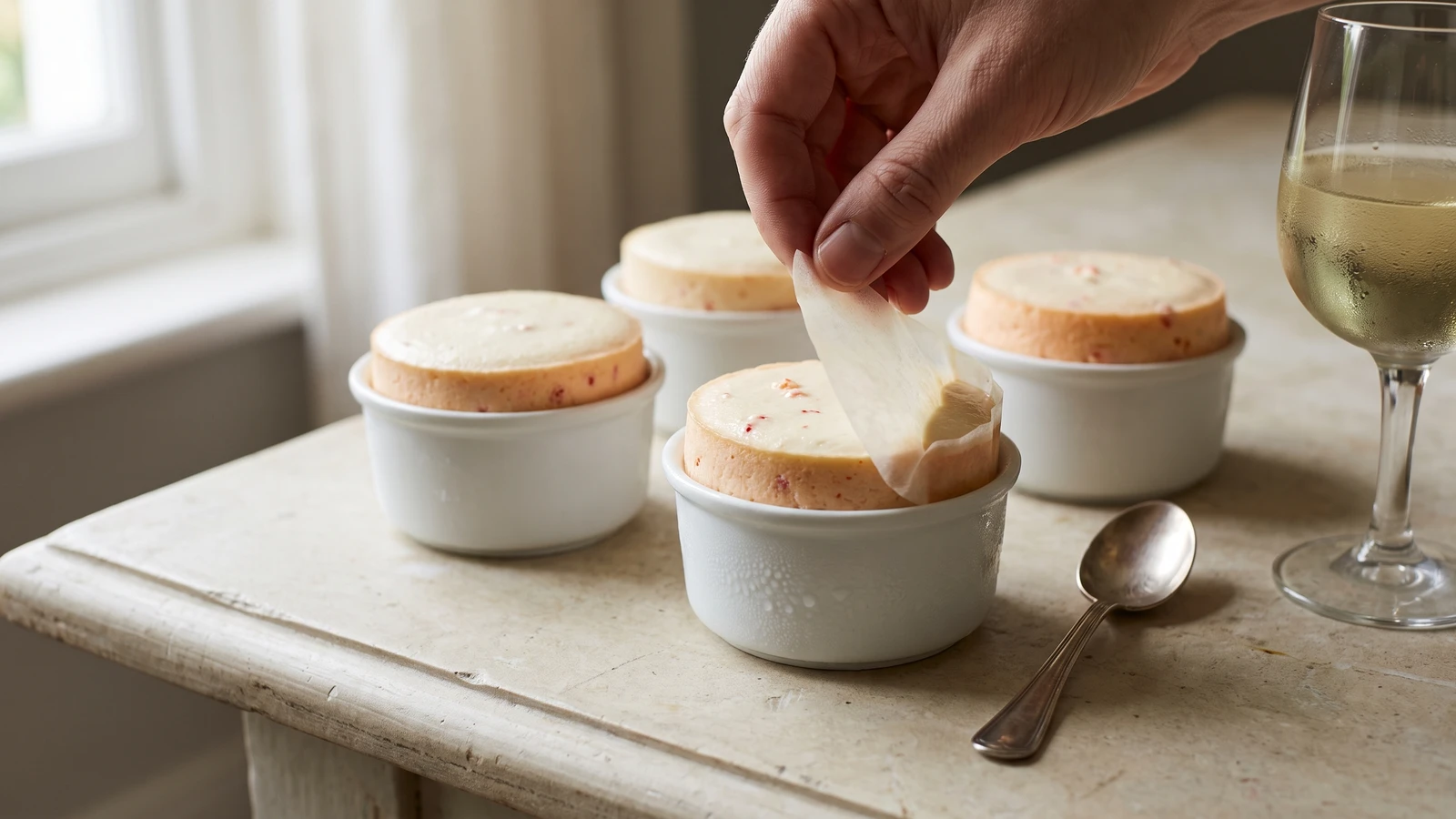
Petits Soufflés Froids d’Écrevisses rise cold and proud from their cassolettes, a coral crayfish mousse held by fish jelly, lightened with cream, and shaped by a paper collar into the likeness of a hot soufflé.
Petits Soufflés Froids d’Écrevisses (small cold crayfish soufflés) teach one true thing before you touch a pan: the paper collar creates the silhouette, but temperature and fish jelly make that silhouette stand. This isn't a baked soufflé cooled down. It is a cold mousse, lightened with half-beaten cream and moulded above the rim so the eye expects heat before the first cool, coral spoonful proves otherwise.
The original kitchen assumed a saucier with fish jelly ready, Mousse d’Écrevisses (No. 976) being prepared elsewhere, silver timbales, and an ice station for holding the finished pieces. Here, one cook uses four small cassolettes, ordinary parchment collars, and a refrigerator. The moulding method from Petites Mousses de Homard (No. 958) stays because it is the dish; the carved ice, formal supports, and brigade quantities are scaffolding, so they go. A salamander has no work here. I keep the prescribed cold Béchamel, a milk sauce bound with white roux, in place of fish velouté because it gives this small home batch body without burying the crayfish.
When the collars come away, each mousse should stand pale coral and proud, tender enough for a spoon but firm enough to keep its clean sides. Fill only when the mousse is cold yet still supple. Too warm and it slumps, too firmly set and it traps gaps; that brief middle moment decides the whole dish.
Petits Soufflés Froids d’Écrevisses belong to the Parisian grand-kitchen hors d’œuvre table, where chilled mousses were moulded to borrow the proud outline of hot soufflés and served individually from cassolettes or silver timbales. Despite the name, they are not egg-white soufflés served cold: half-beaten cream supplies the aeration, fish jelly provides the set, and the removable paper collar creates the characteristic rise.
Quantity
2 cups (480 ml / about 480 g) Mousse d’Écrevisses (No. 976)
freshly prepared as a four-serving batch, substituting an equal measure of cold Béchamel for its fish velouté
Quantity
1/4 cup (60 ml / 60 g)
melted and cooled until fluid
Quantity
1 four-cassolette setup from Petites Mousses de Homard (No. 958)
Quantity
1 teaspoon (5 ml / 3 g)
Quantity
1/2 teaspoon (2.5 ml / 2.5 g)
| Ingredient | Quantity |
|---|---|
| Mousse d’Écrevissesfreshly prepared as a four-serving batch, substituting an equal measure of cold Béchamel for its fish velouté | 2 cups (480 ml / about 480 g) Mousse d’Écrevisses (No. 976) |
| prepared fish jellymelted and cooled until fluid | 1/4 cup (60 ml / 60 g) |
| paper-collar moulding setup | 1 four-cassolette setup from Petites Mousses de Homard (No. 958) |
| plain flour | 1 teaspoon (5 ml / 3 g) |
| cold water | 1/2 teaspoon (2.5 ml / 2.5 g) |
Warm the fish jelly in a small saucepan over the lowest heat only until it flows. It must be fluid but no longer hot, since heat would weaken the cold mousse later. Spoon 1 tablespoon into each cassolette, tilting the dishes until their bottoms wear a thin, even coating. Refrigerate for 10 to 15 minutes, until the jelly is completely firm.
Follow the paper-collar moulding setup from Petites Mousses de Homard (No. 958). Cut four strips of white parchment long enough to line the inside circumference of each cassolette with a small overlap, and wide enough to stand 1 inch (2.5 cm) above the rim. Mix the flour and water into a thick batter, use the smallest dab between the overlapping paper ends, then press until the join holds. Fit each collar snugly against the set jelly and the vessel wall, with no gap through which the mousse could escape.
Prepare the Mousse d’Écrevisses (No. 976) as its own entry directs, scaled to four people, but replace its measure of fish velouté with the same measure of thoroughly cold Béchamel, exactly as this dish requires. Bring the finished mousse to the cassolettes while it is chilled, supple, and not yet set. Fold it once or twice with a flexible spatula to make the diced crayfish evenly distributed, but don't whisk; the half-beaten cream already supplies the soufflé's lightness.
Spoon the mousse into the collared cassolettes, pressing gently around the edges so no hollow pockets remain. Continue until it stands 2/3 inch (about 1.7 cm) above each rim, then level the tops without compacting them. The mousse must hold that height inside the paper. If it sinks or leaks downward, stop and scrape it into a cold bowl, set the bowl over ice for 5 minutes, and fold slowly until a spoonful keeps its shape. Refill the collars. Ça se rattrape.
Place the cassolettes on a level tray and refrigerate for at least 4 hours, covering them with an inverted container that cannot touch the raised tops. They are ready when the mousse feels cold and stable through the parchment, with no movement at the centre. The old ice display was brigade scaffolding and can go; an ordinary refrigerator gives a steadier, safer set.
Take the soufflés from the refrigerator immediately before serving. Release the joined end of each collar, steady the raised mousse lightly through the paper, and peel the parchment sideways and slowly rather than pulling upward. The mousse should remain standing above the cassolette like a small hot soufflé, though it is served properly cold. Set one before each guest. À table!
1 serving (about 135g)
Culinary guides, cultural storytelling, and the editorial depth that makes cooking meaningful.
Discover Culinary ExplorerChef Juliette
Tiny éperlans, lightly floured and fried until their tails stand crisp, arrive in a generous heap on a napkin with fried parsley and grooved lemon, a weeknight lesson in heat and restraint.

Chef Juliette
Brandade de Morue turns salt cod, warm olive oil, and milk into a pale, silky emulsion: keep everything warm and add the oil slowly, then crown the generous dome with butter-fried bread.

Chef Juliette
Salt cod worked warm with cream, one patient spoonful at a time, until the rough flakes become a glossy Nîmes paste, domed generously and ringed with butter-fried croutons for the table.

Chef Juliette
Wine-poached char packed in its earthenware crock beneath butter gold: a make-ahead first course that turns careful cooling, thorough boning, and one unbroken seal into quiet abundance.