
Chef Juliette
Smelt (Éperlans)
Tiny éperlans, lightly floured and fried until their tails stand crisp, arrive in a generous heap on a napkin with fried parsley and grooved lemon, a weeknight lesson in heat and restraint.
A cooking platform built around craft, culture, and the stories behind what we eat.
Created by Chef Juliette
Based on No. 958, Petites Mousses de Homard, from Le Guide Culinaire (1907) by Auguste Escoffier
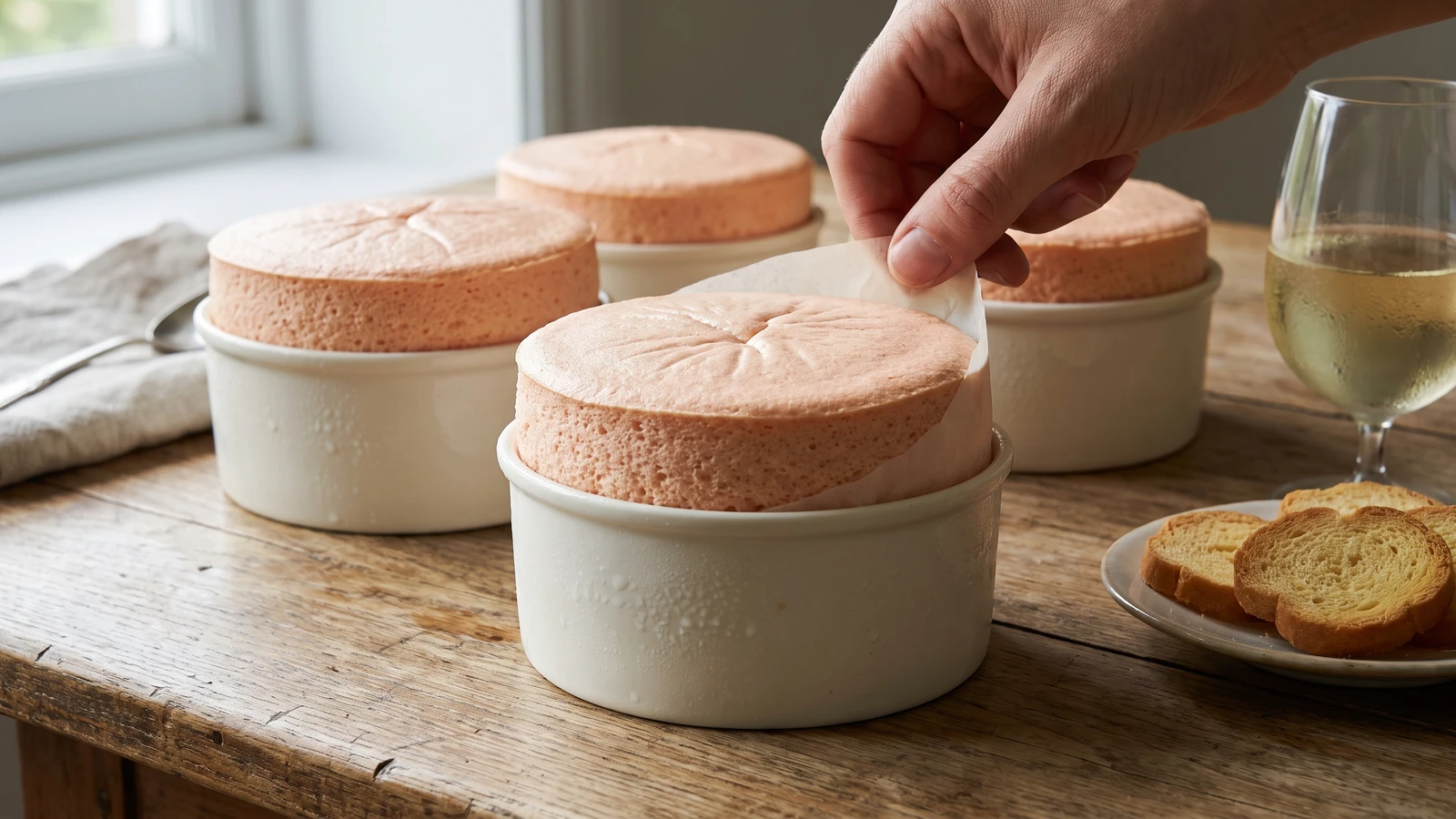
Four cold lobster mousses rise proudly from little cassolettes, set over clear lobster jelly and held by parchment collars: the classical dinner-party illusion made workable for one home cook.
Petites Mousses de Homard (little cold lobster mousses) teach the rule that governs every cold mousse: the lobster base must be cool but still fluid when the whipped cream goes in. Fold into warmth and the cream loses its air; wait until the gelatin sets and the mousse becomes pebbled. Catch the interval between them and each little mousse stands above its cassolette, pale coral and light enough to yield under the spoon.
The original entry assumed a garde-manger (cold station) beside a saucier, lobster jelly ready from a stockpot never off the fire, mousse prepared in quantity, silver timbales, paper collars, and beds of ice. This cold hors d'œuvre had no use for a salamander. At home, two cooked lobster tails supply both meat and shells for a quick fond de homard (concentrated lobster stock), powdered gelatin gives a measured set, straight-sided ramekins replace silver, food-safe parchment replaces white paper, and the refrigerator replaces the ice bed. The brigade's prepared components and banquet quantity are scaffolding; the clear jelly base, whipped cream, paper collar, and proud cold set are the dish and must stay. One cook, one stove, one evening.
If the lobster base begins setting before the cream is ready, don't force the fold. Warm it briefly over barely warm water until it flows again, then cool it to the proper point. Ça se rattrape. Bringing that base to cool and fluid before folding is the step that decides the dish.
Petites mousses de homard belong to the formal Parisian table and the grand-kitchen garde-manger, not to a particular regional farmhouse repertoire. Their cassolette is a small drum-shaped vessel, and the paper collar is functional rather than decorative: it lets a cold mousse stand above the rim and borrow the profile of a soufflé without entering an oven. As the preparation moved into home entertaining, ramekins and refrigerators replaced silver timbales and beds of ice, while the clear jelly base and high creamy set remained its identifying practice.
Quantity
2, about 1 pound (455 g), yielding about 7 ounces (200 g) meat
Quantity
1 tablespoon (15 ml / 14 g)
Quantity
1, about 2 tablespoons (30 ml / 30 g)
thinly sliced
Quantity
1 small sprig
Quantity
1/2 cup (120 ml / 120 g)
Quantity
1 cup (240 ml / 240 g)
Quantity
2 teaspoons (10 ml / 6 g)
divided
Quantity
3/4 cup (180 ml / 180 g)
very cold
Quantity
1 teaspoon (5 ml / 5 g)
Quantity
1/4 teaspoon (1.25 ml / 1.5 g), or to taste
Quantity
1/8 teaspoon (0.6 ml / 0.3 g)
Quantity
1 small pinch
| Ingredient | Quantity |
|---|---|
| cooked lobster tails in shell | 2, about 1 pound (455 g), yielding about 7 ounces (200 g) meat |
| unsalted butter | 1 tablespoon (15 ml / 14 g) |
| small shallotthinly sliced | 1, about 2 tablespoons (30 ml / 30 g) |
| thyme | 1 small sprig |
| dry white wine | 1/2 cup (120 ml / 120 g) |
| water | 1 cup (240 ml / 240 g) |
| powdered gelatin, about 200 Bloomdivided | 2 teaspoons (10 ml / 6 g) |
| heavy creamvery cold | 3/4 cup (180 ml / 180 g) |
| fresh lemon juice | 1 teaspoon (5 ml / 5 g) |
| fine sea salt | 1/4 teaspoon (1.25 ml / 1.5 g), or to taste |
| ground white pepper | 1/8 teaspoon (0.6 ml / 0.3 g) |
| cayenne pepper | 1 small pinch |
Remove the lobster meat from its shells, weigh out 7 ounces (200 g), and keep it covered in the refrigerator. Cut the shells into several pieces. Melt the butter in a small saucepan, add the shells, and stir over medium heat for 3 minutes, until they look glossy and their fragrance deepens. Add the shallot and thyme and cook for 1 minute without browning. Pour in the wine, scrape the pan clean, and reduce it by half. Add the water and hold the fond at a bare simmer for 12 minutes. Strain it through a fine sieve lined with damp cheesecloth, pressing the shells only lightly, then skim away visible fat. Reduce the strained fond to exactly 3/4 cup (180 ml). If it falls short, add a little water; if there is too much, keep reducing.
Stand four 4-fluid-ounce (120 ml) cassolettes on a level tray. Sprinkle 3/4 teaspoon of the gelatin over 1 tablespoon (15 ml) of cold fond and leave it for 5 minutes to bloom. Heat another 3 tablespoons (45 ml) of fond until hot but not boiling, remove it from the heat, and stir in the bloomed gelatin until completely clear. If grains remain, return the pan to the lowest heat and stir gently, never letting it boil. Ça se rattrape. Pour 1 tablespoon (15 ml) into each cassolette, following the source entry's smaller measure for a vessel of this size. Refrigerate for 25 to 30 minutes, until the gelée (savory jelly) is firm.
Once the gelée is set, cut four strips of food-safe parchment about 2 inches (5 cm) wide and long enough to overlap around each cassolette. Wrap one tightly around each vessel so the paper stands exactly 1 inch (2.5 cm) above the brim. Secure the overlap on the outside with tape or a small clip, keeping the fastening away from the mousse. The collar must sit snugly against the rim or the mixture will escape into the gap.
Sprinkle the remaining 1 1/4 teaspoons gelatin over 2 tablespoons (30 ml) of cold fond and leave it for 5 minutes. Warm 1/4 cup (60 ml) of fond, remove it from the heat, and dissolve the bloomed gelatin in it. Keep the final 2 tablespoons (30 ml) of fond cold as insurance. Process the lobster meat with the warm gelatin mixture, lemon juice, salt, white pepper, and cayenne until very smooth, then press the purée through a fine sieve into a chilled bowl. Set that bowl over ice water and stir until the purée feels cool, has thickened slightly, and still falls freely from the spoon. If it begins setting around the edge or forms soft lumps, place the bowl over barely warm water and stir only until fluid, then cool it again.
Whip the cold cream to soft peaks that bend over when the whisk is lifted. Stir one-quarter of it into the lobster purée to lighten the base, then fold in the remaining cream in two additions with broad strokes from the bottom of the bowl. Stop as soon as no white streaks remain. If the mixture becomes too firm to fold cleanly, add the reserved cold fond 1 teaspoon at a time; if it looks loose, refrigerate it for 5 minutes and test again. It should hold a soft mound without becoming stiff.
Spoon a little mousse into each cassolette first, pressing it gently against the sides so no hollow pockets remain. Divide the rest evenly, filling the parchment collars about 3/4 inch (2 cm) above the vessel rims. Smooth the tops level with a small palette knife or the back of a spoon. Give the tray one gentle tap to settle large air pockets, but don't knock out the cream you have just folded so carefully.
Refrigerate the filled cassolettes, collars still in place, for at least 4 hours and up to 24 hours. The mousse is ready when the top feels set yet yields softly under a fingertip. Release each fastening and peel the parchment away slowly. If a collar catches, trace only that spot with the tip of a thin knife warmed in hot water and dried. Each mousse should remain standing above its rim like a little cold soufflé.
Take the petites mousses from the refrigerator 8 to 10 minutes before serving, just long enough for the lobster flavor to open while the set remains firm. Place each cassolette on a small underplate and offer thin brioche toasts alongside. No decorative flourish is needed; the pale coral mousse standing proudly above its rim is the finish. À table!
1 serving (about 125g)
Culinary guides, cultural storytelling, and the editorial depth that makes cooking meaningful.
Discover Culinary ExplorerChef Juliette
Tiny éperlans, lightly floured and fried until their tails stand crisp, arrive in a generous heap on a napkin with fried parsley and grooved lemon, a weeknight lesson in heat and restraint.

Chef Juliette
Brandade de Morue turns salt cod, warm olive oil, and milk into a pale, silky emulsion: keep everything warm and add the oil slowly, then crown the generous dome with butter-fried bread.

Chef Juliette
Salt cod worked warm with cream, one patient spoonful at a time, until the rough flakes become a glossy Nîmes paste, domed generously and ringed with butter-fried croutons for the table.

Chef Juliette
Wine-poached char packed in its earthenware crock beneath butter gold: a make-ahead first course that turns careful cooling, thorough boning, and one unbroken seal into quiet abundance.