
Chef Juliette
Smelt (Éperlans)
Tiny éperlans, lightly floured and fried until their tails stand crisp, arrive in a generous heap on a napkin with fried parsley and grooved lemon, a weeknight lesson in heat and restraint.
A cooking platform built around craft, culture, and the stories behind what we eat.
Created by Chef Juliette
Based on No. 435, Hard-boiled Eggs Chimay, from Le Guide Culinaire (1907) by Auguste Escoffier
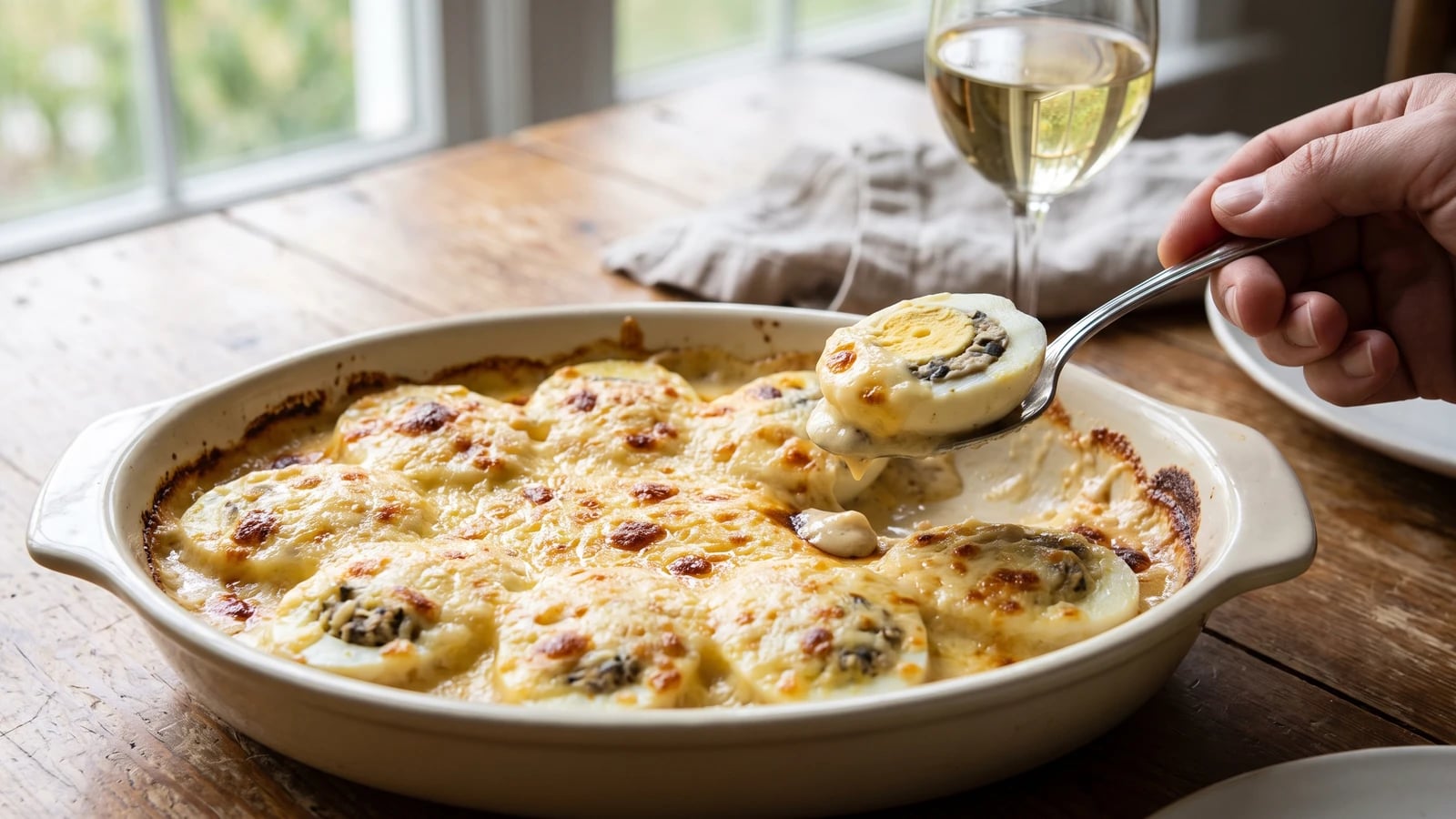
Hard-cooked eggs become Œufs Chimay when their yolks meet dry mushroom duxelle, return to the whites, and disappear under Mornay and Gruyère before a fierce glaze turns the top butter-gold.
Œufs Chimay (hard-boiled eggs filled with yolk and mushrooms, covered in cheese sauce, and glazed) teach a compact truth: a stuffing stays delicate only when its moisture is controlled. The original ratio is exact, cooked yolk matched by an equal quantity of dry duxelle. If the mushrooms carry water, the filling slumps beneath the sauce; dryness here is structure, not fuss.
The original recipe assumed a saucier on staff, a stock never off the fire, and a salamander ready for glazing. At home, the stockpot is scaffolding because this dish calls for no stock, the saucier’s work becomes finished Mornay kept warm and pourable, and the salamander becomes a fully heated broiler. We scale the dish to four eggs in one shallow gratin dish. The separate hands can go; the equal filling ratio, the Mornay mask, and the fierce final glaze are the dish, and they stay. One cook, one stove, one evening.
When it is right, each egg holds a savory, mushroom-dark center beneath ivory sauce, with a Gruyère crust blistered gold and a buttery edge still bubbling. Before you begin, remember the step that decides everything: weigh the cooked yolks, then match them gram for gram with duxelle that is genuinely dry.
Œufs Chimay belong to the codified Parisian grand-kitchen repertoire, although Chimay lies in Belgium and the name came through its princely title rather than a French egg-producing region. The dish is classical French in its grammar: a modest hard-cooked egg is rebuilt with duxelle, masked with Mornay, and finished by glazing. Its familiar ingredients and compact gratin allowed it to travel easily from the grand kitchen to the bourgeois dining room without losing its formal composition.
Quantity
4
Quantity
about 1/3 cup (80 ml / 70 g) Ordinary or Dry Duxelle (No. 223), weighed to equal the cooked yolks
Quantity
1 teaspoon (5 ml / 5 g)
softened, for the gratin dish
Quantity
1 cup (240 ml / 250 g)
warm and pourable
Quantity
1 tablespoon (15 ml / 15 g)
for loosening the Mornay sauce
Quantity
1/4 cup (60 ml / 25 g)
finely grated
Quantity
2 teaspoons (10 ml / 10 g)
melted
Quantity
1 application of Gratins (No. 268), glazing form
| Ingredient | Quantity |
|---|---|
| large eggs | 4 |
| Ordinary or Dry Duxelle | about 1/3 cup (80 ml / 70 g) Ordinary or Dry Duxelle (No. 223), weighed to equal the cooked yolks |
| unsalted buttersoftened, for the gratin dish | 1 teaspoon (5 ml / 5 g) |
| Mornay saucewarm and pourable | 1 cup (240 ml / 250 g) |
| whole milk (optional)for loosening the Mornay sauce | 1 tablespoon (15 ml / 15 g) |
| Gruyèrefinely grated | 1/4 cup (60 ml / 25 g) |
| unsalted buttermelted | 2 teaspoons (10 ml / 10 g) |
| Gratins | 1 application of Gratins (No. 268), glazing form |
Place the eggs in a saucepan in one layer and cover them with cool water by 1 inch. Bring just to a boil over medium heat, cover the pan, remove it from the heat, and leave the eggs for 11 minutes. Transfer them directly to ice water for at least 5 minutes, then peel. If a shell clings, peel beneath a thin stream of cool water; if a white tears, keep it and turn the damaged edge inward in the gratin dish. The Mornay will cover an honest repair. Ça se rattrape.
Cut the eggs lengthwise and lift out the yolks without splitting the whites. Weigh the yolks, then pound or mash them into a smooth paste. Fold in exactly the same weight of Ordinary or Dry Duxelle (No. 223), about 70 g for four large eggs, until the mixture is even and holds together when pressed. If it feels loose, chill it for 10 minutes; do not stiffen it with breadcrumbs, which would change the filling rather than rescue it.
Butter a shallow broiler-safe gratin dish. Divide the filling among the eight whites, pressing it into each cavity and mounding the surface with two teaspoons. Arrange the halves snugly in the dish, filled side up, so they support one another when the sauce is poured over them.
Warm the Mornay over low heat until it coats a spoon but still pours in a broad ribbon. If it has tightened while waiting, whisk in the milk a teaspoon at a time; if it is too thin, hold it at the gentlest simmer until it recovers its body. Ça se rattrape. Spoon the sauce over every egg, letting it settle between the halves without burying their shape completely.
Heat the broiler fully and set a rack about 6 inches beneath it. Sprinkle the Gruyère evenly over the Mornay and dot the surface with the melted butter. Apply the glazing form of Gratins (No. 268): broil for 2 to 4 minutes, rotating the dish once if needed, until the sauce bubbles at the rim and the top blisters butter-gold. Do not walk away. If one patch colors too quickly, lower the dish or rotate it at once; prolonged heat only toughens eggs that are already cooked.
Let the gratin stand for 3 minutes so the sauce settles around the eggs without losing its gloss. Serve two halves per person while the Gruyère crown is still bronzed and the filling remains tender. Cooking well is not cooking fancy. À table!
1 serving (about 140g)
Culinary guides, cultural storytelling, and the editorial depth that makes cooking meaningful.
Discover Culinary ExplorerChef Juliette
Tiny éperlans, lightly floured and fried until their tails stand crisp, arrive in a generous heap on a napkin with fried parsley and grooved lemon, a weeknight lesson in heat and restraint.

Chef Juliette
Brandade de Morue turns salt cod, warm olive oil, and milk into a pale, silky emulsion: keep everything warm and add the oil slowly, then crown the generous dome with butter-fried bread.

Chef Juliette
Salt cod worked warm with cream, one patient spoonful at a time, until the rough flakes become a glossy Nîmes paste, domed generously and ringed with butter-fried croutons for the table.

Chef Juliette
Wine-poached char packed in its earthenware crock beneath butter gold: a make-ahead first course that turns careful cooling, thorough boning, and one unbroken seal into quiet abundance.