
Chef Juliette
Smelt (Éperlans)
Tiny éperlans, lightly floured and fried until their tails stand crisp, arrive in a generous heap on a napkin with fried parsley and grooved lemon, a weeknight lesson in heat and restraint.
A cooking platform built around craft, culture, and the stories behind what we eat.
Created by Chef Juliette
Based on No. 305, Anchovy Paupiettes, from Le Guide Culinaire (1907) by Auguste Escoffier
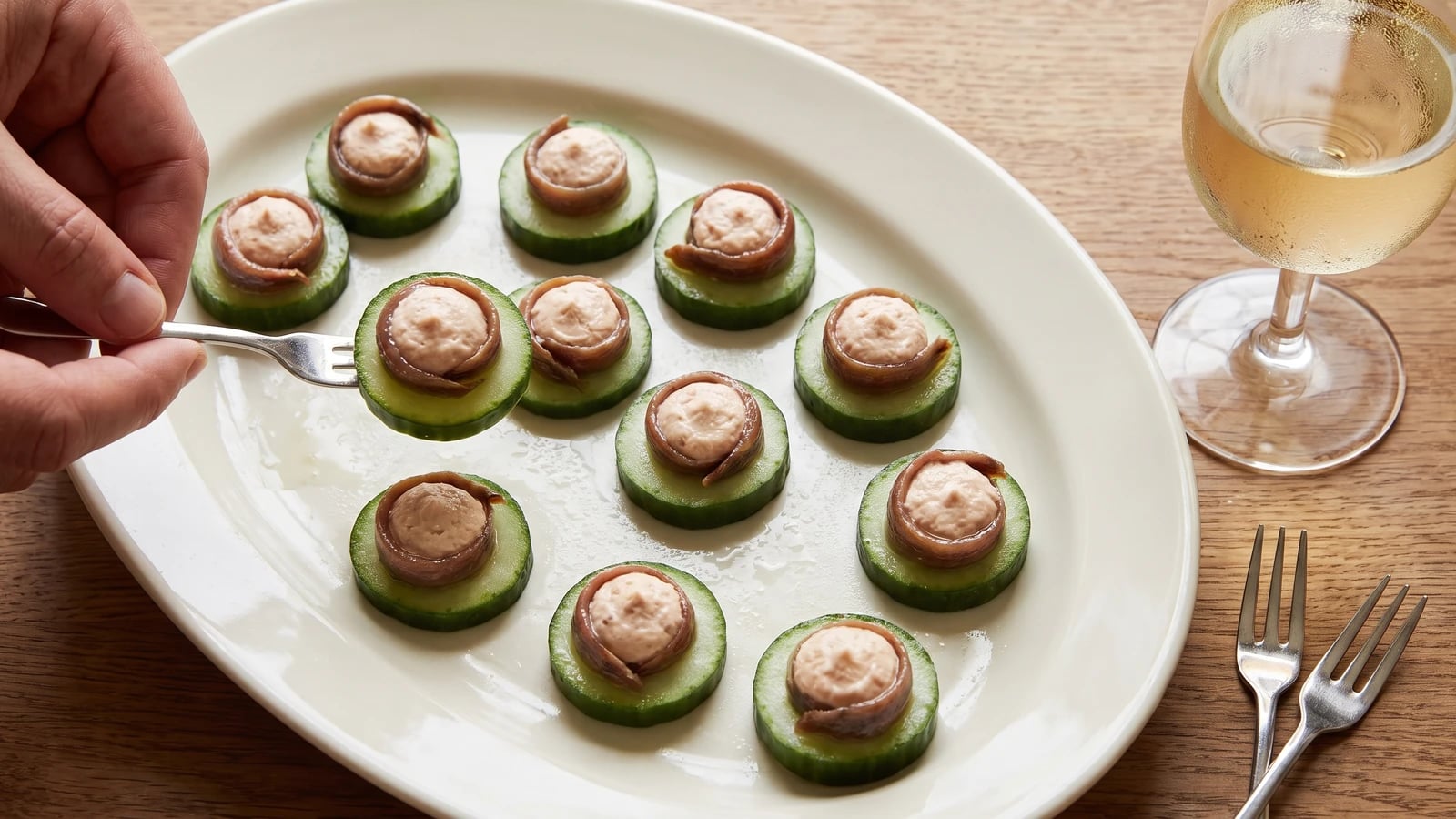
Cold cucumber cups, sharpened by cooked marinade and circled with anchovy, carry a silk-smooth tuna cream: a precise little hors d’oeuvre whose success depends on draining every layer well.
Paupiettes d’Anchois (anchovy paupiettes) teach a small but exact lesson: a cold hors d’oeuvre succeeds by controlling water. The cucumber must stay firm, the marinade must season rather than soak, and the tuna cream must sit cleanly inside its anchovy ring. Drain every layer well. That is the one true thing to know before you touch a pan.
The original recipe assumed a garde-manger station with Blanchings (No. 273), a five-quart batch of Cooked Marinade for Venison (No. 168), and tunny cream already cold and ready to pipe. Your honest equivalent is one cup of the finished marinade, twelve cucumber rounds, and a small processor followed by a sieve. The brigade-sized batch is scaffolding and can go. Blanching, marinating, hollowing, ringing with anchovy, and filling with fish cream are the dish, so every one stays. One cook, one stove, one evening.
On the platter, the paupiettes are pale jade and ivory, each anchovy forming a dark, glossy boundary between crisp cucumber and soft tuna cream. Before you assemble them, let the cucumber drain until a pressed fingertip comes away dry. That quiet pause decides whether the little cups stand proudly or slide about in their own juices.
Paupiettes d’Anchois belong to the classical Parisian hors d’oeuvre froid repertoire, the cold opening courses organized by the garde-manger rather than to one regional household table. Paupiette usually means a thin piece wrapped around a filling, but here the name is applied with deliberate wit: no cucumber is rolled, and the anchovy fillet makes the ring around a hollowed slice. The form passed readily to the home aperitif because its discipline lies in knife work, marinating, and careful assembly, not specialized equipment.
Quantity
2 (about 12 oz / 340 g total), for Blanchings (No. 273)
cut from their straight central sections into twelve 1/2-inch (1.25 cm) rounds
Quantity
1 cup (240 ml / about 240 g) Cooked Marinade for Venison (No. 168)
completely cooled
Quantity
1/3 cup loosely packed (80 ml / 70 g)
thoroughly drained
Quantity
2 tablespoons (30 ml / 28 g)
softened but not melted
Quantity
2 tablespoons (30 ml / 30 g)
very cold and divided
Quantity
1 teaspoon (5 ml / 5 g)
Quantity
1/16 teaspoon (0.3 ml / 0.15 g)
Quantity
12 fillets (about 2 oz / 55 g)
drained
| Ingredient | Quantity |
|---|---|
| slim seedless cucumberscut from their straight central sections into twelve 1/2-inch (1.25 cm) rounds | 2 (about 12 oz / 340 g total), for Blanchings (No. 273) |
| Cooked Marinade for Venisoncompletely cooled | 1 cup (240 ml / about 240 g) Cooked Marinade for Venison (No. 168) |
| oil-packed tunathoroughly drained | 1/3 cup loosely packed (80 ml / 70 g) |
| unsalted buttersoftened but not melted | 2 tablespoons (30 ml / 28 g) |
| heavy creamvery cold and divided | 2 tablespoons (30 ml / 30 g) |
| fresh lemon juice | 1 teaspoon (5 ml / 5 g) |
| ground white pepper | 1/16 teaspoon (0.3 ml / 0.15 g) |
| oil-packed anchovy filletsdrained | 12 fillets (about 2 oz / 55 g) |
Prepare the cucumber rounds through Blanchings (No. 273), using the cucumber treatment given there. Cool them as directed, then spread them on a clean towel and drain for 10 minutes. Press another towel gently over the tops without crushing them. The blanching should tame the raw edge while leaving the rounds firm enough to hold their shape.
Lay the rounds in one layer in a small nonreactive dish and pour over the completely cooled Cooked Marinade for Venison (No. 168). Cover and chill for 45 minutes, turning the slices once so they season evenly. Drain them on a rack for 15 minutes, then blot both faces. Taste one edge: if it has become sharper than you want, rinse that round very briefly in cold water and dry it thoroughly. Ça se rattrape. Do not leave the cucumber soaking for hours, because this marinade was built for venison and works quickly on delicate flesh.
Blend the drained tuna, softened butter, lemon juice, and white pepper until no visible flakes remain. Add 1 tablespoon of the cold cream and blend briefly, then press the mixture through a fine sieve. Stir in only enough of the remaining cream to make a smooth filling that holds a soft peak. Taste before adding anything; tuna and anchovies already bring plenty of salt. If the cream turns oily, stop working it and chill it for 10 minutes, then whisk in a teaspoon of the reserved cold cream. Ça se rattrape: coolness brings the emulsion back together.
With a 1/2-teaspoon melon baller or the tip of a small spoon, hollow a shallow cup from the centre of each cucumber round. Leave a firm rim and at least 1/4 inch (6 mm) of cucumber beneath the hollow. You are making a cup, not a tunnel. Blot the hollows once more before filling, because any liquid left there will loosen the tuna cream.
Curl one anchovy fillet around each hollow, shiny side outward, overlapping its ends slightly to make a complete ring. If a fillet is unusually broad, split it lengthwise; if it is short, pinch the ends gently into the tuna cream after filling. Blot only the underside of each fillet so it grips the cucumber while keeping its natural oil sheen.
Spoon the tuna cream into a small piping bag, or use two teaspoons, and fill each anchovy ring just above its rim. Keep the tops softly rounded rather than piled high. Arrange the paupiettes on a cold platter, cover without touching the filling, and chill for 30 minutes so the cream firms and the anchovy settles against it.
Blot the platter if any moisture has gathered, then serve three paupiettes per guest while the cucumber is cold and firm. They need no decorative greenery and no extra salt. The cucumber, anchovy, and tuna cream have already completed the composition. À table!
1 serving (about 95g)
Culinary guides, cultural storytelling, and the editorial depth that makes cooking meaningful.
Discover Culinary ExplorerChef Juliette
Tiny éperlans, lightly floured and fried until their tails stand crisp, arrive in a generous heap on a napkin with fried parsley and grooved lemon, a weeknight lesson in heat and restraint.

Chef Juliette
Brandade de Morue turns salt cod, warm olive oil, and milk into a pale, silky emulsion: keep everything warm and add the oil slowly, then crown the generous dome with butter-fried bread.

Chef Juliette
Salt cod worked warm with cream, one patient spoonful at a time, until the rough flakes become a glossy Nîmes paste, domed generously and ringed with butter-fried croutons for the table.

Chef Juliette
Wine-poached char packed in its earthenware crock beneath butter gold: a make-ahead first course that turns careful cooling, thorough boning, and one unbroken seal into quiet abundance.