Culinary Explorer

A cooking platform built around craft, culture, and the stories behind what we eat.
Discover Culinary Explorer
Tomato Jelly (1st Method)

Tomato Jelly (1st Method)

Created by Chef Juliette

Based on No. 2972, Tomato Jelly (1st Method), from Le Guide Culinaire (1907) by Auguste Escoffier

Gelée de Tomates turns drained tomato juice into a clear, ruby preserve, with apple jelly carrying the set, vanilla carrying the perfume, and one fierce boil ending precisely at nappe.

Sauces & Condiments
French
Make Ahead
Dinner Party
15 min
Active Time
20 min cook9 hr 15 min total
YieldAbout 2½ cups (five 4-ounce jars)

Gelée de Tomates, Première Méthode (Tomato Jelly, First Method) is a lesson in judging the endpoint. Before you touch the pan, know this: the clock cannot tell you when a jelly is finished, but nappe, the sheeting stage, can. Tomato supplies fragrance and colour but little dependable set, so apple jelly carries the pectin while vanilla rounds the fruit’s sharp, green edge.

The original formula assumed a broad preserving pan and a range with a quiet side and a fiercely heated centre. At home, use a wide stainless-steel saucepan, warm the mixture over your smallest burner, then move it to the strongest heat you own. I’ve halved the book’s one-pound formula to make five small jars. The yield and the stove changed because they were brigade scaffolding; the tomato-to-apple-to-sugar ratio, five-minute warming, vanilla, and rapid boil remain because they are the dish. One cook, one stove, one evening.

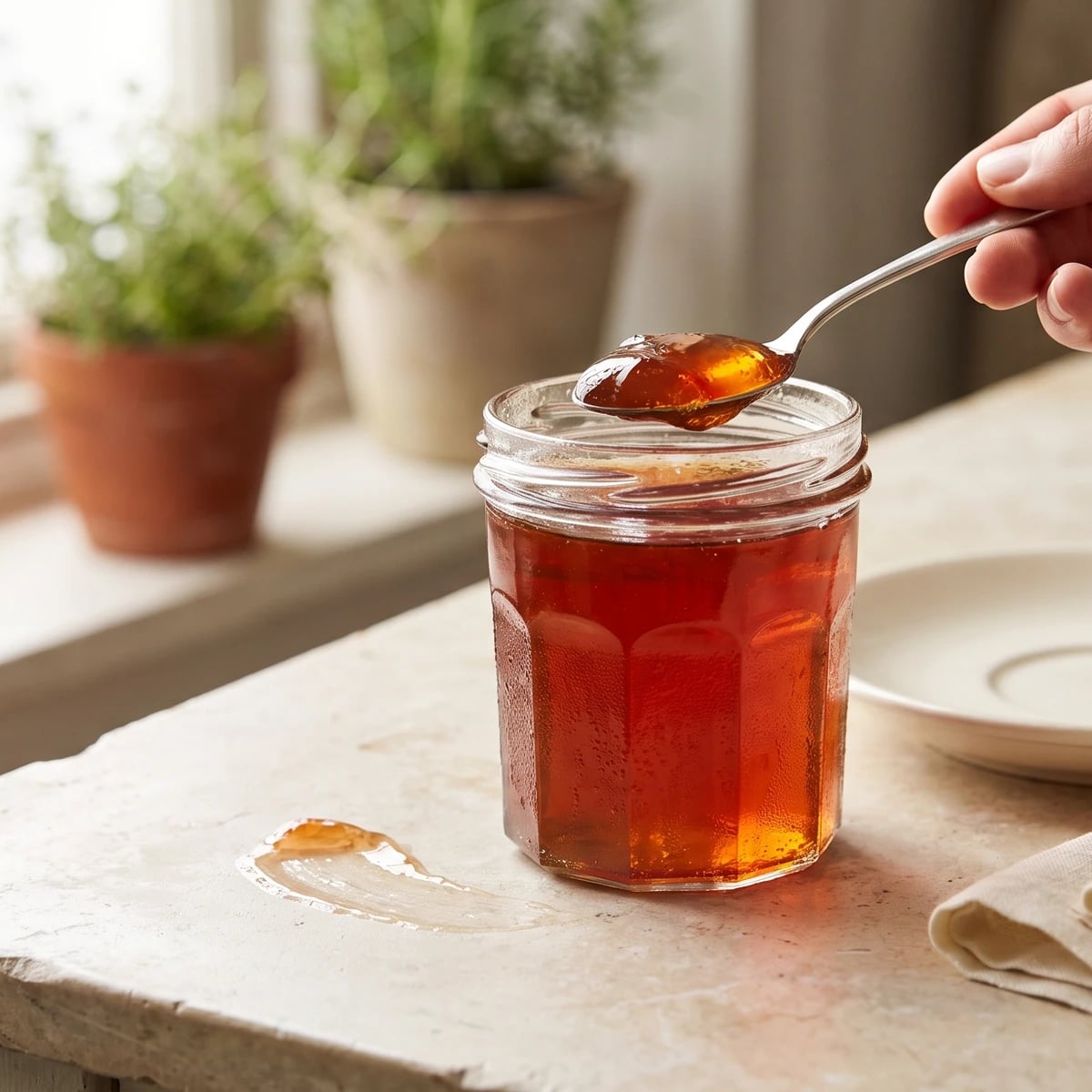
Finished correctly, the jelly is clear ruby-red, softly trembling, and glossy where a spoon passes through it. The one step that matters is leaving the fierce fire exactly when the syrup gathers on the spoon and falls in slow, heavy drops. Watch the nappe, not the minutes.

This formula belongs to the confiturier’s shelf of French cuisine bourgeoise and to the classical garde-manger, rather than to one provincial larder. Its structure corrects a common misconception: tomato supplies flavour and colour here, while already-set apple jelly supplies the cohesive pectin that clear tomato juice cannot reliably provide. Vanilla places the result among sweet preserves, even though tomato often stands on the savoury side of the French table.

The technique, the tradition, and the story behind every dish.

Discover Culinary Explorer

Ingredients

drained tomato juice from Tomato Jam (No. 2962)

Quantity

Scant 1 cup (220 ml / 227 g)

plain apple jelly

Quantity

1⅕ cups (284 ml / about 370 g)

granulated sugar

Quantity

1⅓ cups plus 1 tablespoon (330 ml / 283 g)

large vanilla bean

Quantity

½ bean

left whole

boiling water (optional)

Quantity

Up to 2 tablespoons (30 ml / 30 g)

only if needed to rescue an over-set jelly

clean preserving jars with screw lids for The Cooking, Potting, and Sealing of Jams (No. 2955)

Quantity

5 jars, 4 ounces (120 ml) each

Equipment Needed

  • Wide 3-quart stainless-steel preserving pan or saucepan
  • Broad metal spoon or skimmer for the nappe test
  • Two small saucers for chilled testing
  • Instant-read or sugar thermometer
  • Jar funnel and ladle
  • Five 4-ounce (120 ml) jars with screw lids for The Cooking, Potting, and Sealing of Jams (No. 2955)

Instructions

  1. 1

    Ready the jars

    Place two small saucers in the freezer for testing the set. Wash the jars and lids well, then warm the glass gradually in a low oven or a basin of hot water and stand it on a folded towel. The Cooking, Potting, and Sealing of Jams (No. 2955) calls for warmed pots followed by paper, glycerine, and string; keep the warmed glass, but replace that obsolete closure with clean screw lids and refrigeration. The closure was scaffolding. The careful potting remains.

  2. 2

    Combine the formula

    Measure the prepared drained tomato juice from Tomato Jam (No. 2962) into a wide, heavy stainless-steel saucepan. Add the apple jelly, sugar, and whole half vanilla bean. Use a pan of at least 3 quarts so the mixture has room to boil hard without climbing over the rim.

  3. 3

    Warm five minutes

    Set the pan partly over the smallest burner at its lowest heat for five minutes, the honest home equivalent of placing a preserving pan at the side of the fire. Stir slowly until the apple jelly loosens and every grain of sugar dissolves, but do not let the mixture reach a proper boil. If sugar remains gritty after five minutes, give it one more minute over low heat; fierce heat must wait until the syrup is smooth.

  4. 4

    Boil to nappe

    Move the pan to your widest burner and turn the heat high. Bring the jelly to a fierce, rolling boil, stirring across the bottom often enough to prevent catching. As the loose froth subsides and the bubbles become heavier and glossier, begin testing every twenty seconds. Lift a broad spoon or skimmer: at first the syrup runs off quickly, but at nappe it gathers toward the centre and falls at long intervals in slow, large drops that nearly join into a sheet. A chilled-plate sample should mound softly and wrinkle only slightly when pushed; about 105°C (221°F) at sea level is useful confirmation, never the final judge. Remove the pan immediately. If a sample turns stiff or sticky, stir in 1 tablespoon (15 ml / 15 g) boiling water, return the pan to the boil for ten seconds, and test again. Ça se rattrape.

  5. 5

    Rest before potting

    Leave the pan off the heat for seven to eight minutes, exactly as the source method directs. Remove the vanilla bean and skim away any thick surface foam without disturbing the clear jelly beneath. The brief rest lets bubbles rise and the syrup settle, but it should remain fluid enough to pour.

  6. 6

    Fill and chill

    Ladle the jelly into the warm jars, leaving ¼ inch (6 mm) of headspace. Wipe the rims and close with clean screw lids, following the practical potting intent of The Cooking, Potting, and Sealing of Jams (No. 2955). Cool the jars on a folded towel, then refrigerate within two hours. Because this formula has no standardized acidification or tested canning process, treat it as a refrigerated preserve, not a shelf-stable one.

  7. 7

    Judge the set

    Chill the jelly for at least eight hours before judging it. It should tremble and hold a spoon track without becoming rubbery. If it remains loose, scrape it into a clean pan, return it swiftly to nappe, and fill clean warmed jars again according to The Cooking, Potting, and Sealing of Jams (No. 2955). If it is too firm, reheat it gently with boiling water, 1 teaspoon at a time, until it falls from the spoon in a soft sheet. Serve cold with pâté, roast poultry, or a mild cheese. À table!

Chef Tips

  • Use a plain apple jelly with a firm, clean set. Cinnamon, mixed spice, or a strongly flavoured commercial jelly changes the book’s formula; the apple is here to provide pectin and quiet fruitiness, not to announce itself.
  • The drained juice from Tomato Jam (No. 2962) should be clear and free of pulp. A little cloudiness will not prevent the set, but it dulls the jewel-like appearance that distinguishes a jelly from a jam.
  • Don’t double the batch in one pan. A deeper quantity evaporates slowly, forcing the tomato and vanilla to cook long after their freshest flavour has gone. Make two quick batches instead.
  • When fresh tomatoes are pale and tired, good whole canned tomatoes are the honest choice for preparing the referenced juice. Technique first, always.
  • Serve this in small spoonfuls. Its sweetness and vanilla belong beside savoury cold preparations as a bright counterpoint, not spread over the plate like a sauce.

Advance Preparation

  • Prepare and drain the tomato juice from Tomato Jam (No. 2962) up to two days ahead, then keep it covered and refrigerated.
  • Make the jelly at least one day before serving. Eight hours in the cold establishes the set, while another day lets the vanilla settle more evenly through the tomato.
  • Keep every jar refrigerated and use within four weeks. Freeze for up to three months if longer storage is needed, leaving extra headspace for expansion.

Frequently Asked Questions

Nutrition Information

1 serving (about 155g)

Calories
435 calories
Total Fat
0 g
Saturated Fat
0 g
Trans Fat
0 g
Unsaturated Fat
0 g
Cholesterol
0 mg
Sodium
25 mg
Total Carbohydrates
109 g
Dietary Fiber
0 g
Sugars
106 g
Protein
0 g

Note: Chef personas and recipes are created with AI assistance. Cook with care: follow safe food-handling practices, check doneness with a thermometer when needed, and adapt for allergies and your kitchen.

Where cooking meets culture.

Culinary guides, cultural storytelling, and the editorial depth that makes cooking meaningful.

Discover Culinary Explorer

More from Fruit-stews and Jams

Browse the full collection