
Chef Juliette
Various Almond Preparations
Five almond preparations, one discipline: remove the skins cleanly, dry every kernel through, then cut, toast, or cloak it in pale caramel without letting its fragrant oils escape.
A cooking platform built around craft, culture, and the stories behind what we eat.
Created by Chef Juliette
Based on No. 2924, Iced Soufflées, from Le Guide Culinaire (1907) by Auguste Escoffier
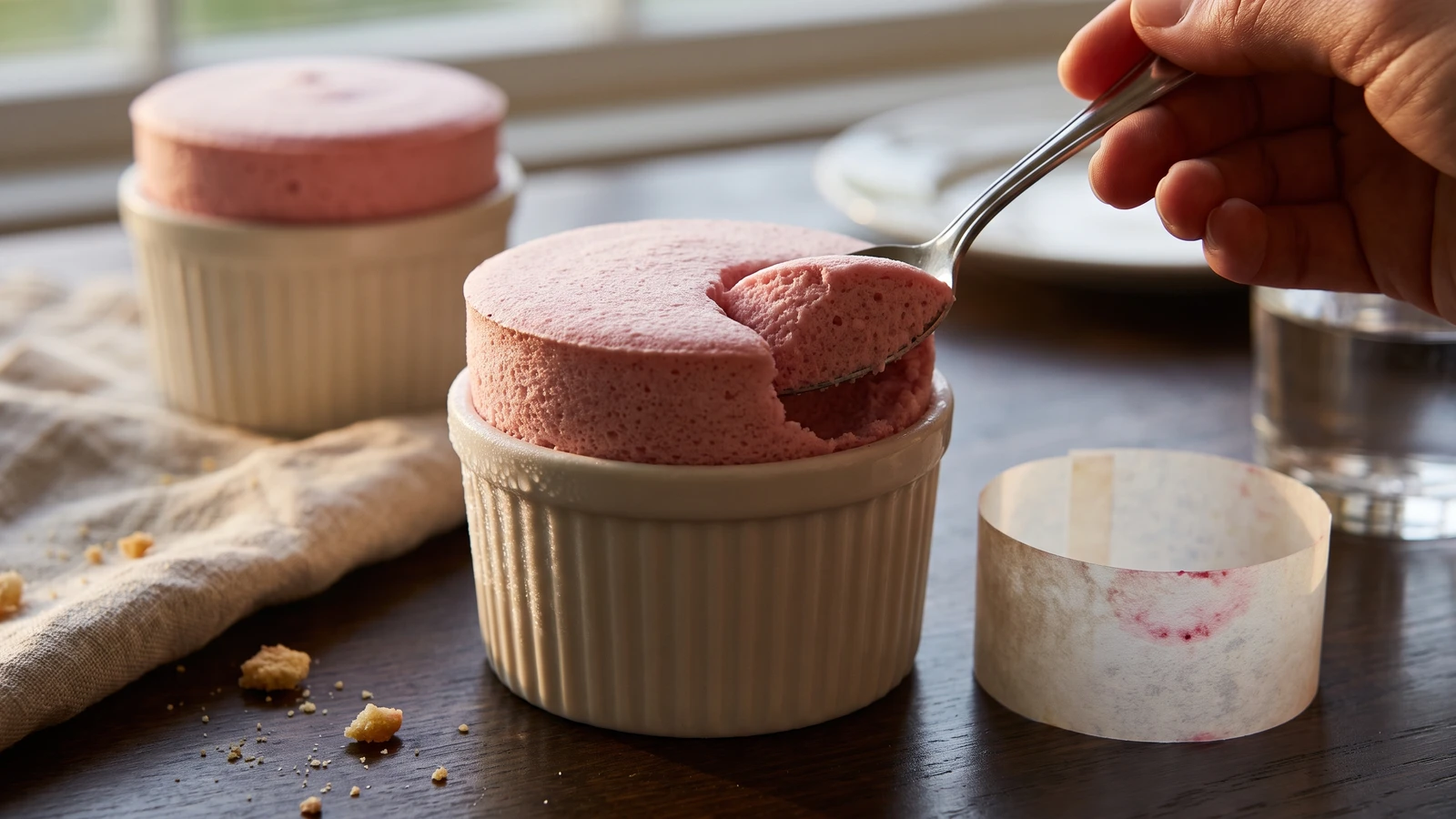
The cold soufflé that teaches sugar work: small-crack syrup streamed into stiff whites, then raspberry purée and cream folded through for a feather-light, rose-pink freeze.
Soufflés glacés aux framboises (iced raspberry soufflés) teach that a dessert can rise by architecture rather than oven heat. The one true thing to know is this: sugar cooked to the small-crack stage must enter stiff egg whites in a thin, unbroken thread. That hot syrup gives the mousse enough structure to stand proudly above its ramekin after freezing.
The original preparation assumed a pâtisserie station, ten egg whites, pint measures, a copper sugar pan, and another pair of hands ready while the syrup raced through its final temperatures. Here, three whites make six individual soufflés, a stand mixer supplies the second pair of hands, and a thermometer replaces the old finger test. The large basin and brigade quantity were scaffolding. The equal measures of fruit purée and cream, the small-crack sugar, and that thin thread into the whites are the dish itself, so they stay exactly in proportion. One cook, one stove, one evening.
The book also permits Preparation of Iced Mousse with Cream (No. 2916) as an alternate filling, especially for vanilla, coffee, or chocolate, but plainly prefers this cooked-sugar meringue for fruit. Set out every bowl and build every paper collar before the syrup boils. Once The Cooking of Sugar (No. 2344) reaches 285°F (141°C), the pour cannot wait.
Soufflé glacé belongs to the Parisian pâtisserie and formal dining-room canon, where confectioners borrowed the tall collar and risen silhouette of the hot soufflé for a dessert set by cold rather than oven heat. Its name describes its appearance, not its cooking method: classical pastry distinguishes individual soufflés from larger mousses, which are moulded in one form for several diners. Fruit versions favor cooked-sugar meringue folded with purée and cream, while vanilla, coffee, and chocolate belong to the richer iced-mousse family.
Quantity
3
at room temperature
Quantity
¾ cup (180 ml / 150 g)
Quantity
3 tablespoons (45 ml / 45 g)
Quantity
⅔ cup plus 2 teaspoons (170 ml / about 170 g)
thoroughly chilled
Quantity
⅔ cup plus 2 teaspoons (170 ml / 170 g)
thoroughly chilled
Quantity
1 tablespoon (15 ml / 15 g)
Quantity
1 home-scaled batch
chilled; optional alternate filling used instead of the egg whites, sugar, water, purée, and whipped cream
| Ingredient | Quantity |
|---|---|
| large egg whitesat room temperature | 3 |
| granulated sugar, for The Cooking of Sugar (No. 2344) | ¾ cup (180 ml / 150 g) |
| water | 3 tablespoons (45 ml / 45 g) |
| strained seedless raspberry puréethoroughly chilled | ⅔ cup plus 2 teaspoons (170 ml / about 170 g) |
| heavy creamthoroughly chilled | ⅔ cup plus 2 teaspoons (170 ml / 170 g) |
| cold heavy cream for rescuing overwhipped cream (optional) | 1 tablespoon (15 ml / 15 g) |
| raspberry Preparation of Iced Mousse with Cream (No. 2916) (optional)chilled; optional alternate filling used instead of the egg whites, sugar, water, purée, and whipped cream | 1 home-scaled batch |
Wrap a strip of parchment around the outside of each ramekin so it rises 1½ inches (4 cm) above the rim, then secure it with kitchen twine or tape placed well away from the filling. Set the ramekins on a small tray that fits level in your freezer. Chill the raspberry purée, cream, mixing bowl, and cream whisk thoroughly before you begin.
Whisk the cold cream until it forms very stiff peaks and clear ridges, as the source requires, but stop while its surface remains smooth and satin-like. Refrigerate it at once. If it turns grainy at the edge, don't keep beating. Ça se rattrape: fold in the optional spoonful of cold liquid cream by hand until the texture smooths, then return it to the cold.
Put the egg whites in the impeccably clean bowl of a stand mixer fitted with its whisk. Keep the mixer off for the moment, but have it beside the stove with the cord safely clear of the flame and saucepan. The whites must be ready to reach stiff peaks while the syrup passes through its final temperatures.
Combine the sugar and water in the smallest heavy stainless-steel saucepan that holds them comfortably. Heat gently until the sugar dissolves, washing any crystals from the sides with a clean brush dipped in water. Once the syrup boils, stop stirring and cook it according to The Cooking of Sugar (No. 2344). When it reaches 240°F (116°C), start whipping the whites at medium speed, then increase to high so they stand in very stiff peaks as the syrup reaches the small-crack stage, 285°F (141°C). If crystals seize the syrup before it colors, add 1 tablespoon (15 ml / 15 g) water, dissolve it gently, and begin the climb again. Ça se rattrape. If the syrup turns amber, restart with fresh sugar because caramel would change the raspberry completely.
The instant the syrup reaches 285°F (141°C), take it from the heat. With the mixer running at medium-high speed, pour the syrup into the stiff whites in a very thin, steady thread aimed between the whisk and the side of the bowl. Don't pour onto the whisk, which flings syrup into hard threads, and don't pour directly down the bowl, where it sets before reaching the whites. Continue whisking until the meringue is very glossy, holds a firm peak, and the bowl has cooled from hot to merely warm, about 6 minutes. If a few hardened sugar threads form, lift them out once the meringue cools rather than crushing them back into it; the remaining meringue is perfectly usable.
Transfer the meringue to a broad mixing bowl. Fold in the chilled raspberry purée in two additions, cutting through the center and turning the bowl until no dark streaks remain. Add the stiffly whipped cream in three additions, sacrificing the first spoonful to loosen the meringue and folding the rest gently so its air survives. The finished mousse should be uniform, pale pink, and thick enough to mound from the spatula. If it begins to loosen, stop folding; further work removes more air, while the freezer will still set what you have.
Divide the mixture among the collared ramekins, filling each about 1 inch (2.5 cm) above its ceramic rim. Level the tops with the back of a spoon without pressing out the air, then freeze uncovered until firm, at least 6 hours. Once solid, cover loosely to protect the surface. If you chose the optional raspberry Preparation of Iced Mousse with Cream (No. 2916), skip Steps 2 through 6 and spoon that finished component directly into the prepared collars before freezing.
Take the soufflés from the freezer 5 minutes before serving. Release the tape or twine and peel each parchment collar straight away from the frozen edge, turning the ramekin rather than tugging at the mousse. The pale raspberry crown should stand cleanly above the rim like a hot soufflé caught at its proudest moment. Serve at once. À table!
1 serving (about 103g)
Culinary guides, cultural storytelling, and the editorial depth that makes cooking meaningful.
Discover Culinary ExplorerChef Juliette
Five almond preparations, one discipline: remove the skins cleanly, dry every kernel through, then cut, toast, or cloak it in pale caramel without letting its fragrant oils escape.

Chef Juliette
A pastry pantry lesson in one tray: filberts warmed only until their red skins release, rubbed clean, cooled, and chopped into a fragrant mise-en-place for cakes, creams, pralines, and petits fours.

Chef Juliette
The smallest pâtisserie discipline decides whether a cake leaves its mould intact: clarified butter in every corner, followed by the lightest veil of dry flour or fécule.

Chef Juliette
Four whites, one spotless bowl, and a patient change of speed: whisk gently until loosened, then briskly to glossy stiffness, with powdered sugar waiting if the foam begins to granulate.