
Chef Juliette
Various Almond Preparations
Five almond preparations, one discipline: remove the skins cleanly, dry every kernel through, then cut, toast, or cloak it in pale caramel without letting its fragrant oils escape.
A cooking platform built around craft, culture, and the stories behind what we eat.
Created by Chef Juliette
Based on No. 2339, Various Preparations of Filberts and Hazel-nuts, from Le Guide Culinaire (1907) by Auguste Escoffier
A pastry pantry lesson in one tray: filberts warmed only until their red skins release, rubbed clean, cooled, and chopped into a fragrant mise-en-place for cakes, creams, pralines, and petits fours.
Diverses préparations d’avelines et de noisettes (various preparations of filberts and hazelnuts) teach one decisive principle: the heat is there to loosen the skin, not to roast the nut deeply. Warm the kernels until their reddish skins blister and lift, then rub while they are still warm. Wait until they cool and the skins tighten again.
The original preparation assumed the warm mouth of a pastry oven and a pastry cook replenishing a permanent Mise-en-place, the elementary preparation kept ready for later formulas, in broad quantities. Your honest equivalent is a rimmed tray in a moderate home oven and a useful batch from 500 grams of shell-on nuts. The source gives no fixed proportion because this is pantry work. I have changed the equipment, scale, and storage, not the sequence: the brigade’s open bulk bin is scaffolding, while cracking, slight grilling, rubbing, and chopping are the preparation itself.
Watch the skins rather than the clock. They should split and smell freshly nutty while the kernels remain only pale gold. That brief warming is the step that matters most; take it too far and the clean flavor needed for pastry becomes a full roast.
The preparation’s real home is the laboratoire, the pastry workroom of French pâtisserie, where nuts were shelled, skinned, and chopped before the day’s cakes and confiseries began. In French kitchen usage, noisette is the broad word for hazelnut, while aveline identifies the larger filbert type, commonly recognized by its reddish skin. Removing that loosened skin was practical rather than decorative: it cleared away papery bitterness and supplied the pastry pantry with a clean, fragrant nut preparation.
Quantity
4 cups (960 ml / about 500 g), yielding about 2 cups (480 ml / 270 g) kernels
cracked, skinned, and chopped as directed
| Ingredient | Quantity |
|---|---|
| shell-on filberts or hazelnutscracked, skinned, and chopped as directed | 4 cups (960 ml / about 500 g), yielding about 2 cups (480 ml / 270 g) kernels |
Heat the oven to 175°C (350°F). Crack the filberts carefully, keeping the kernels as whole as possible, and suppress every fragment of shell. Sort as you work, discarding any kernel that is shriveled, mold-marked, or smells stale. If you begin with shelled nuts, use about 2 cups (480 ml / 270 g) and start at the next step.
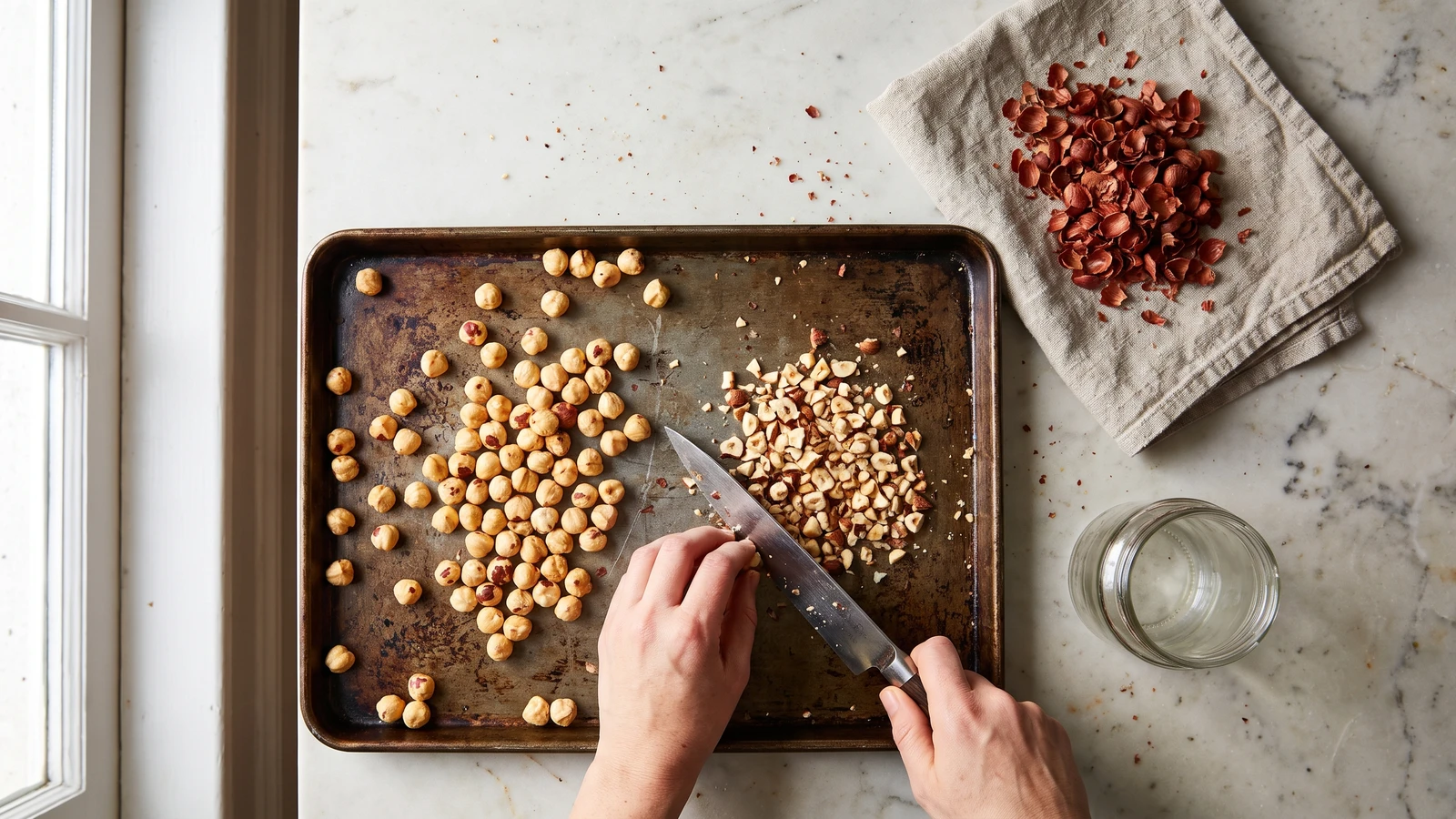
Spread the kernels in one uncrowded layer on a dry rimmed baking sheet. Warm them for 8 to 12 minutes, shaking the tray once, until the skins darken slightly, split, and begin lifting from the kernels. The nuts should smell fresh and rounded, with only pale gold showing beneath the skin. This moderate oven replaces the old oven mouth; no oil and no deep roasting are wanted.
Tip the warm nuts into the center of a clean, rough tea towel, fold the cloth over them, and rub firmly so the loosened skins flake away. Open the towel, pick out the clean kernels, and repeat. If a stubborn portion still holds its skin, return only those nuts to the oven for 2 minutes and rub again. Ça se rattrape. Do not keep roasting the entire batch merely to chase the final flecks; a little skin left behind is better than a bitter nut.
Spread the skinned nuts back on the cool tray and let them cool completely. Leave them whole if a later formula requires whole kernels, or chop with a chef’s knife into even pieces about 2 to 4 mm across for the classical chopped preparation. A food processor may replace the pastry room’s long knife work, but use short pulses and stop often. If the nuts begin clumping as their oils warm, spread them out and chill for 10 minutes, then finish with the knife; ça se rattrape before they become nut paste.
Transfer the whole or chopped nuts to airtight containers only when they are fully cool. Any trapped warmth creates condensation and steals their crisp texture. Keep them at cool room temperature for up to 1 week, refrigerate for up to 1 month, or freeze in small portions for up to 3 months. This is the home version of the pastry cook’s permanent Mise-en-place: a modest batch, protected from air, ready when the next formula calls.
1 serving (about 27g)
Culinary guides, cultural storytelling, and the editorial depth that makes cooking meaningful.
Discover Culinary ExplorerChef Juliette
Five almond preparations, one discipline: remove the skins cleanly, dry every kernel through, then cut, toast, or cloak it in pale caramel without letting its fragrant oils escape.

Chef Juliette
The smallest pâtisserie discipline decides whether a cake leaves its mould intact: clarified butter in every corner, followed by the lightest veil of dry flour or fécule.

Chef Juliette
Four whites, one spotless bowl, and a patient change of speed: whisk gently until loosened, then briskly to glossy stiffness, with powdered sugar waiting if the foam begins to granulate.

Chef Juliette
Three pastry colours, one disciplined hand: carmine, spinach green, and yellow kept as clean stocks, then blended drop by drop until the confection hints at fruit, leaf, or gold without becoming a paint box.