
Chef Juliette
Various Almond Preparations
Five almond preparations, one discipline: remove the skins cleanly, dry every kernel through, then cut, toast, or cloak it in pale caramel without letting its fragrant oils escape.
A cooking platform built around craft, culture, and the stories behind what we eat.
Created by Chef Juliette
Based on No. 2344, The Cooking of Sugar, from Le Guide Culinaire (1907) by Auguste Escoffier
Seven states, one pan, and no room for wandering: learn petit filet, grand boulé, grand cassé, and caramel by temperature and a safe cold-water test, catching crystallization before it ruins the batch.
La cuisson du sucre (the cooking of sugar) teaches one hard truth: sugar remembers every stray crystal. Keep the pan walls clean, stop stirring once the boil begins, and a clear syrup climbs cleanly from petit filet to caramel. Leave one grain clinging above the syrup and the whole batch can turn to sand.
The original entry assumed loaf sugar that needed skimming, a responsive copper saucepan, and a pastry cook stationed at the stove to test boiling syrup with fingers and teeth. Your home batch uses refined granulated sugar, a heavy pale stainless-steel pan, a clipped thermometer, and cold-water tests made with a spoon. Skimming was scaffolding for less-refined sugar and can usually go; clean pan walls, the original sequence, and exact stopping temperatures are the technique itself and must stay. This changes the equipment and removes an unsafe test, not the intent. One cook, one stove, one evening.
Choose your stopping point before the heat begins, because the stages arrive within minutes of one another. You aren't collecting all seven from one pan; you're learning the ladder, then stopping each batch where its next preparation requires. The step that decides everything is washing every crystal from the pan wall before the syrup concentrates.
La cuisson du sucre belongs to French pâtisserie and confiserie, where the pastry kitchens of Paris and confectioners throughout France shared the vocabulary of filet, boulé, cassé, and caramel to describe concentration by behavior. The names tell how cooled syrup stretches, rolls, bends, or snaps, not how sweet it tastes, and caramel is not a separate syrup but the state reached after grand cassé when the sugar begins to brown. The vocabulary and control remain alive in home kitchens, while the old fingertip and tooth tests have properly given way to a thermometer and spoon-led cold-water tests.
Quantity
2 cups (475 ml / 400 g)
Quantity
⅔ cup (160 ml / 160 g)
Quantity
2⅔ teaspoons (13 ml / 18 g)
preferred for preventing crystallization
Quantity
4 drops (about 0.2 ml / 0.2 g)
use in place of the glucose syrup
Quantity
2 cups (475 ml / 475 g)
divided for brushing, stage tests, and crystallization rescue if needed
| Ingredient | Quantity |
|---|---|
| refined white granulated sugar | 2 cups (475 ml / 400 g) |
| water | ⅔ cup (160 ml / 160 g) |
| glucose syrup (optional)preferred for preventing crystallization | 2⅔ teaspoons (13 ml / 18 g) |
| fresh lemon juice (optional)use in place of the glucose syrup | 4 drops (about 0.2 ml / 0.2 g) |
| cold waterdivided for brushing, stage tests, and crystallization rescue if needed | 2 cups (475 ml / 475 g) |
Choose the stage you need before beginning. Clip the thermometer inside a clean, narrow saucepan without letting its probe touch the bottom. Set out a small cup of cold water with the pastry brush, a separate bowl of cold water with several clean teaspoons, and a dry heatproof trivet. If making grand cassé or caramel for shards, line a rimmed tray with a silicone mat. Keep children, pets, and bare forearms away from the stove; hot sugar clings to skin and burns far more severely than boiling water.
Put the sugar and ⅔ cup (160 ml / 160 g) water in the saucepan. Add the glucose syrup, or the lemon juice in its place, but not both. Stir gently over medium-low heat only until every crystal dissolves and the syrup turns completely clear. Bring it to a boil over medium heat, then stop stirring. If a little foam rises, skim it without disturbing the pan walls; refined sugar rarely produces the scum once found on loaf sugar.
Dip the pastry brush in cold water and wash any crystals from the inside wall of the saucepan, working above the boiling syrup and never touching it. Continue whenever another grain appears. As the free water evaporates, the bubbles become thicker and the syrup moves more stiffly; from this point the temperatures climb quickly. If the syrup clouds and grains spread through the pan, stop. Ça se rattrape: remove it from the heat, let it cool completely, add ¼ cup (60 ml / 60 g) of the reserved water, and dissolve it again over gentle heat before returning to the boil. Never pour water into fiercely hot syrup.
At 215°F (102°C), the syrup has reached petit filet, the small-thread stage. Place one drop on a cool teaspoon, wait briefly, touch it with a second spoon, and draw the spoons apart; a fine, weak thread should form and break easily. At 222°F (106°C), grand filet, the large-thread stage, produces several stronger threads. Use the thermometer as the decision and the spoon test as confirmation. Keep your fingers out of the saucepan.
For the remaining stages, use cold water. At 236°F (113°C), drop about ¼ teaspoon of syrup into the bowl, wait until it is completely cool, then gather it beneath the water; petit boulé, the small-ball stage, forms a soft ball that flattens readily. At 248°F (120°C), grand boulé, the large-ball stage, forms a firmer ball that holds its shape under gentle pressure. Test with a clean spoon each time and discard every sample.
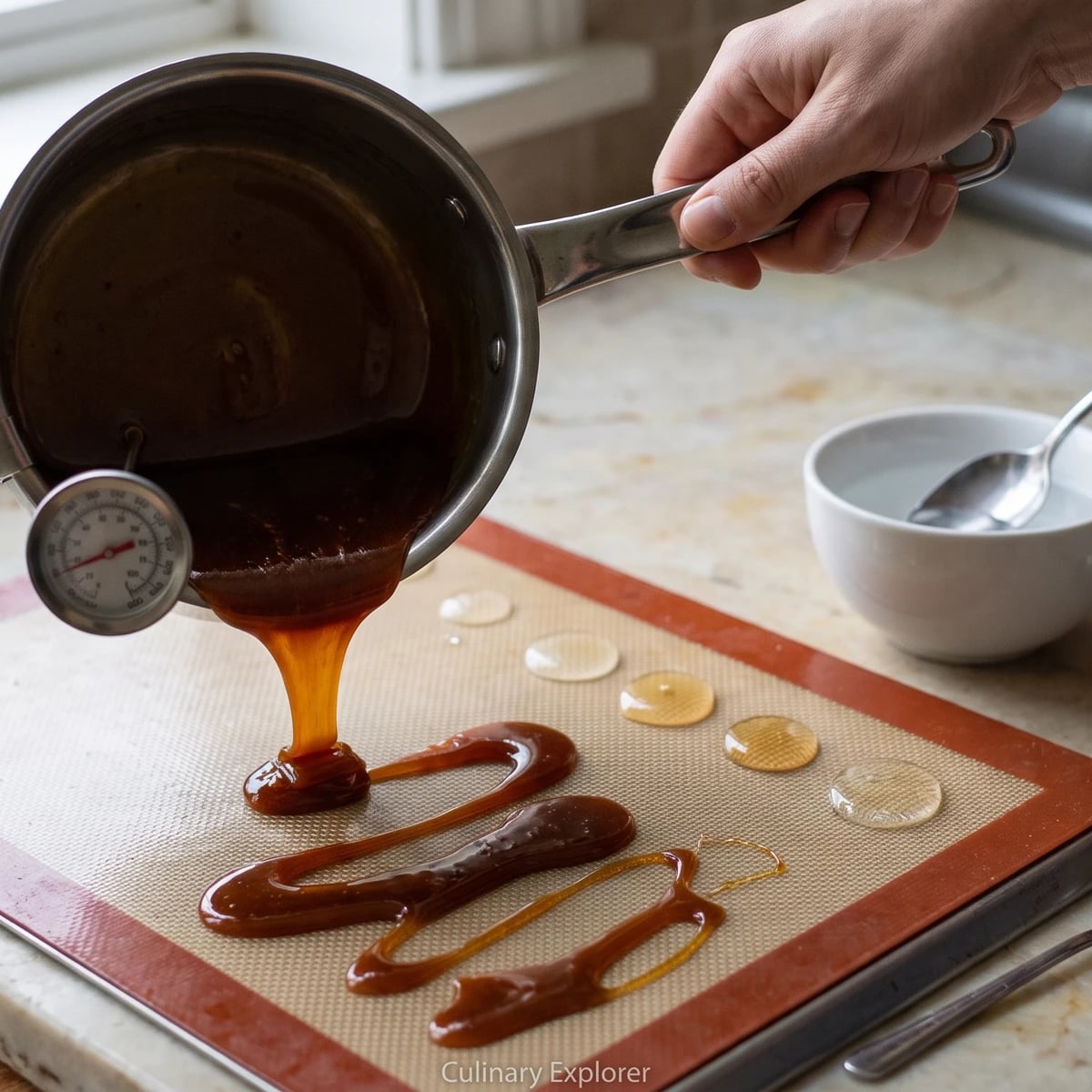
At 285°F (141°C), a spoonful dropped into cold water becomes a thin, flexible sheet or strand that bends before breaking. This is petit cassé, the small-crack stage. At 315°F (157°C), the cooled syrup becomes rigid and snaps cleanly; this is grand cassé, the large-crack stage. Do not test it against your teeth. If grand cassé is your target, remove the pan from the heat immediately and use the sugar at once, because the retained heat keeps cooking it.
If caramel is the target, continue beyond grand cassé without stirring. At 360°F (182°C), the syrup should be deep amber, glass-clear at its thin edges, and smell bittersweet rather than acrid. Remove the pan immediately and set it on the dry trivet. Pale caramel lacks depth, but blackened sugar tastes burnt and cannot be rescued. Never add liquid unless the receiving recipe specifically calls for it, and then only with the pan off the heat and your hands protected, because caramel rises violently when liquid enters.
Use filet and boulé syrups immediately in the preparation that requires them. For a grand cassé or caramel sheet, pour the sugar carefully onto the silicone mat without scraping the crystallized residue from the pan walls, then leave it untouched until completely hard. Break or cut it as its final preparation directs. Once the saucepan is cool, fill it with warm water and let the remaining sugar dissolve; force and chipped caramel have no place in the washing-up.
1 serving (about 410g)
Culinary guides, cultural storytelling, and the editorial depth that makes cooking meaningful.
Discover Culinary Explorer
Chef Juliette
Five almond preparations, one discipline: remove the skins cleanly, dry every kernel through, then cut, toast, or cloak it in pale caramel without letting its fragrant oils escape.

Chef Juliette
A pastry pantry lesson in one tray: filberts warmed only until their red skins release, rubbed clean, cooled, and chopped into a fragrant mise-en-place for cakes, creams, pralines, and petits fours.

Chef Juliette
Three states, one lesson: control butter’s water and texture before it meets the pastry, then soften, work to pommade, or clarify according to the job it must do.

Chef Juliette
The smallest pâtisserie discipline decides whether a cake leaves its mould intact: clarified butter in every corner, followed by the lightest veil of dry flour or fécule.