
Chef Juliette
Various Almond Preparations
Five almond preparations, one discipline: remove the skins cleanly, dry every kernel through, then cut, toast, or cloak it in pale caramel without letting its fragrant oils escape.
A cooking platform built around craft, culture, and the stories behind what we eat.
Created by Chef Juliette
Based on No. 2916, Preparation of Iced Mousse with Cream, from Le Guide Culinaire (1907) by Auguste Escoffier
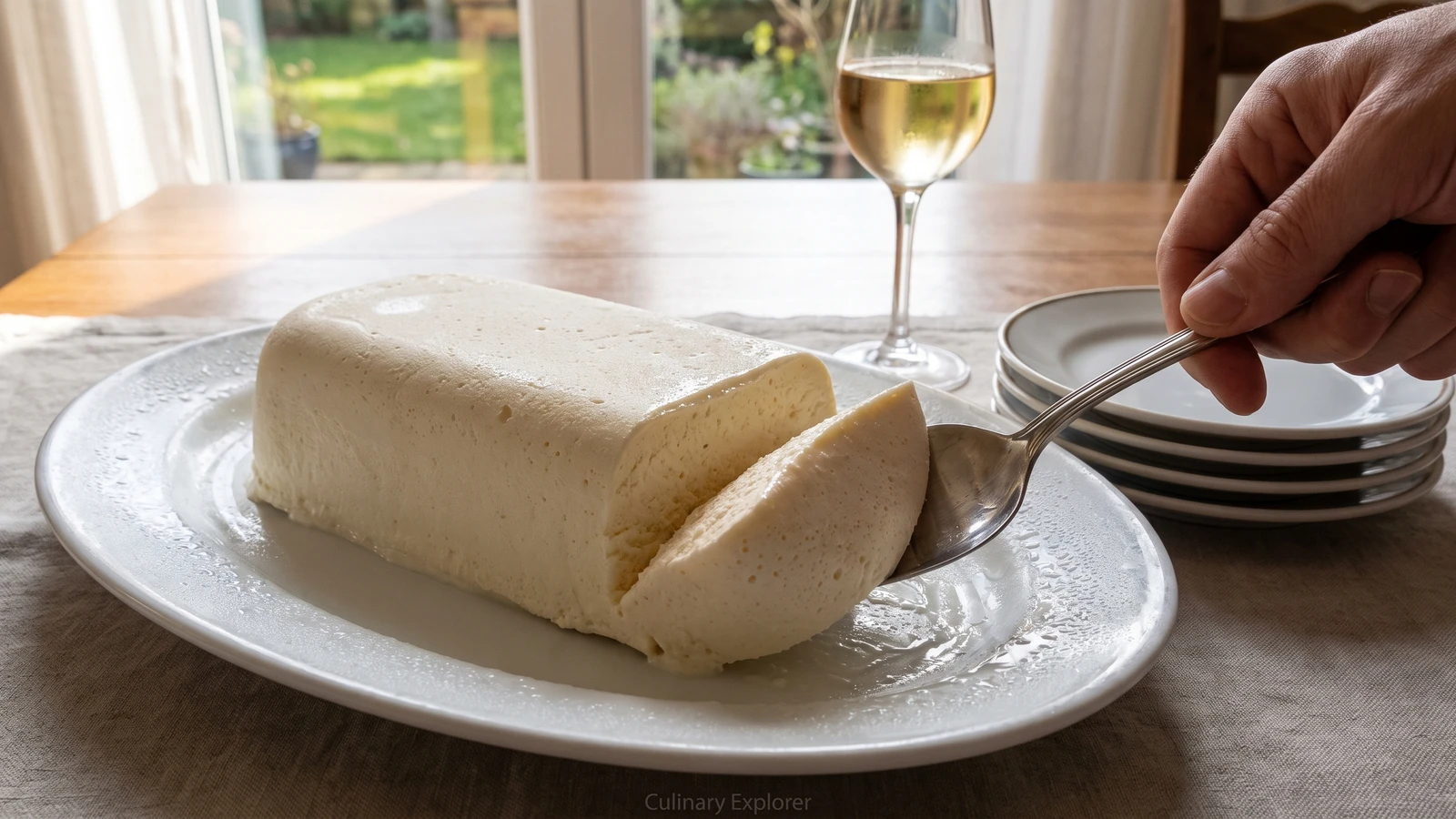
A stone-cold crème anglaise, real cream, and patient whisking over ice become a pale, airy frozen mousse, proof that temperature, not force, is what lets this classical dessert hold its lift.
Mousse glacée à la crème (iced cream mousse) teaches one severe little truth: the crème anglaise (English pouring custard) must be stone cold before the cream and whisk meet it. Whisk it warm and it will never take the air. Get the temperature right, and the mixture swells into a pale froth that freezes with a fine, creamy lightness rather than the hard density of unchurned custard.
The original formula assumed raw cream, a basin kept packed with ice, paper-lined lidded moulds, and enough hands to whisk while someone else managed the cold. Here it is quartered in the same proportions for four people, with pasteurized heavy cream, a hand mixer, white parchment, and a well-sealed home freezer mould. Food-grade tragacanth remains the first choice; a much smaller quantity of xanthan is the honest home equivalent when tragacanth cannot be found, because the two gums do not have equal strength. The paper and brigade quantities were scaffolding. The cold custard, added cream, stabilizer, and whisking over ice are the dish, and they stay.
This is one cook, one stove, one evening, although the mousse is quite content to wait in the freezer for tomorrow. Before you touch the pan, clear freezer space and prepare plenty of ice. The step that decides everything is chilling the crème anglaise completely before you ask it to hold air.
Mousse glacée belongs to the Parisian grand-kitchen repertoire, where confectioners joined crème anglaise, fresh cream, and flavouring before whisking the mixture over ice and sealing it in decorative moulds. Within the classical glossary, Mousses form a broad family of light moulded preparations, both savory and sweet, rather than a category belonging only to chocolate. Unlike ice cream, this preparation gains its air before freezing instead of being churned continuously, a distinction that gives it a softer, more delicate crumb.
Quantity
1 cup (240 ml / 115 g)
sifted
Quantity
4
Quantity
½ cup plus 1½ tablespoons (140 ml / 145 g)
Quantity
½ cup plus 1½ tablespoons (140 ml / 140 g)
thoroughly chilled
Quantity
1½ teaspoons (7.5 ml / 5 g) tragacanth, or ¼ teaspoon (1.25 ml / 0.8 g) xanthan
Quantity
1 teaspoon (5 ml / 4 g)
for the vanilla preparation
Quantity
½ cup plus 1½ tablespoons (140 ml / 140 g)
thoroughly chilled, for the fruit preparation
| Ingredient | Quantity |
|---|---|
| powdered sugarsifted | 1 cup (240 ml / 115 g) |
| large egg yolks | 4 |
| whole milk | ½ cup plus 1½ tablespoons (140 ml / 145 g) |
| pasteurized heavy cream, at least 36% fatthoroughly chilled | ½ cup plus 1½ tablespoons (140 ml / 140 g) |
| food-grade powdered gum tragacanth, or xanthan gum | 1½ teaspoons (7.5 ml / 5 g) tragacanth, or ¼ teaspoon (1.25 ml / 0.8 g) xanthan |
| pure vanilla extract (optional)for the vanilla preparation | 1 teaspoon (5 ml / 4 g) |
| smooth strained fresh fruit purée (optional)thoroughly chilled, for the fruit preparation | ½ cup plus 1½ tablespoons (140 ml / 140 g) |
Line a 1-quart (1-litre) loaf tin or freezer-safe mould with white parchment, leaving enough overhang to cover the surface later. Chill the lined mould. Fill a wide bowl halfway with ice and cold water, and make certain the filled mould will sit level in the freezer before the mixture is ready.
Whisk the yolks with the powdered sugar in a heatproof bowl until perfectly smooth and slightly pale, but don't beat them into a foam. Warm the milk in a small heavy saucepan until tiny bubbles gather around its edge. Pour one-third of the hot milk into the yolks while whisking, then whisk this mixture back into the remaining milk. Cook over low heat, stirring constantly with a flexible spatula, until the crème anglaise reaches 180 to 183°F (82 to 84°C) and nappes the spatula, coating it so a finger drawn through leaves a clean path. Never let it boil. If the first fine grains appear, remove the pan immediately, whisk in 1 tablespoon of the measured cold cream, then blend briefly and strain. Ça se rattrape. Solid scrambled curds have gone too far, so watch the edge of the pan closely.
Strain the crème anglaise into a clean bowl and set it over the prepared ice bath. Stir slowly until no warmth remains, replacing melting ice as needed. Cover the surface and refrigerate until the custard is cold through, ideally 40°F (4°C) or below, about 45 minutes. Mere coolness isn't enough. Warm custard loosens the cream and lets every bubble escape.
Return the bowl of cold crème anglaise to a fresh ice bath and pour in the remaining chilled cream. Start the hand mixer on low, then sift the tragacanth into the moving liquid in a fine, steady rain so it cannot gather into lumps. If using xanthan, add only the smaller quantity given. Mix in the vanilla. For a fruit mousse, omit the vanilla unless it suits the chosen fruit and add the cold strained purée now, preserving the source formula's equal-volume proportion. Let the mixture stand over ice for 5 minutes so the gum can hydrate. If small lumps remain, blend for 10 seconds and strain the mixture while it is still cold.
Whisk over the ice bath at medium-high speed for 6 to 10 minutes, turning the bowl occasionally so every part stays cold. The preparation is ready when it has increased by roughly one-third, holds a mass of fine bubbles, and leaves a soft track behind the whisk. You want abundant froth, not stiff whipped-cream peaks. If little happens after 3 minutes, the mixture is too warm. Stop, refrigerate it for 15 minutes, renew the ice bath, and begin again. Never try to overcome warmth with faster whisking.
Spoon the frothy mixture into the chilled mould without pressing out its air. Smooth the top lightly, fold over the parchment, and seal the mould tightly with its lid or two snug layers of food wrap. Freeze until firm through the centre, about 3 hours in four small moulds or 4 hours in one large mould. A loose covering encourages icy edges, so close it thoroughly as the source directs.
Transfer the mousse to the refrigerator for 10 minutes before serving. Unwrap it, invert it onto a chilled platter, and peel away the parchment. If it clings, hold a warm damp towel against the outside of the mould for 5 seconds, then try again; prolonged heat melts the fine outer bubbles. Cut with a warm, dry knife or serve with a broad spoon. If the mousse has frozen very hard overnight, give it another 10 minutes in the refrigerator. À table!
1 serving (about 120g)
Culinary guides, cultural storytelling, and the editorial depth that makes cooking meaningful.
Discover Culinary ExplorerChef Juliette
Five almond preparations, one discipline: remove the skins cleanly, dry every kernel through, then cut, toast, or cloak it in pale caramel without letting its fragrant oils escape.

Chef Juliette
A pastry pantry lesson in one tray: filberts warmed only until their red skins release, rubbed clean, cooled, and chopped into a fragrant mise-en-place for cakes, creams, pralines, and petits fours.

Chef Juliette
The smallest pâtisserie discipline decides whether a cake leaves its mould intact: clarified butter in every corner, followed by the lightest veil of dry flour or fécule.

Chef Juliette
Four whites, one spotless bowl, and a patient change of speed: whisk gently until loosened, then briskly to glossy stiffness, with powdered sugar waiting if the foam begins to granulate.