
Chef Juliette
Various Almond Preparations
Five almond preparations, one discipline: remove the skins cleanly, dry every kernel through, then cut, toast, or cloak it in pale caramel without letting its fragrant oils escape.
A cooking platform built around craft, culture, and the stories behind what we eat.
Created by Chef Juliette
Based on No. 2499, Brazilian Pudding, from Le Guide Culinaire (1907) by Auguste Escoffier
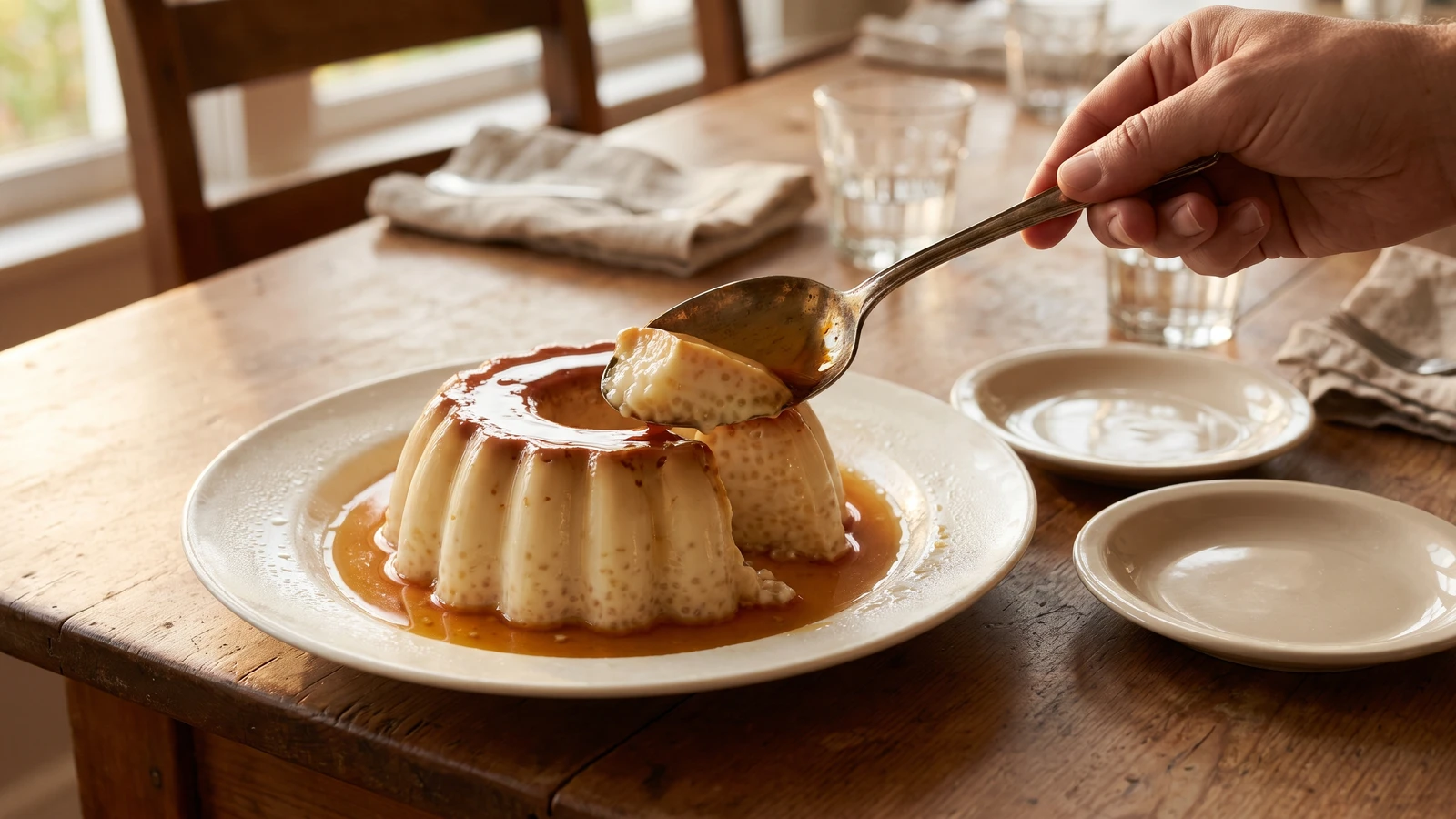
Pouding Brésilien teaches the nerve of caramel and the gentleness of custard: old-gold sugar clothing a tender vanilla tapioca pudding, poached quietly, chilled, and turned out into its own shining sauce.
Pouding Brésilien (Brazilian tapioca pudding) teaches two kinds of control: courage over the sugar and gentleness with the custard. One true thing before you touch a pan: caramel pulled at old gold is aromatic and faintly bitter, but one shade further lets bitterness run through every pearl. The caramel is not decoration. It is the dish's only sauce.
The original preparation assumed a pastry station, a copper sugar pan, practiced fingers for judging syrup, and enough pudding to fill several moulds. Here, the quantity becomes one seamless 6-cup mould for eight servings. A pale-lined saucepan and thermometer replace the finger tests because hot sugar demands respect, while the broken ice used for clothing an aspic mould goes entirely because caramel sets against room-temperature metal. Those were brigade scaffolding. Chemiser, to clothe the mould evenly with caramel, and poaching the pudding quietly in a bain-marie are the dish itself, so both stay.
Cook the tapioca until nearly every pearl turns translucent, then keep the water bath below a boil. Most of all, pull the caramel at old gold. If it goes dark and acrid, don't bury the bitterness beneath custard. Ça se rattrape: begin a fresh small batch.
Pouding Brésilien belongs to the French classical entremets repertoire, not as a transcription of Brazil's milk flans, but as a French pudding named for tapioca, the starch made from cassava associated with Brazil and the wider Amazon basin. The preparation joins a tapioca pudding base to the sugar cook's caramel and the cold kitchen's method of clothing a mould, showing how freely classical techniques moved between savoury and sweet work. Its identity remains spare: caramel, tapioca pudding, bain-marie, then a plain unmoulding without fruit or cream.
Quantity
1/2 cup (120 ml / 80 g)
Quantity
3 cups (720 ml / 740 g)
divided
Quantity
1
split lengthwise and seeds scraped
Quantity
1/3 cup (80 ml / 65 g)
Quantity
2 tablespoons (30 ml / 28 g)
Quantity
4
separated
Quantity
1/2 cup (120 ml / 150 g) from The Cooking of Sugar (No. 2344), for clothing the mould as in Another Method of Preparing Aspics de Filets de Soles (No. 916)
pulled at old gold
Quantity
About 6 cups (1.4 liters / 1.4 kg), or as needed
| Ingredient | Quantity |
|---|---|
| small pearl tapioca | 1/2 cup (120 ml / 80 g) |
| whole milkdivided | 3 cups (720 ml / 740 g) |
| vanilla beansplit lengthwise and seeds scraped | 1 |
| caster sugar | 1/3 cup (80 ml / 65 g) |
| unsalted butter | 2 tablespoons (30 ml / 28 g) |
| large eggsseparated | 4 |
| caramelpulled at old gold | 1/2 cup (120 ml / 150 g) from The Cooking of Sugar (No. 2344), for clothing the mould as in Another Method of Preparing Aspics de Filets de Soles (No. 916) |
| boiling water for the bain-marie | About 6 cups (1.4 liters / 1.4 kg), or as needed |
Combine the tapioca with 1 cup (240 ml) of the measured milk in a heavy saucepan and leave it for 30 minutes. The soak gives every pearl a head start, so the centres soften before the surrounding milk grows too thick. Heat the oven to 325°F (165°C), set a deep roasting pan inside, and bring the bain-marie water to a boil.
Have ready the caramel from The Cooking of Sugar (No. 2344), removed from the heat at old gold. Pour it immediately into a clean, dry 6-cup metal mould, then tilt and turn the mould away from your body until the base and sides wear a thin, even coat. This is chemiser, the clothing principle described in Another Method of Preparing Aspics de Filets de Soles (No. 916); the aspic kitchen's broken ice is unnecessary because caramel sets against room-temperature metal. If the caramel crystallizes before colouring, return to its own formula and remake it. If it has gone mahogany and smells acrid, discard it and begin again. Burnt sugar itself cannot be rescued.
Add the remaining 2 cups (480 ml) milk, the vanilla pod, and its seeds to the soaked tapioca. Bring it slowly to a bare simmer, then cook for 18 to 25 minutes, stirring frequently across the entire pan floor, until almost every pearl is translucent and the milk has thickened but still falls easily from the spoon. If the milk catches, don't scrape the scorched layer. Ça se rattrape: pour the unburnt pudding into a clean saucepan and finish it over gentler heat.
Remove the vanilla pod. Stir the sugar and butter into the hot tapioca until both disappear, then let the mixture cool for about 10 minutes, until warm rather than fiercely hot. Whisk the yolks in a bowl, beat in a ladleful of tapioca to temper them, and return everything to the saucepan. Beat the whites to soft peaks, loosen the tapioca with one-third of them, then fold in the remainder with broad, gentle strokes. Soft peaks give lift without leaving dry clumps in the finished pudding.
Spoon the mixture into the caramel-clothed mould and tap it once against a folded towel to release large air pockets. Cover loosely with foil and set it in the hot roasting pan. Pour boiling water around the mould until it reaches halfway up the sides, then bake in the bain-marie for 50 to 60 minutes. It is ready when the edges are firm, the centre trembles as one body, and an instant-read thermometer reaches 175 to 180°F (79 to 82°C). If the water begins bubbling hard, add a little cool water and lower the oven heat; boiling water makes an egg pudding coarse.
Lift the mould from the bain-marie and leave it on a rack for 45 to 60 minutes, no longer. Cover and refrigerate for at least 4 hours, preferably overnight. The tapioca finishes absorbing the custard as it rests, while the firm caramel slowly loosens into an amber sauce.
Run a thin knife around the upper rim without cutting into the pudding. Dip the bottom of the mould in hot water for 8 to 10 seconds, place a shallow serving platter over it, and invert in one confident movement. If it clings, hold a hot cloth against the mould for another few seconds and try again. Spoon the pooled caramel over the top and serve plain, exactly as intended. À table!
1 serving (about 150g)
Culinary guides, cultural storytelling, and the editorial depth that makes cooking meaningful.
Discover Culinary ExplorerChef Juliette
Five almond preparations, one discipline: remove the skins cleanly, dry every kernel through, then cut, toast, or cloak it in pale caramel without letting its fragrant oils escape.

Chef Juliette
A pastry pantry lesson in one tray: filberts warmed only until their red skins release, rubbed clean, cooled, and chopped into a fragrant mise-en-place for cakes, creams, pralines, and petits fours.

Chef Juliette
The smallest pâtisserie discipline decides whether a cake leaves its mould intact: clarified butter in every corner, followed by the lightest veil of dry flour or fécule.

Chef Juliette
Four whites, one spotless bowl, and a patient change of speed: whisk gently until loosened, then briskly to glossy stiffness, with powdered sugar waiting if the foam begins to granulate.