
Chef Juliette
Various Almond Preparations
Five almond preparations, one discipline: remove the skins cleanly, dry every kernel through, then cut, toast, or cloak it in pale caramel without letting its fragrant oils escape.
A cooking platform built around craft, culture, and the stories behind what we eat.
Created by Chef Juliette
Based on No. 2471, Surprise Omelet “à la Napolitaine” otherwise “Bombe Vésuve”, from Le Guide Culinaire (1907) by Auguste Escoffier
Bombe Vésuve teaches the grand frozen omelet’s one law: freeze the heart hard, seal it completely in meringue, then brown and flame it before the ice has time to surrender.
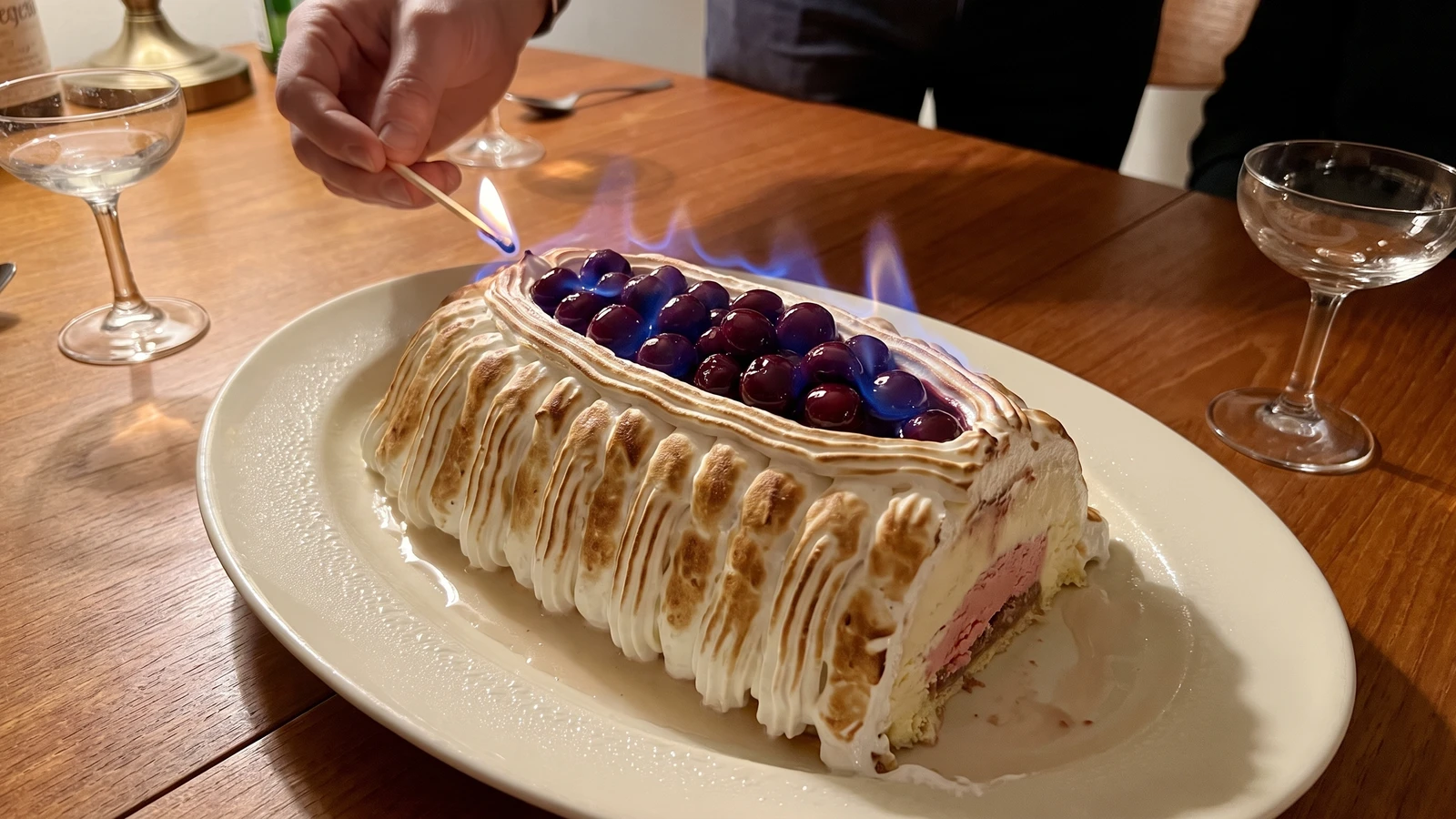
Omelette-Surprise à la Napolitaine, dite Bombe Vésuve (Vesuvius frozen surprise omelet), teaches one law: cold must be made colder before fire comes near it. Vanilla and strawberry ices, broken candied chestnut, and a cushion of Pâte à Génoise Fine disappear beneath kirsch-scented Meringue à l’Italienne. The white case bronzes, the centre stays frozen, and Jubilee cherries flare in the hollow. The unbroken meringue seal is the dish; leave one bare patch and the heat finds the ice.
The original kitchen assumed ready ices, a Génoise cushion, two kinds of meringue, several pastry cooks, and a salamander already fierce. Your honest equivalents are components made ahead, a small broiler-safe platter, an ordinary freezer, and the oven broiler heated before the dessert leaves the cold. The brigade relay is scaffolding and goes. The alternating ices, candied chestnut, kirsch meringue, pale barquette, swift browning, and last-moment Jubilee flame all stay. One cook, one stove, one evening.
Freeze every assembled layer until it is truly hard, then cover the dome completely, right down to the platter. If the meringue slips or a seam opens, stop and patch it before the broiler ever comes into the argument. Ça se rattrape. This seal is the one step that matters most.
Omelette-surprise belongs to the Parisian grand-hotel and banquet table, where frozen ices were insulated beneath meringue and flashed in fierce heat immediately before service. In this à la Napolitaine form, the name points to alternating flavours and colours of ice rather than a claim of Neapolitan household origin. The Bombe Vésuve nickname comes from the central meringue crater filled with Jubilee Cherries and lit like a small volcano at the celebration table.
Quantity
1 oval, 7 by 5 inches (18 by 13 cm), about 6 ounces (170 g), Pâte à Génoise Fine (No. 2376)
trimmed into a low, even cushion
Quantity
1½ cups (360 ml / 240 g)
Quantity
1½ cups (360 ml / 240 g)
Quantity
⅔ cup (160 ml / 120 g)
Quantity
5 cups (1.2 L / 500 g) Meringue à l’Italienne (No. 2383)
Quantity
1½ tablespoons (22 ml / 21 g)
Quantity
1 boat, 6 by 2½ inches (15 by 6 cm), from Barquettes (No. 314), made with 1 cup (240 ml / 110 g) Ordinary Meringue (No. 2382)
baked dry without coloration
Quantity
1 cup (240 ml / 300 g) Jubilee Cherries (No. 2566), including their syrup and Kirsch
| Ingredient | Quantity |
|---|---|
| Pâte à Génoise Fine cushiontrimmed into a low, even cushion | 1 oval, 7 by 5 inches (18 by 13 cm), about 6 ounces (170 g), Pâte à Génoise Fine (No. 2376) |
| full-fat vanilla ice cream | 1½ cups (360 ml / 240 g) |
| full-fat strawberry ice cream | 1½ cups (360 ml / 240 g) |
| broken candied chestnuts | ⅔ cup (160 ml / 120 g) |
| Meringue à l’Italienne | 5 cups (1.2 L / 500 g) Meringue à l’Italienne (No. 2383) |
| Kirsch | 1½ tablespoons (22 ml / 21 g) |
| baked meringue boatbaked dry without coloration | 1 boat, 6 by 2½ inches (15 by 6 cm), from Barquettes (No. 314), made with 1 cup (240 ml / 110 g) Ordinary Meringue (No. 2382) |
| Jubilee Cherries | 1 cup (240 ml / 300 g) Jubilee Cherries (No. 2566), including their syrup and Kirsch |
Chill a broiler-safe oval metal platter in the freezer. Trim the Pâte à Génoise Fine (No. 2376) into a low oval cushion about 7 by 5 inches (18 by 13 cm), with a level surface and gently sloping edges. Set it on a small piece of baking parchment on the frozen platter. Keep the cushion no thicker than ¾ inch (2 cm); too much cake insulates well but overwhelms the ices.
Let both ices stand just until spreadable but never runny. Cover the Génoise with half the vanilla ice cream, scatter over one-third of the broken candied chestnuts, and freeze for 15 minutes. Add half the strawberry ice cream and another third of the chestnuts, then freeze again. Repeat with the remaining vanilla ice cream, the last chestnuts, and the remaining strawberry ice cream, shaping everything into a smooth elongated dome. If an ice layer turns glossy or begins soaking into the cake, stop and freeze it for 10 minutes before continuing; a soft layer is hurried, not ruined.
Freeze the layered dome uncovered for at least 4 hours, until pressing the thickest part leaves no indentation. This hard freeze is not waiting-room scaffolding. It creates the thermal reserve that lets the exterior brown while the centre remains properly frozen.
Fold the Kirsch gradually into the Meringue à l’Italienne (No. 2383), lifting from underneath so the meringue keeps its body. It should hold a firm ridge from the spatula. If it slackens and flows, rewhip it briefly at medium speed until the ridges return. Ça se rattrape. Reserve about ½ cup (120 ml / 50 g) in the cold for sealing or repairs.
Spread the remaining Meringue à l’Italienne (No. 2383) over the frozen dome, carrying it completely down to the platter and keeping it about ¾ inch (2 cm) thick, with extra thickness at the centre. Set the baked meringue boat from Barquettes (No. 314), made with Ordinary Meringue (No. 2382), lengthwise on top. Pipe or spread more Italian meringue over the boat’s exterior and around its base, leaving the hollow open for the cherries. Inspect the whole dessert closely. If cake or ice shows through, patch it with the reserved meringue; one continuous coat, with no cracks or thin seams, is what protects the frozen centre.
Return the completed Bombe Vésuve to the freezer for at least 1 hour, until the meringue feels firm and the platter is thoroughly cold. Once firm, cover it loosely without letting wrapping touch the decoration.
Heat the oven broiler on high for 10 minutes and position a rack about 8 inches (20 cm) below it. Take the Bombe Vésuve straight from the freezer to the oven and brown it for 60 to 90 seconds, rotating the platter once, until the ridges carry irregular caramel-gold patches. Do not walk away. If ice cream beads through a seam, remove the dessert immediately, cover the leak with reserved meringue, freeze for 15 minutes, then colour only the repaired area beneath the broiler or with a cook’s torch. Pale meringue is better than a melted centre.
Warm the Jubilee Cherries (No. 2566) gently in a small saucepan until hot and glossy, without boiling, then spoon them with their syrup and Kirsch into the meringue barquette. Place the platter on a stable, cleared table before lighting it. Turn off any fan, secure loose sleeves and hair, and ignite the cherries with a long match at the very last moment. Never pour alcohol from a bottle near a flame, and never carry the dessert while it is alight. Let the blue flame die completely, then cut at once with a warm, dry knife. À table!
1 serving (about 275g)
Culinary guides, cultural storytelling, and the editorial depth that makes cooking meaningful.
Discover Culinary ExplorerChef Juliette
Five almond preparations, one discipline: remove the skins cleanly, dry every kernel through, then cut, toast, or cloak it in pale caramel without letting its fragrant oils escape.

Chef Juliette
A pastry pantry lesson in one tray: filberts warmed only until their red skins release, rubbed clean, cooled, and chopped into a fragrant mise-en-place for cakes, creams, pralines, and petits fours.

Chef Juliette
The smallest pâtisserie discipline decides whether a cake leaves its mould intact: clarified butter in every corner, followed by the lightest veil of dry flour or fécule.

Chef Juliette
Four whites, one spotless bowl, and a patient change of speed: whisk gently until loosened, then briskly to glossy stiffness, with powdered sugar waiting if the foam begins to granulate.