Culinary Explorer

A cooking platform built around craft, culture, and the stories behind what we eat.
Discover Culinary Explorer
Meringue à l’Italienne

Meringue à l’Italienne

Created by Chef Juliette

Based on No. 2383, Meringue à l’Italienne, from Le Guide Culinaire (1907) by Auguste Escoffier

Glossy, stable Meringue à l’Italienne from stiff whites and large-ball sugar syrup, timed to finish together and joined in one unbroken pour for mousses, parfaits, and celebration desserts.

Desserts
French
Special Occasion
Celebration
Make Ahead
10 min
Active Time
20 min cook30 min total
YieldAbout 4 cups (8 dessert portions)

Meringue à l’Italienne (Italian meringue) is the master preparation that teaches coordination. Sugar cooked to the large-ball stage and egg whites at stiff peak must be ready together, then the syrup goes in slowly, steadily, and without a pause. That is the one true thing to know before you touch the pan. Meet the timing, and the meringue turns dense, white, and brilliantly glossy.

The book’s formula assumes a pastry station that can watch syrup and whites at once, a copper sugar pan, loaf sugar, and a practiced finger test. At home, a stand mixer supplies the second pair of hands, a small heavy stainless saucepan replaces copper, plain granulated sugar needs no scum-skimming, and a digital thermometer replaces the finger test safely. The pound of sugar and eight whites is halved to 8 ounces (227 g) and four whites, quantity changed, ratio untouched. One cook, one stove, one evening.

The copper, the scum-skimming, and the brigade quantity are scaffolding. The 248°F (120°C) endpoint, stiff whites, and unbroken pour are the dish itself, so none moves. The pour is the step that matters most: aim between bowl and whisk, keep the stream thin, and once you begin, don’t stop.

Meringue à l’Italienne belongs to the French pâtisserie vocabulary, especially the Paris pastry kitchen, where it became the stable meringue for entremets, petits fours, mousses, and frozen parfaits. The name describes a method rather than a regional Italian dessert: hot sugar syrup sets and stabilizes the whites, unlike meringue française, in which dry sugar is beaten directly into them. Its reliability carried it from professional pastry work to the home table, provided the syrup and whites are timed together.

The technique, the tradition, and the story behind every dish.

Discover Culinary Explorer

Ingredients

The Cooking of Sugar

Quantity

1 batch The Cooking of Sugar (No. 2344), using 1 cup plus 2 tablespoons (270 ml / 227 g) granulated sugar and 1/3 cup (80 ml / 80 g) water

cooked to the large-ball stage, 248°F (120°C)

large egg whites

Quantity

4 large (about 1/2 cup / 120 ml / 120 g)

at room temperature

Equipment Needed

  • 4.5 to 5 quart stand mixer with whisk attachment
  • 1.5 quart heavy stainless steel saucepan with a pouring lip
  • Digital sugar thermometer accurate to at least 250°F (121°C)
  • Clean pastry brush
  • Heatproof spatula

Instructions

  1. 1

    Set the station

    Fit a stand mixer with its whisk and put the egg whites in the scrupulously clean bowl. Set the sugar pan, thermometer, damp pastry brush, and a heatproof mat beside the mixer before applying any heat. Once the syrup approaches its final temperature, there is no useful time for opening drawers.

    Fat prevents whites from mounting properly. The bowl and whisk must be clean and dry, and not a trace of yolk may follow the whites into the bowl.
  2. 2

    Cook the sugar

    Put the sugar and water in the saucepan and prepare The Cooking of Sugar (No. 2344), stopping precisely at the large-ball stage, 248°F (120°C). Stir gently over low heat only until the sugar dissolves, then bring it to a boil and leave it alone. If crystals appear above the syrup, wash them down with the damp pastry brush. If the syrup turns cloudy and grainy, remove it from the heat and let the bubbling settle, add enough water to wet the sugar again, and dissolve it slowly before resuming. Ça se rattrape. If it takes amber colour, it has passed the required stage and must be remade.

  3. 3

    Time the whites

    When the syrup reaches 230°F (110°C), start whisking the whites at medium speed. Let them become evenly foamy, then raise the speed and beat until the peaks stand upright without looking dry or clotted. Watch the thermometer while they mount. The whites and the 248°F (120°C) syrup must finish together. If the whites arrive first, turn the mixer to its lowest speed; if the syrup arrives first, lift the pan from the heat for the few seconds needed to finish the whites, then proceed at once.

  4. 4

    Pour without pause

    Take the large-ball syrup from The Cooking of Sugar (No. 2344) off the heat and set the mixer to medium. Pour the syrup slowly into the moving whites in one thin, continuous stream, aiming into the narrow space between the whisk and the bowl. Never pour onto the whisk wires, where the syrup will spin into threads, or directly down the bowl wall, where it can harden. Once the pour begins, do not pause. Hot sugar burns seriously, so keep your free hand and face clear of the bowl.

    If the stream catches the whisk, lower the speed one notch and redirect it without stopping. Leave any hardened threads on the bowl rather than scraping them into the meringue; a small loss will not spoil the batch.
  5. 5

    Whisk until cool

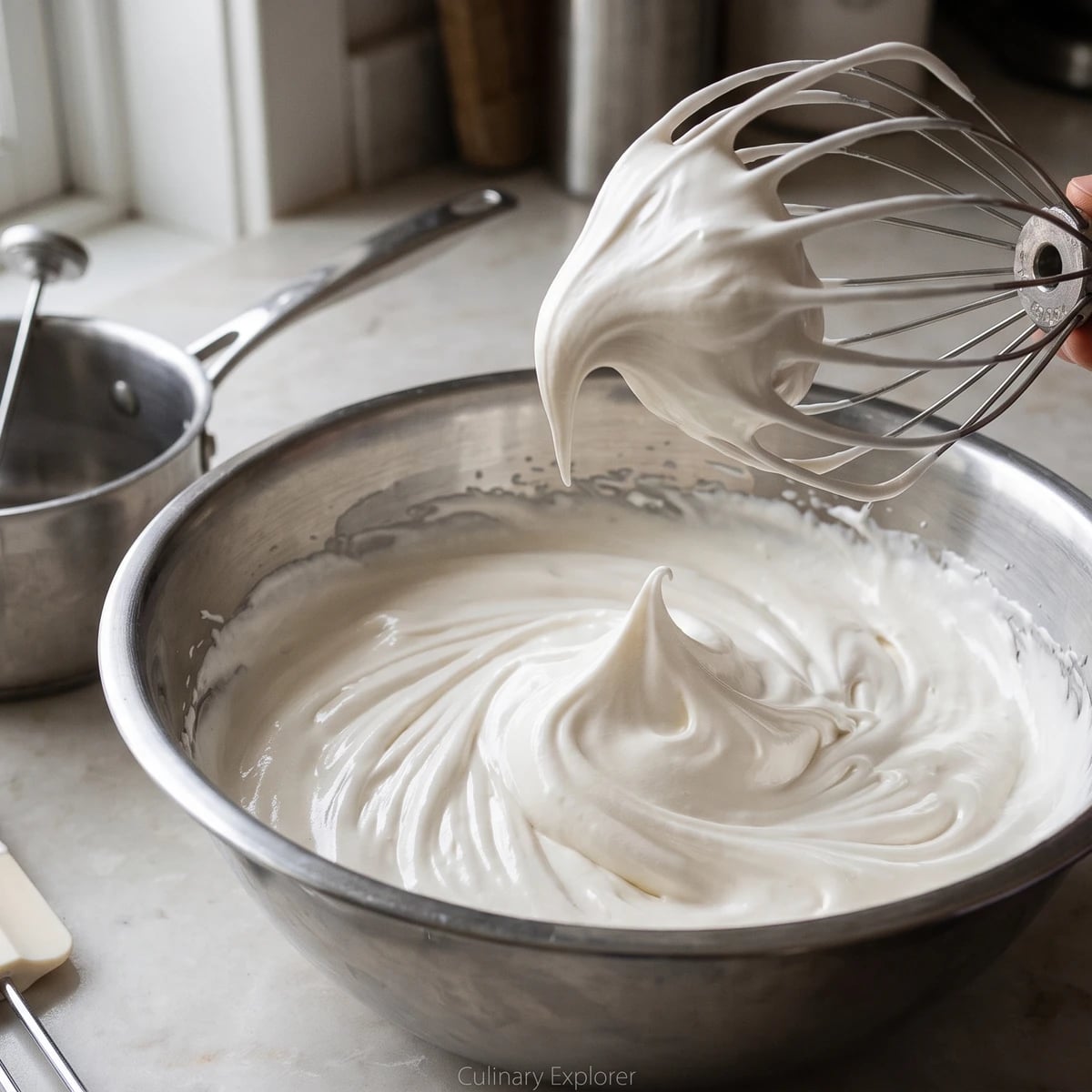
    As soon as all the syrup is incorporated, increase the mixer to high and whisk briskly for 8 to 12 minutes. The meringue is ready when it is brilliantly white, dense, and glossy, the bowl feels barely warm, and a lifted whisk leaves a firm peak with only its tip bending. If the mixture looks loose while it is still hot, keep whisking. Heat temporarily softens it, and the structure appears as it cools.

  6. 6

    Use or hold

    Use the meringue as soon as it has cooled. Fold it into a mousse or parfait only when no warmth remains, or spread and pipe it as the dessert requires. If it must wait, cover the bowl and keep it cool; do not stir it down before using. The preparation is complete, glossy, stable, and ready for the dessert that called for it. À table!

Chef Tips

  • Use plain white granulated sugar. Modern refined sugar replaces loaf sugar honestly and produces no scum worth skimming; purity matters here, not the shape in which the sugar was sold.
  • Trust the scale for the sugar and the thermometer for its stage. The source ratio is exact, and the jump from syrup to large ball happens quickly once most of the water has boiled away.
  • The measured water only helps the sugar dissolve evenly. It cooks away before the syrup reaches 248°F (120°C), so a little more water changes the cooking time, not the final sugar concentration.
  • A hand mixer leaves one cook trying to whisk, monitor the thermometer, and pour hot syrup at once. A stand mixer is the useful home equivalent to another pair of hands, not a luxury.
  • Use the finished meringue the same day for its best gloss. It is particularly suited to mousses and frozen parfaits because the cooked syrup gives the whites enough stability to survive folding.

Advance Preparation

  • Separate the egg whites up to 24 hours ahead and keep them covered in the refrigerator. Bring them to room temperature for about 30 minutes before whisking.
  • Measure the sugar and water and arrange the equipment several hours ahead, but do not begin cooking the syrup until the mixer bowl is ready.
  • The finished meringue may be held at cool room temperature for up to 2 hours or refrigerated airtight for up to 24 hours. It may lose a little gloss in the refrigerator, so make it on the day it will be folded, piped, or spread.

Frequently Asked Questions

Nutrition Information

1 serving (about 48g)

Calories
120 calories
Total Fat
0 g
Saturated Fat
0 g
Trans Fat
0 g
Unsaturated Fat
0 g
Cholesterol
0 mg
Sodium
25 mg
Total Carbohydrates
28 g
Dietary Fiber
0 g
Sugars
28 g
Protein
2 g

Note: Chef personas and recipes are created with AI assistance. Cook with care: follow safe food-handling practices, check doneness with a thermometer when needed, and adapt for allergies and your kitchen.

Where cooking meets culture.

Culinary guides, cultural storytelling, and the editorial depth that makes cooking meaningful.

Discover Culinary Explorer

More from Entremets (Sweets)

Browse the full collection