
Chef Juliette
Smelt (Éperlans)
Tiny éperlans, lightly floured and fried until their tails stand crisp, arrive in a generous heap on a napkin with fried parsley and grooved lemon, a weeknight lesson in heat and restraint.
A cooking platform built around craft, culture, and the stories behind what we eat.
Created by Chef Juliette
Based on No. 2323, Pannequets à la Moscovite, from Le Guide Culinaire (1907) by Auguste Escoffier
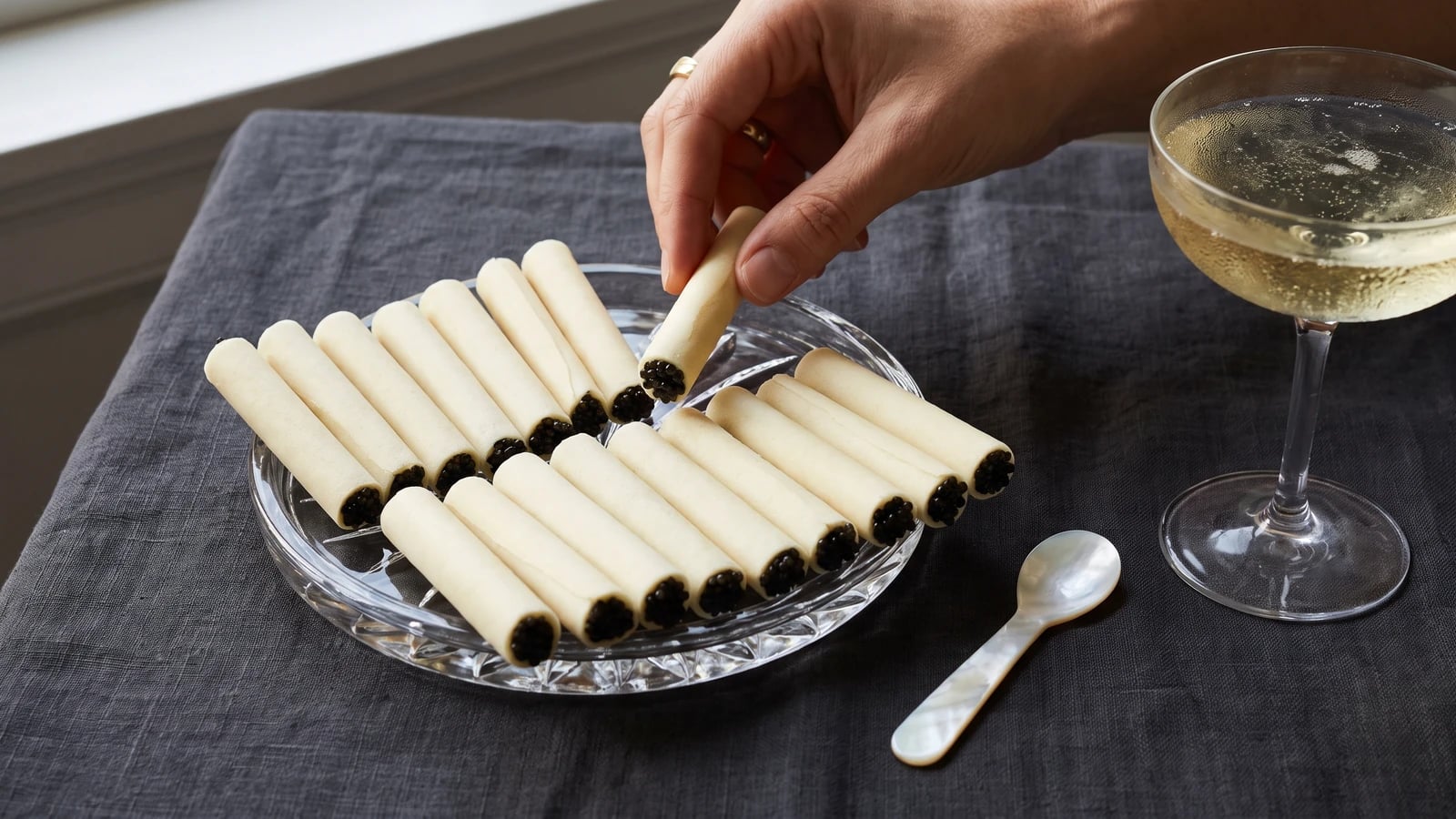
Cold, neat, and briny, these unsweetened pannequets wrap cayenne-touched caviare in slim little cigarettes, a special-occasion hors d'oeuvre whose whole discipline is keeping every element chilled and every pearl intact.
Pannequets à la Moscovite (cold pancake cigarettes filled with cayenned caviare) teach a lesson that hot cooking often lets you dodge: temperature is part of structure. The pannequet must be cool and supple, the caviare cold and intact, and the finished roll firm enough to lift in two fingers without squeezing out its filling. No heat comes near this one.
The original needed neither saucier, stockpot, nor salamander. It assumed a garde-manger, the cold station, with ordinary unsugared pannequets already prepared, enough hands to cut trays of exact rectangles, and crystal hors-d'oeuvre dishes waiting for service. At home, four finished pannequets, one chilled tray, and a sharp knife give you sixteen bites for four people. The crystal is service ceremony, and a chilled glass platter is its honest equivalent; the three-inch rectangle, cayenned caviare, and tight cigarette roll are the dish and must stay. One cook, one stove, one evening.
Work in small batches and put each roll seam-side down in the cold as soon as it's made. The one step that decides the result happens before the knife touches the pancake: chill the pannequets, caviare, tray, and serving dish, then keep them cold.
Pannequets à la Moscovite belong to the Parisian classical hors-d'oeuvre repertoire, where the garde-manger turned ready pancakes and costly caviare into small cold bites for formal service. In French culinary nomenclature, à la Moscovite signals a Russian association, here carried by caviare, but the dish is not a blini: its wrapper is the ordinary unsugared French pannequet. Crystal dishes were part of the service ceremony; the enduring preparation is the cayenne-pricked roe rolled tightly inside the pale pancake.
Quantity
4 ordinary unsugared Pannequets (No. 2403), each about 8 inches (20 cm) across
fully cooled
Quantity
1/4 cup (60 ml / 60 g)
thoroughly chilled
Quantity
1 small pinch, about 1/16 teaspoon (0.3 ml / 0.1 g)
| Ingredient | Quantity |
|---|---|
| Preparations for Pancakes and Pannequetsfully cooled | 4 ordinary unsugared Pannequets (No. 2403), each about 8 inches (20 cm) across |
| black caviarethoroughly chilled | 1/4 cup (60 ml / 60 g) |
| cayenne | 1 small pinch, about 1/16 teaspoon (0.3 ml / 0.1 g) |
Chill a metal tray, the serving dish, a small bowl, and the caviare for at least 30 minutes. Take the fully cooled ordinary unsugared Pannequets from Preparations for Pancakes and Pannequets (No. 2403) from the cold only when everything else is ready. If the pannequets retain any warmth, stop and chill them between sheets of parchment; warmth softens the caviare and turns neat rolls slack.
Lay one pannequet flat on the chilled tray. Using a sharp knife and a ruler or paper guide, cut four clean rectangles measuring 3 inches by 1 1/2 inches (7.5 by 4 cm), choosing the most even central portions. Repeat with the remaining pannequets and return each batch of rectangles to the cold. Reserve the trimmings for the cook; they do not belong on the serving dish.
Set aside 1 tablespoon of the caviare, then sprinkle the cayenne over the remainder. Fold it through once or twice with a small spoon, gently enough to leave the pearls whole. Taste a few pearls together. The cayenne should arrive after the caviare, never before it; if it bites too sharply, fold in the reserved plain caviare until the balance returns.
Work with four rectangles at a time. Spread each with a scant 3/4 teaspoon of cayenned caviare in a thin, even coat, leaving about 1/8 inch (3 mm) bare along one long edge. Beginning at the opposite long edge, roll across the narrow dimension into a tight cigarette about 3 inches (7.5 cm) long. Set it seam-side down on the chilled tray. If a roll bulges or leaks, unroll it immediately, scrape away the excess, and roll again. Ça se rattrape.
Chill the completed cigarettes seam-side down for 20 to 30 minutes, lightly covered so they neither dry nor absorb refrigerator aromas. Arrange them in a single layer on the chilled crystal or glass hors-d'oeuvre dish, keeping their clean ends visible. Bring them out only when the glasses are poured, and serve at once. À table!
1 serving (about 55g)
Culinary guides, cultural storytelling, and the editorial depth that makes cooking meaningful.
Discover Culinary ExplorerChef Juliette
Tiny éperlans, lightly floured and fried until their tails stand crisp, arrive in a generous heap on a napkin with fried parsley and grooved lemon, a weeknight lesson in heat and restraint.

Chef Juliette
Brandade de Morue turns salt cod, warm olive oil, and milk into a pale, silky emulsion: keep everything warm and add the oil slowly, then crown the generous dome with butter-fried bread.

Chef Juliette
Salt cod worked warm with cream, one patient spoonful at a time, until the rough flakes become a glossy Nîmes paste, domed generously and ringed with butter-fried croutons for the table.

Chef Juliette
Wine-poached char packed in its earthenware crock beneath butter gold: a make-ahead first course that turns careful cooling, thorough boning, and one unbroken seal into quiet abundance.