Chef Juliette
Suet Dumpling
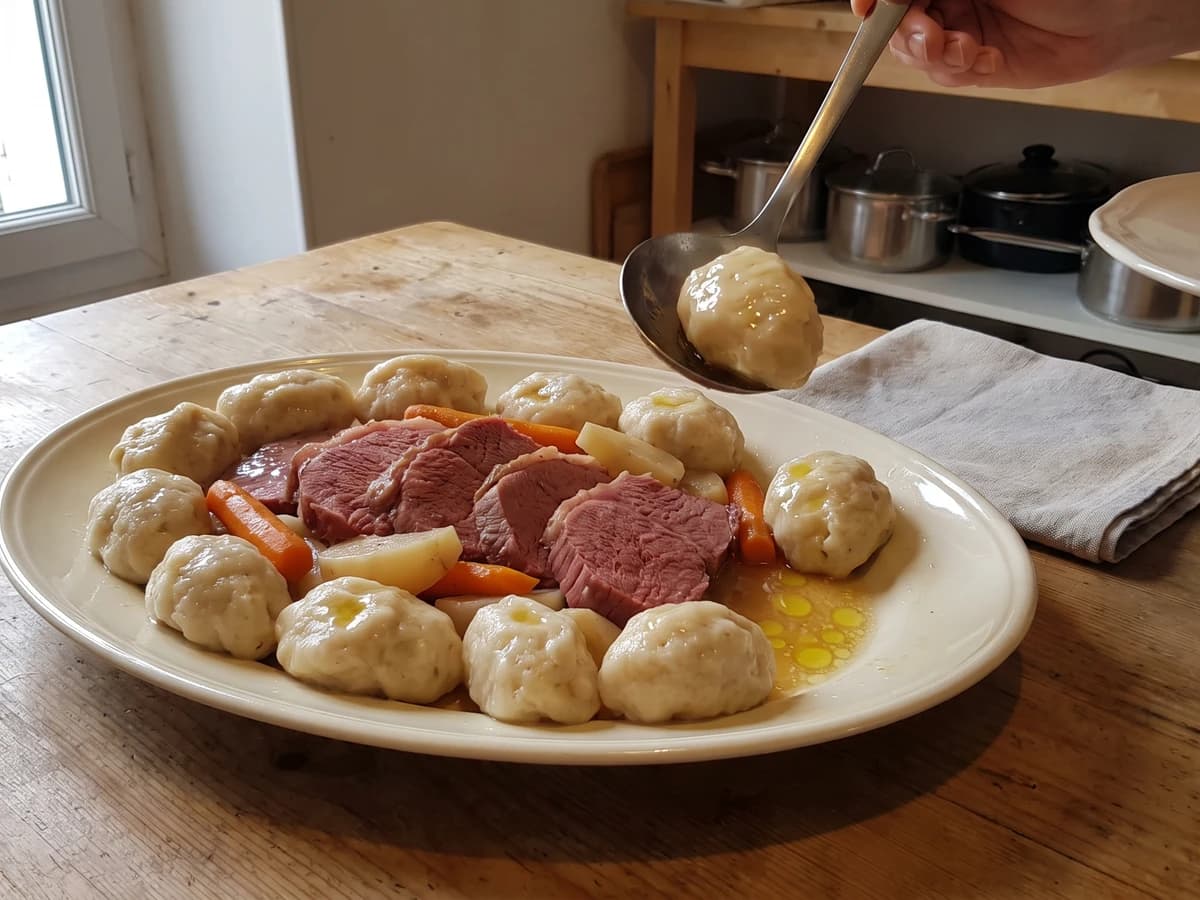
Boulettes au suif, poached beside salt beef, turn equal weights of flour and finely chopped suet into tender, rich dumplings. Keep the beef liquor at a bare tremble and the old garnish works beautifully at home.
A cooking platform built around craft, culture, and the stories behind what we eat.

Created by Chef Juliette
Based on No. 2181, Stuffed Onions, from Le Guide Culinaire (1907) by Auguste Escoffier
Oignons farcis teach the discipline of the shell: mild onions hollowed without weakness, filled with their own flesh and Duxelle, braised in butter and stock, then glazed until the tops bronze.
Oignons farcis (stuffed onions) teach the discipline of the shell. An onion looks sturdy, but the whole dish depends on leaving exactly one-third inch (8 mm) of tender wall: thinner collapses in the braise, thicker stays sharp while the filling cooks. The reward is sweet onion around a savory mushroom-and-pork center, glossed with its own reduced braising liquor.
The original recipe assumed Duxelle for Garnishing Small Pies, Onions, Cucumbers, etc. (No. 225) waiting among the prepared garnishes, a stockpot never off the fire, a saucier on staff to baste and reduce, and a salamander for the final fierce glaze. At home, the referenced Duxelle remains a finished component, one cup of good stock replaces the stockpot, a covered gratin dish handles the braise, and the broiler supplies the rapid gratin. The brigade quantity becomes four equal onions, one per guest. The staffing and service choreography were scaffolding and can go; the equal-volume filling, gentle braise, and glossy finish are the dish, so they stay.
Measure the chopped onion flesh before adding the Duxelle, because equal volumes are what keep the filling sweet, savory, and properly moist. Most of all, hollow patiently and stop at that one-third-inch wall. That is the step that decides everything.
Oignons farcis belong to the French cuisine bourgeoise and the classical garnish repertoire rather than to one claimed province, with generous mild onions made into edible vessels beside roasted meat. The home practice of filling vegetables with their own flesh passed into grand kitchens, where Duxelle for Garnishing Small Pies, Onions, Cucumbers, etc. (No. 225) and the glazing methods gathered under Gratins (No. 268) gave it sharper form; “Spanish onion” describes the large, mild type, not a Spanish origin for the dish. Its kinship with Stuffed Turnips.—A (No. 2177), Stuffed Turnips.—B (No. 2178), and the suggested Soufflé fillings reveals the larger classical system: one hollowed vegetable, many possible garnishes.
Quantity
4 medium-large onions (about 2 pounds / 900 g total)
evenly sized
Quantity
4 quarts (3.8 liters / 3.8 kg)
Quantity
2 tablespoons (30 ml / 36 g)
for the parboiling water
Quantity
1½ cups (360 ml / about 260 g)
finely chopped after hollowing
Quantity
1½ cups (360 ml / about 360 g) Duxelle for Garnishing Small Pies, Onions, Cucumbers, etc. (No. 225), adjusted to exactly equal the volume of chopped onion flesh
Quantity
4 tablespoons (60 ml / 56 g)
softened and divided
Quantity
1 cup (240 ml / about 240 g)
| Ingredient | Quantity |
|---|---|
| mild Spanish onionsevenly sized | 4 medium-large onions (about 2 pounds / 900 g total) |
| water | 4 quarts (3.8 liters / 3.8 kg) |
| fine saltfor the parboiling water | 2 tablespoons (30 ml / 36 g) |
| reserved parboiled onion fleshfinely chopped after hollowing | 1½ cups (360 ml / about 260 g) |
| Duxelle for Garnishing Small Pies, Onions, Cucumbers, etc. | 1½ cups (360 ml / about 360 g) Duxelle for Garnishing Small Pies, Onions, Cucumbers, etc. (No. 225), adjusted to exactly equal the volume of chopped onion flesh |
| unsalted buttersoftened and divided | 4 tablespoons (60 ml / 56 g) |
| unsalted light chicken or veal stock | 1 cup (240 ml / about 240 g) |
Cut each onion horizontally one-quarter of its height down from the top. Reserve the edible flesh from those top pieces, peel the onion bases, and trim only the root hairs so the root plates remain intact. Bring the water and salt to a gentle boil, add the onion bases and top pieces, then lower the heat to a steady simmer. Cook the bases for 18 to 22 minutes, until the outer layers bend without cracking and a small knife enters halfway with slight resistance. The centers should remain firmer because the onions still have a braise ahead of them. Drain them upside down and cool until comfortable to handle.
Working through the cut opening, lift out the center of each onion with a melon baller or sturdy teaspoon, following its natural layers. Leave the root plate intact and keep a wall one-third inch (8 mm) thick all around. This is the principle inside the method: a thin shell collapses, while a thick one remains harsh. If the spoon pierces the base, patch the opening from inside with a broad piece of onion flesh and stand the onion directly on that patch during the braise. Chop all the removed flesh finely and measure it.
Measure a volume of Duxelle for Garnishing Small Pies, Onions, Cucumbers, etc. (No. 225) exactly equal to the volume of chopped onion flesh, up to 1½ cups (360 ml) of each. Fold them together until evenly distributed. If your onions yield less flesh, reduce the Duxelle to match rather than padding the mixture; the equal-volume ratio keeps the onion present against the richer mushroom-and-pork preparation.
Heat the oven to 350°F (175°C). Butter a 9-inch (23 cm) shallow broiler-safe gratin dish with 1 tablespoon (14 g) of the butter. Fill the onion shells, pressing just firmly enough to remove large gaps and leaving the filling slightly proud of each opening. Stand the onions close together in the dish, pour the stock around them until it reaches roughly one-third of their height, and dot the tops with another tablespoon (14 g) of butter. Cover tightly with buttered parchment and foil, then braise for 35 to 45 minutes, basting once after 20 minutes. They are ready when a knife slips easily through the onion wall and the center of the pork-containing filling reaches 160°F (71°C). If the dish dries before the onions are tender, add the reserved stock two tablespoons at a time.
Heat the broiler. Carefully pour the braising liquor into a small saucepan, leaving the onions upright in their dish. Boil the liquor until reduced to about one-third cup (80 ml), glossy, and thick enough to cling lightly to a spoon. Take it off the heat and whisk in the remaining 2 tablespoons (28 g) butter, a monter au beurre, or finishing with butter. If the glaze separates into oily beads, stop heating and whisk in a teaspoon of cold stock. Ça se rattrape. Following the glazing form of Gratins (No. 268), brush the onions and filling generously with the glaze, then broil for 2 to 4 minutes, rotating the dish if needed, until the filling is bronzed and the glaze bubbles around the edges.
Rest the oignons farcis for 5 minutes so the glaze settles over the tender layers. Spoon any liquor from the dish around them and serve one onion per guest, whole and generous, beside a roast or simply with dressed bitter leaves and bread for catching the sauce. À table!
1 serving (about 285g)
Culinary guides, cultural storytelling, and the editorial depth that makes cooking meaningful.
Discover Culinary ExplorerChef Juliette
Boulettes au suif, poached beside salt beef, turn equal weights of flour and finely chopped suet into tender, rich dumplings. Keep the beef liquor at a bare tremble and the old garnish works beautifully at home.

Chef Juliette
Bread, flour, frangipane, and rice become four cool, supple panades for binding forcemeats, each changing body and flavor while preserving tenderness. The finest Mousselines need none, and knowing that distinction is the lesson.

Chef Juliette
Panade au pain is bread, milk, salt, heat, and attention: stir until the paste releases cleanly, butter it against a skin, and you have the quiet binder behind tender French farces.

Chef Juliette
Panade de farine teaches the drying stroke behind pâte à choux: flour meets boiling buttered water, then stays over the fire until the paste gathers, smooths, and quits the pan cleanly.