Chef Juliette
Suet Dumpling
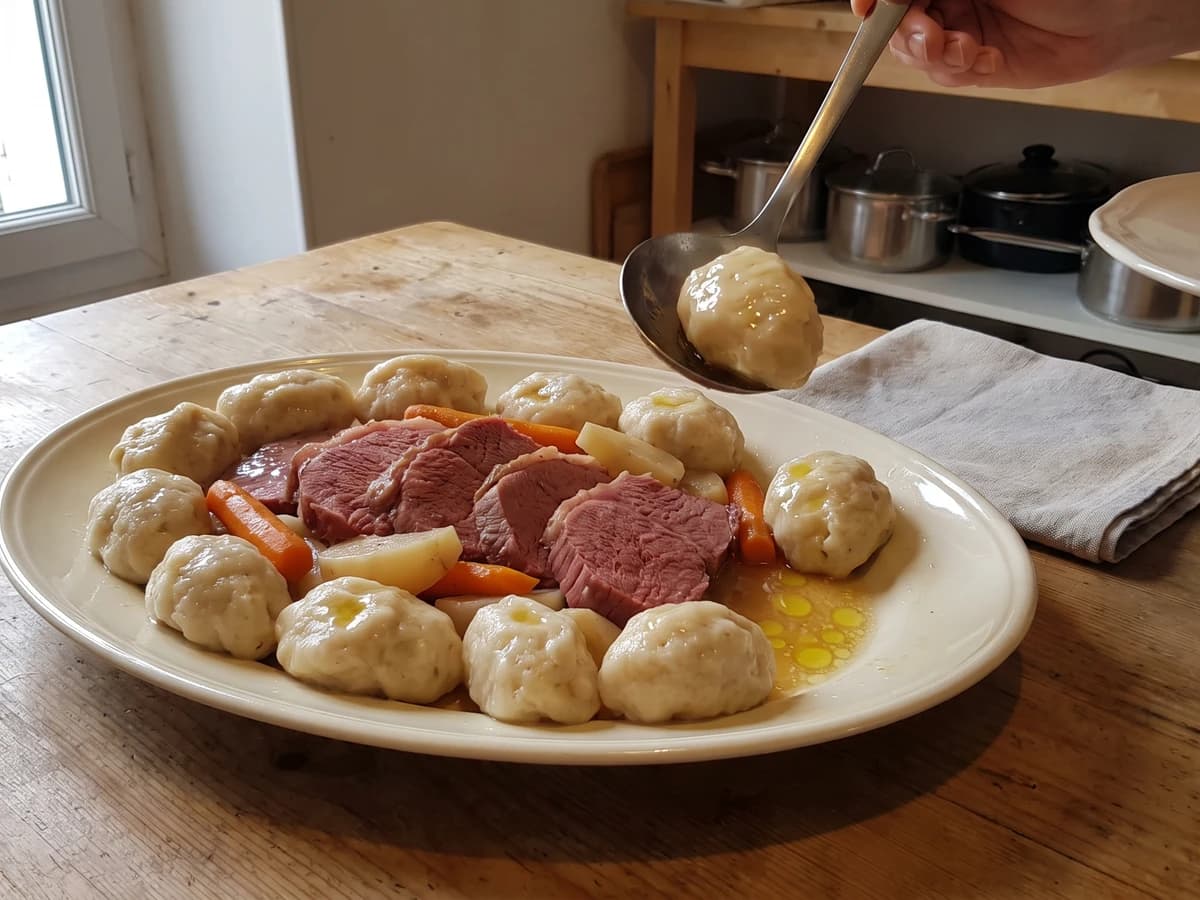
Boulettes au suif, poached beside salt beef, turn equal weights of flour and finely chopped suet into tender, rich dumplings. Keep the beef liquor at a bare tremble and the old garnish works beautifully at home.
A cooking platform built around craft, culture, and the stories behind what we eat.
Created by Chef Juliette
Based on No. 189, Various Panadas for Stuffings, from Le Guide Culinaire (1907) by Auguste Escoffier
Bread, flour, frangipane, and rice become four cool, supple panades for binding forcemeats, each changing body and flavor while preserving tenderness. The finest Mousselines need none, and knowing that distinction is the lesson.
Panades variées pour farces (various panadas for stuffings) teach the difference between binding a forcemeat and burdening it. A panade should hold the juices and give the cooked farce a clean slice, but it must disappear into the texture. If you can identify a plug of bread or flour, it has not done its job. The one true thing to know before touching a pan is this: every panade must be completely cold before it meets chilled meat and fat.
The original entry assumed a garde-manger making a pound at a time, a saucier's white stock never off the fire, and a mortar with a fine drum sieve ready for the rice. Here each formula is halved to about 225 g, enough for roughly 450 g of forcemeat, and the rice is worked in a small food processor or through a household sieve. Quantity and equipment changed because one cook needs one batch, not a service tray. The ratios, proper cooking-out, and complete cooling remain. Those are the dish. Keeping four pans moving at once was brigade scaffolding, so choose one.
Bread gives the most familiar, tender body, flour the cleanest and firmest bind, frangipane a richer tenderness, and rice a delicate neutral paste. Mousselines, the finest and lightest forcemeats, need no panade at all. Dry your chosen paste until it leaves the pan cleanly, then spread it thin and cool it all the way through. That final cooling is the step that decides the result.
Panade belongs to the working vocabulary of the French garde-manger, with the family organized in the Parisian grandes cuisines from bread-thickened stuffings already familiar at bourgeois and provincial tables. It traveled in both directions: household bread and rice binders entered the formal forcemeat system, while cooks carried the flour and frangipane versions back into smaller kitchens. Panade does not mean bread and milk alone; in the canon it is a family of cooked pastes, and Mousselines stand deliberately outside it because their lightness comes from meat, cream, and careful working.
Quantity
3 cups (710 ml / 142 g)
crust removed and crumb finely torn
Quantity
scant 1/2 cup (115 ml / 118 g)
Quantity
generous 1/2 teaspoon (3 ml / 3.5 g)
Quantity
scant 1/2 cup (115 ml / 115 g)
Quantity
3 tablespoons (45 ml / 43 g)
Quantity
generous 1/2 teaspoon (3 ml / 3.5 g)
Quantity
1/2 cup plus 1 teaspoon (125 ml / 64 g)
sifted
Quantity
scant 1/2 cup (110 ml / 57 g)
sifted
Quantity
2
Quantity
3 tablespoons (45 ml / 43 g)
melted
Quantity
1/2 teaspoon (2.5 ml / 3 g)
Quantity
1/16 teaspoon (0.3 ml / 0.1 g)
Quantity
1/16 teaspoon (0.3 ml / 0.1 g)
Quantity
scant 1/2 cup (115 ml / 118 g)
brought just to the boil
Quantity
1/2 cup plus 2 tablespoons (150 ml / 113 g)
Quantity
2/3 cup plus 2 teaspoons (170 ml / 175 g)
| Ingredient | Quantity |
|---|---|
| Bread panade: fresh white bread crumbcrust removed and crumb finely torn | 3 cups (710 ml / 142 g) |
| Bread panade: whole milk | scant 1/2 cup (115 ml / 118 g) |
| Bread panade: fine salt | generous 1/2 teaspoon (3 ml / 3.5 g) |
| Flour panade: water | scant 1/2 cup (115 ml / 115 g) |
| Flour panade: unsalted butter | 3 tablespoons (45 ml / 43 g) |
| Flour panade: fine salt | generous 1/2 teaspoon (3 ml / 3.5 g) |
| Flour panade: plain floursifted | 1/2 cup plus 1 teaspoon (125 ml / 64 g) |
| Frangipane panade: plain floursifted | scant 1/2 cup (110 ml / 57 g) |
| Frangipane panade: large egg yolks | 2 |
| Frangipane panade: unsalted buttermelted | 3 tablespoons (45 ml / 43 g) |
| Frangipane panade: fine salt | 1/2 teaspoon (2.5 ml / 3 g) |
| Frangipane panade: ground white pepper | 1/16 teaspoon (0.3 ml / 0.1 g) |
| Frangipane panade: freshly grated nutmeg | 1/16 teaspoon (0.3 ml / 0.1 g) |
| Frangipane panade: whole milkbrought just to the boil | scant 1/2 cup (115 ml / 118 g) |
| Rice panade: short-grain white rice | 1/2 cup plus 2 tablespoons (150 ml / 113 g) |
| Rice panade: lightly seasoned pale chicken stock | 2/3 cup plus 2 teaspoons (170 ml / 175 g) |
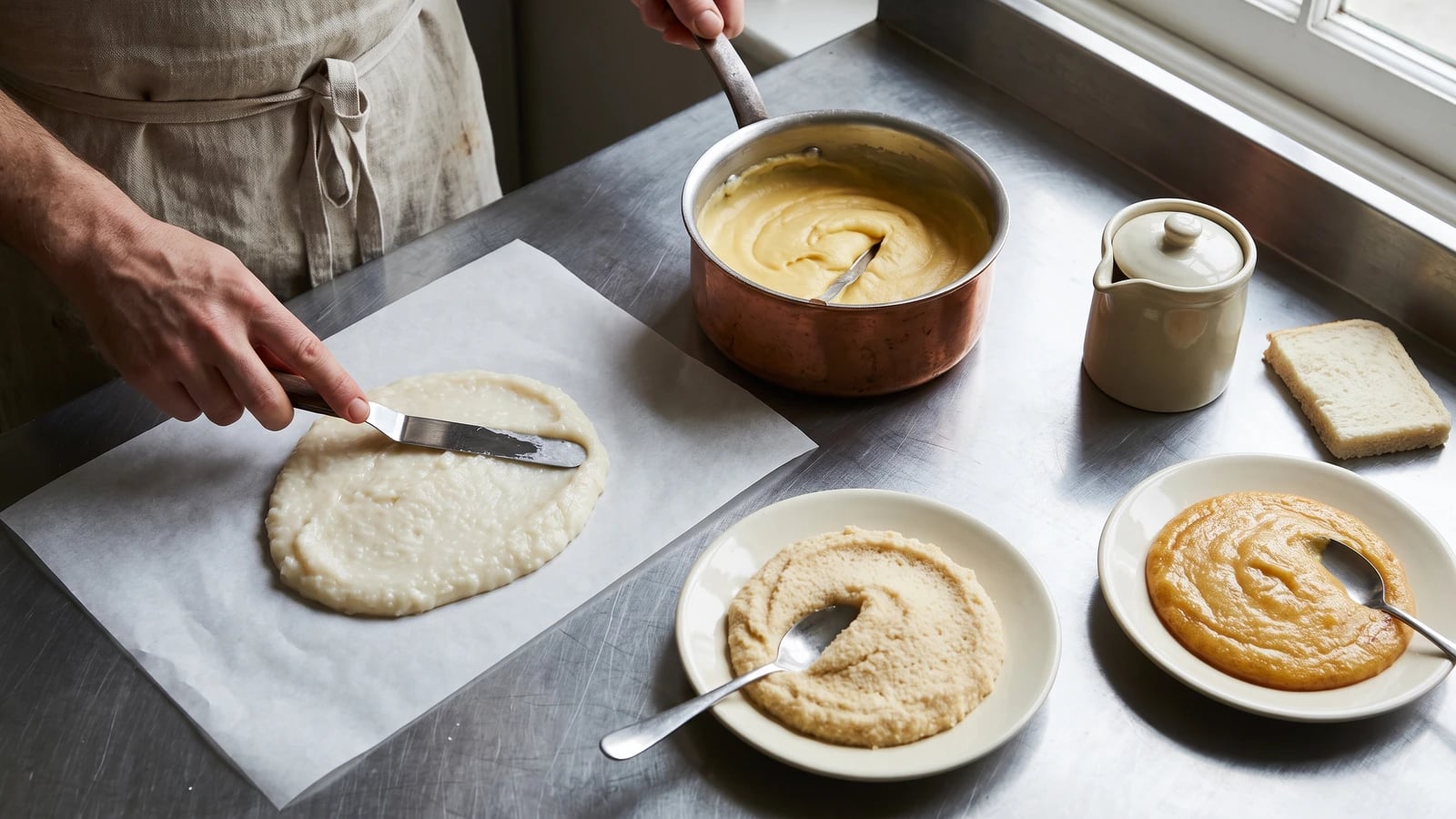
Choose one ingredient set, not all four. Use bread when a tender, familiar body suits the farce; flour when you need a neutral, firmer bind; frangipane for richness; or rice when the forcemeat should remain pale and delicate. Whichever you choose, line a shallow plate or small tray with parchment so the finished paste can cool quickly.
For the bread panade, bring the milk and salt just to the boil in a small heavy saucepan. Remove it from the heat, add all the bread crumb, and beat firmly until no dry pockets remain. Return the pan to medium-low heat and work the paste continuously for 5 to 7 minutes, until it is smooth, compact, and leaves both the spoon and the bottom of the pan cleanly. If it remains wet, keep drying it; if it tightens before becoming smooth, beat in a teaspoon of milk while it is still warm. Ça se rattrape. Spread it about 1/2 inch thick on the prepared plate.
For the flour panade, bring the water, butter, and salt to a full boil. Take the pan off the heat, add the sifted flour all at once, and stir until every trace of dry flour disappears. Return it to medium heat and beat for 2 to 3 minutes, until the paste forms a single satiny mass and a pale film appears on the pan floor. Do not brown it. If flour hides in small dry lumps, remove the pan from the heat and beat hard before continuing; adding water at this stage only makes the paste slack. Spread it on the prepared plate.
For the frangipane panade, work the flour and egg yolks together in a bowl until smooth, then mix in the melted butter, salt, white pepper, and nutmeg. Whisk in the boiling milk little by little, keeping the mixture smooth after every addition. Pour it into the saucepan and cook over low heat for 5 to 6 minutes, stirring into every corner, until the paste is thick, glossy, and pulls cleanly from the pan. This frangipane is a savory enriched panade, not the almond filling used in pastry. If small lumps form, take it off the heat, whisk vigorously, and press it through a fine sieve while warm. Spread it on the prepared plate.
For the rice panade, heat the oven to 325°F (165°C). Combine the rice and pale chicken stock in a small lidded ovenproof saucepan, bring them to a gentle simmer, cover tightly, and bake for 30 to 40 minutes without stirring. The rice is ready when the stock has disappeared and every grain crushes easily against the pan. If the liquid is gone while the rice is still firm, add stock 1 tablespoon (15 ml / 15 g) at a time, cover, and continue cooking. If the rice is tender but loose, uncover it and dry it briefly over low heat. Process the warm rice into a fine paste in a small food processor, or press it firmly through a fine-mesh sieve, then spread it on the prepared plate.
Press parchment directly against the surface and let the panade lose its first warmth, then refrigerate it for at least 30 minutes. It must feel cold through the center before it meets forcemeat. Warm panade softens the meat's fat and damages the fine texture you are trying to protect; if mixing has already begun and the bowl feels warm, stop, set the bowl over ice, and chill it before continuing. Ça se rattrape.
Work the cold panade briefly with a spatula to restore its suppleness, then incorporate only the amount required by the forcemeat formula. If no proportion is supplied, begin with 1 part panade to 2 parts chilled meat mixture by weight and cook a small poached test before adding more. A good panade holds the farce together without announcing itself. If the test crumbles, add a little more panade; if it is already dense, stop. The binder is support, not the principal ingredient.
1 serving (about 225g)
Culinary guides, cultural storytelling, and the editorial depth that makes cooking meaningful.
Discover Culinary ExplorerChef Juliette
Boulettes au suif, poached beside salt beef, turn equal weights of flour and finely chopped suet into tender, rich dumplings. Keep the beef liquor at a bare tremble and the old garnish works beautifully at home.

Chef Juliette
Panade au pain is bread, milk, salt, heat, and attention: stir until the paste releases cleanly, butter it against a skin, and you have the quiet binder behind tender French farces.

Chef Juliette
Panade de farine teaches the drying stroke behind pâte à choux: flour meets boiling buttered water, then stays over the fire until the paste gathers, smooths, and quits the pan cleanly.

Chef Juliette
Panade frangipane turns flour, yolks, butter, and milk into a silken classical binder. Strain before heat, whisk through five gentle minutes, then cover the surface closely as it cools.