
Chef Juliette
Smelt (Éperlans)
Tiny éperlans, lightly floured and fried until their tails stand crisp, arrive in a generous heap on a napkin with fried parsley and grooved lemon, a weeknight lesson in heat and restraint.
A cooking platform built around craft, culture, and the stories behind what we eat.
Created by Chef Juliette
Based on No. 1325, Fritôt of Sheep’s Trotters, from Le Guide Culinaire (1907) by Auguste Escoffier
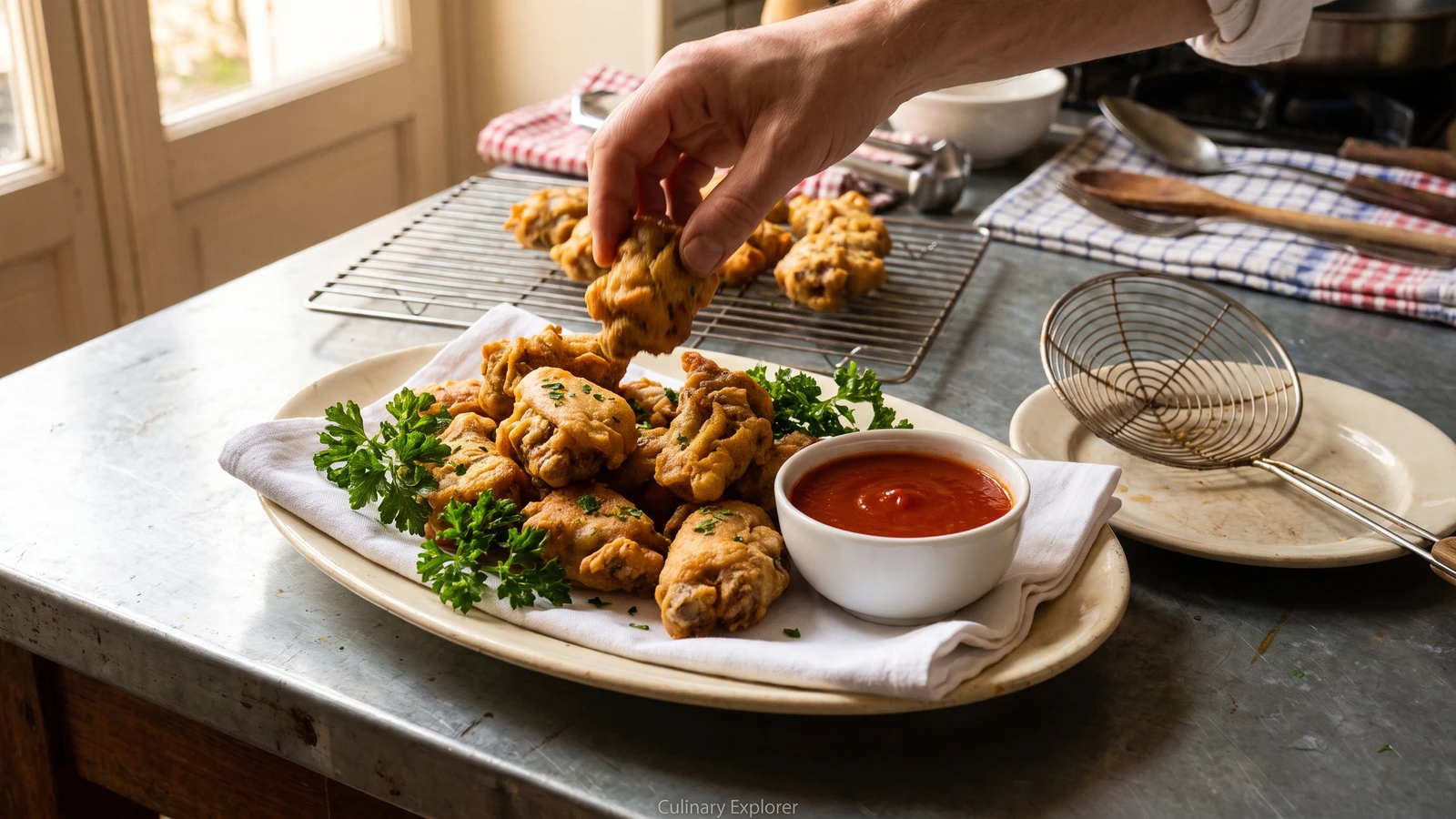
Tender sheep’s trotters under a light, dry golden shell, sharpened with lemon and parsley and served with tomato sauce apart: a lesson in drying, battering, and frying without heaviness.
Fritôt de pieds de mouton (battered and fried sheep’s trotters) teaches the difference between frying to cook and frying to finish. The trotters are already tender; your task is to build a dry golden shell around their soft, gelatinous richness. Surface moisture is the enemy. Rush them wet into the batter and even a fine coating will slide away.
The brigade entry assumes its invisible support: cooked trotters waiting cold, Cooked Marinade for Venison (No. 168) already cooled, Batter for Vegetables (No. 232) rested by another pair of hands, a saucier holding the tomato sauce, and a fryer broad enough to take the whole service batch. A stockpot never off the fire and a salamander solve nothing here. At home, buy the trotters fully cooked, use a narrow heavy pot so abundant fat doesn’t require a vat, and fry in two or three small batches. One cook, one stove, one evening.
The brigade’s volume is scaffolding and can go. The brief lemon-and-parsley steep, the rested batter, and properly hot frying fat are the dish, so they stay. Turn the fritôt in its marinade, drain it patiently, and dry every visible bead before battering. That is the step that decides the fritôt.
Fritôt de pieds de mouton belongs most clearly to the Parisian traiteur and bistro table, where inexpensive cooked offal could be held cold and finished quickly to order. In the classical kitchen, fritôt names the treatment rather than the ingredient: a cooked item is briefly seasoned or marinated, dipped in batter, and fried until its coating is dry and golden. Sheep’s feet brought thrift and gelatinous richness to the method, while tomato sauce served apart protected the delicate fried shell.
Quantity
4 trotters (about 2 lb / 900 g bone-in before trimming)
chilled, split lengthwise into 8 half-trotters, with loose large bones removed
Quantity
1 cup (240 ml / 250 g) Cooked Marinade for Venison (No. 168)
prepared and fully cooled
Quantity
3 tablespoons (45 ml / 45 g)
Quantity
½ teaspoon (2.5 ml / 2 g)
Quantity
2 tablespoons (30 ml / 8 g)
finely chopped
Quantity
1½ cups (360 ml / 380 g) Batter for Vegetables (No. 232)
prepared and rested
Quantity
6 cups (1.4 liters / 1.3 kg)
Quantity
1 packed cup (240 ml / 30 g)
washed and dried completely
Quantity
1 cup (240 ml / 250 g)
warmed and served separately
| Ingredient | Quantity |
|---|---|
| fully cooked sheep’s trotterschilled, split lengthwise into 8 half-trotters, with loose large bones removed | 4 trotters (about 2 lb / 900 g bone-in before trimming) |
| Cooked Marinade for Venisonprepared and fully cooled | 1 cup (240 ml / 250 g) Cooked Marinade for Venison (No. 168) |
| fresh lemon juice | 3 tablespoons (45 ml / 45 g) |
| neutral oil | ½ teaspoon (2.5 ml / 2 g) |
| flat-leaf parsleyfinely chopped | 2 tablespoons (30 ml / 8 g) |
| Batter for Vegetablesprepared and rested | 1½ cups (360 ml / 380 g) Batter for Vegetables (No. 232) |
| neutral frying oil | 6 cups (1.4 liters / 1.3 kg) |
| flat-leaf parsley sprigswashed and dried completely | 1 packed cup (240 ml / 30 g) |
| prepared smooth tomato saucewarmed and served separately | 1 cup (240 ml / 250 g) |
Arrange the fully cooked, chilled half-trotters in a shallow dish and pour over the prepared, fully cooled Cooked Marinade for Venison (No. 168). Turn them once, cover, and refrigerate for 20 minutes, just long enough to season the surface without softening their set shape. Drain for 5 minutes and pat them carefully dry. If a half breaks, press it back together while cold and chill it briefly; its natural gelatin will help it hold.
Warm the tomato sauce to a gentle simmer, then cover it and take it off the heat. Pour the frying oil into a narrow heavy pot, leaving the vessel no more than half full, and heat it to 175°C / 350°F. Set a wire rack over a rimmed tray nearby. Abundant fat matters because it surrounds the fritôt and recovers its heat quickly; the narrow pot gives you that depth without a brigade-sized quantity.
Exactly 15 minutes before frying, toss the half-trotters with the lemon juice, neutral oil, and chopped parsley. Turn them several times so every surface is seasoned. Drain them over the dish for 2 minutes, then blot away visible pools without rubbing off all the parsley. Wet trotters shed their coating, so if you still see beads of liquid, give them another minute before reaching for the batter.
Make certain the parsley sprigs are completely dry. Lower a small handful into the oil with a wire skimmer, stand back from the first splutter, and fry for 5 to 10 seconds, until crisp but still vividly green. Lift them immediately to the rack and repeat. Return the oil to 180°C / 355°F before frying the trotters.
Set the rested Batter for Vegetables (No. 232) beside the stove without beating or stirring it again. Hold each half-trotter by one end, dip it completely, and let the excess fall back until only a thin, even veil remains. If the batter slides away in bare patches, the trotter is still wet. Blot it again and redip it; forcing on more batter only makes a heavy shell.
Lower two or three battered halves into the oil and fry for 3 to 4 minutes, turning once, until the coating is evenly golden, feels dry under the skimmer, and the bubbling has quieted. Let the oil return to 175 to 180°C / 350 to 355°F between batches. If a batch emerges pale and oily, the temperature fell. Ça se rattrape: restore the oil to 180°C / 355°F and refry those pieces for 30 to 45 seconds. If the coating darkens too quickly, lower the heat before the next batch.
Lift each batch onto the rack and leave it for 60 to 90 seconds, without stacking, until the shell stays crisp and no longer leaves an oily mark. Arrange the fritôt on an oval platter lined with a clean cotton napkin or absorbent paper, then border it with the very green fried parsley. Bring the warm tomato sauce separately and never pour it over the batter. À table!
1 serving (about 340g)
Culinary guides, cultural storytelling, and the editorial depth that makes cooking meaningful.
Discover Culinary ExplorerChef Juliette
Tiny éperlans, lightly floured and fried until their tails stand crisp, arrive in a generous heap on a napkin with fried parsley and grooved lemon, a weeknight lesson in heat and restraint.

Chef Juliette
Brandade de Morue turns salt cod, warm olive oil, and milk into a pale, silky emulsion: keep everything warm and add the oil slowly, then crown the generous dome with butter-fried bread.

Chef Juliette
Salt cod worked warm with cream, one patient spoonful at a time, until the rough flakes become a glossy Nîmes paste, domed generously and ringed with butter-fried croutons for the table.

Chef Juliette
Wine-poached char packed in its earthenware crock beneath butter gold: a make-ahead first course that turns careful cooling, thorough boning, and one unbroken seal into quiet abundance.