Culinary Explorer

A cooking platform built around craft, culture, and the stories behind what we eat.
Discover Culinary Explorer
Atole de Cacahuate Oaxaqueño

Atole de Cacahuate Oaxaqueño

Created by

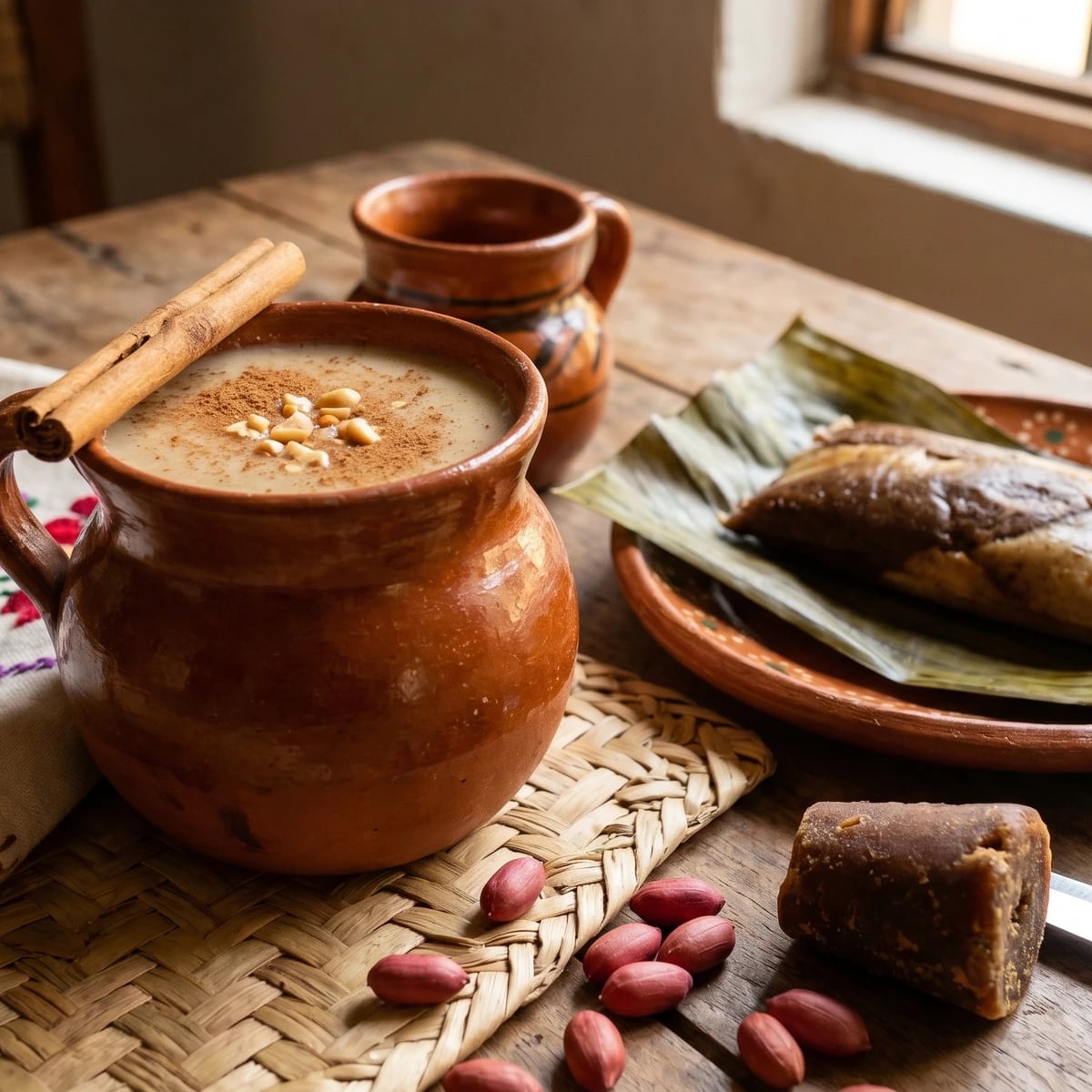
A Oaxacan breakfast atole from the Mixteca, built on comal-toasted peanuts ground silky with masa and sweetened with piloncillo and canela. The cup that warms a cold morning in the sierra.

Beverages
Mexican
Weeknight
Comfort Food
15 min
Active Time
35 min cook50 min total
Yield6 servings

This atole is from Oaxaca. Specifically from the Mixteca and the Sierra Norte, where the mornings are cold, the markets open before sunrise, and the women set up their cazos of atole next to the tamal sellers before the first bus pulls in.

Atole de cacahuate is not as famous as champurrado or atole de elote, and that is exactly the problem. Oaxaca has a dozen atoles, almost none of them known outside the state, and this one belongs in any honest accounting of the cuisine. The peanut is toasted on a comal until the skins flake and the oils release. Then it is ground fine with masa. The masa is what makes it atole and not horchata. No me vengas con atajos. If you skip the masa and just blend peanuts with milk, you have made a peanut drink. You have not made atole.

The sweetener is piloncillo, the unrefined cane sugar pressed into dark cones, sold in every mercado in Mexico. White sugar will work and it will taste like nothing. Piloncillo gives you the smoky molasses depth that ties the peanut to the canela and makes the cup taste like an Oaxacan morning. My mother kept piloncillo in a clay jar on the counter and she would shave it with a knife when she needed it. I do the same. Cada estado, su propia cocina, and this cup belongs to Oaxaca.

Atole, from the Nahuatl 'atolli,' is one of the oldest continuously prepared dishes in Mesoamerica, a corn-thickened drink that predates the conquest by at least two thousand years and was central to daily nutrition and ceremonial offering among the Zapotec, Mixtec, and Mexica peoples. The peanut, native to South America, traveled north through pre-Columbian trade networks and was naturalized in Oaxaca's Mixteca region long before European contact, where it was incorporated into atoles, salsas, and moles. The piloncillo and canela that round out the modern version are colonial-era additions: cane sugar arrived with the Spanish in the 16th century, and Ceylon cinnamon came through the Manila galleon trade, making this cup a quiet record of three continents settling into one Oaxacan breakfast.

The technique, the tradition, and the story behind every dish.

Discover Culinary Explorer

Ingredients

raw shelled peanuts, skins on

Quantity

1 cup

masa harina

Quantity

1/2 cup

preferably nixtamalized, like Maseca for tortillas

water

Quantity

6 cups

divided

Mexican canela

Quantity

1 stick (about 4 inches)

piloncillo

Quantity

3/4 cup

chopped, or 3/4 cup dark brown sugar packed

kosher salt

Quantity

1/2 teaspoon

whole milk

Quantity

1 cup

pure vanilla extract (optional)

Quantity

1 teaspoon

Mexican vanilla if you have it

Equipment Needed

  • Cast iron comal or heavy skillet for toasting
  • High-powered blender
  • Heavy 4-quart pot
  • Wooden spoon or whisk
  • Small clay jarros for serving

Instructions

  1. 1

    Toast the peanuts

    Heat a dry comal or heavy skillet over medium. Add the peanuts in a single layer and toast them, shaking the pan often, for 8 to 10 minutes. The skins will darken and start to flake. The kitchen will smell like a market stand in Tlaxiaco. Pull them off the heat the moment they turn the color of a worn copper pot. Burned peanuts make a bitter atole and there is no fixing it later.

    Do not skip the skins. The skins carry color and depth. The senoras in the Mixteca leave them on and so do you.
  2. 2

    Grind the peanuts

    Let the toasted peanuts cool for five minutes. Transfer them to a blender with 2 cups of the water. Blend on high for two full minutes, until you have a thick beige cream with no visible peanut pieces. Stop and scrape down the sides if you need to. The smoother you blend, the silkier the finished atole. A grainy peanut means a grainy atole.

  3. 3

    Dissolve the masa

    In a separate bowl, whisk the masa harina with 2 cups of cold water until completely smooth, with no lumps. Cold water, not warm. Warm water clumps the masa and you will fight those lumps for the rest of the cooking. The mixture should look like thin pancake batter.

  4. 4

    Build the pot

    Pour the remaining 2 cups of water into a heavy 4-quart pot. Add the canela stick, the piloncillo, and the salt. Bring to a gentle simmer over medium heat, stirring until the piloncillo dissolves completely. The piloncillo gives this atole the smoky molasses depth that white sugar cannot. La manteca es el sabor in some kitchens, the piloncillo is the alma in this one.

  5. 5

    Combine and thicken

    Lower the heat to medium-low. Pour the blended peanut cream into the pot, then whisk in the masa slurry. Whisk constantly. The atole will thicken in 8 to 12 minutes as the masa cooks out. You are looking for the consistency of warm cream, thick enough to coat the back of a wooden spoon but still pourable. If it gets too thick, thin it with a splash of hot water.

  6. 6

    Finish with milk

    Stir in the whole milk and the vanilla if using. Cook for 3 more minutes, just to warm the milk through and let the flavors marry. Do not boil hard once the milk is in. Taste it now. The salt should not be loud, but it should be there. Without salt, the peanut tastes flat and the piloncillo tastes one-note.

    If you want this richer, the way some cooks in the Sierra Norte make it on a cold morning, swap half the water at the end for more milk. If you want it lighter, leave the milk out entirely. Both are honest.
  7. 7

    Serve in jarros

    Fish out the canela stick. Ladle the atole into clay jarros, the small ones. The clay holds the heat and adds a faint earthy note that a glass mug will never give you. Serve immediately, with pan dulce or a fresh tamal de mole on the side. Asi se hace y punto.

Chef Tips

  • Buy raw peanuts with the skins on, not the salted cocktail kind. The skins carry color and a faint bitterness that balances the piloncillo. If your peanut vendor only sells them blanched, you can still make this, but the atole will read paler and sweeter than it should.
  • Piloncillo is non-negotiable if you want the real thing. Look for the dark cones in any tienda mexicana. Brown sugar is a compromise, not an upgrade. It gives you sweetness without the smoke.
  • Atole thickens as it sits and cools. If you are reheating leftovers, add a splash of hot water or milk and whisk hard. It will come back.

Advance Preparation

  • The peanuts can be toasted and ground with the water up to one day ahead. Refrigerate the peanut cream and whisk it back together before using.
  • Atole is best the moment it is made. Leftovers keep refrigerated for two days but the texture tightens. Thin with hot water or milk when reheating, and reheat gently over low heat, whisking constantly.

Frequently Asked Questions

Nutrition Information

1 serving (about 300g)

Calories
295 calories
Total Fat
13 g
Saturated Fat
3 g
Trans Fat
0 g
Unsaturated Fat
10 g
Cholesterol
5 mg
Sodium
200 mg
Total Carbohydrates
38 g
Dietary Fiber
3 g
Sugars
25 g
Protein
7 g

Note: Chef personas and recipes are created with AI assistance. Cook with care: follow safe food-handling practices, check doneness with a thermometer when needed, and adapt for allergies and your kitchen.

Where cooking meets culture.

Culinary guides, cultural storytelling, and the editorial depth that makes cooking meaningful.

Discover Culinary Explorer

More from Oaxacan Beverages

Browse the full collection