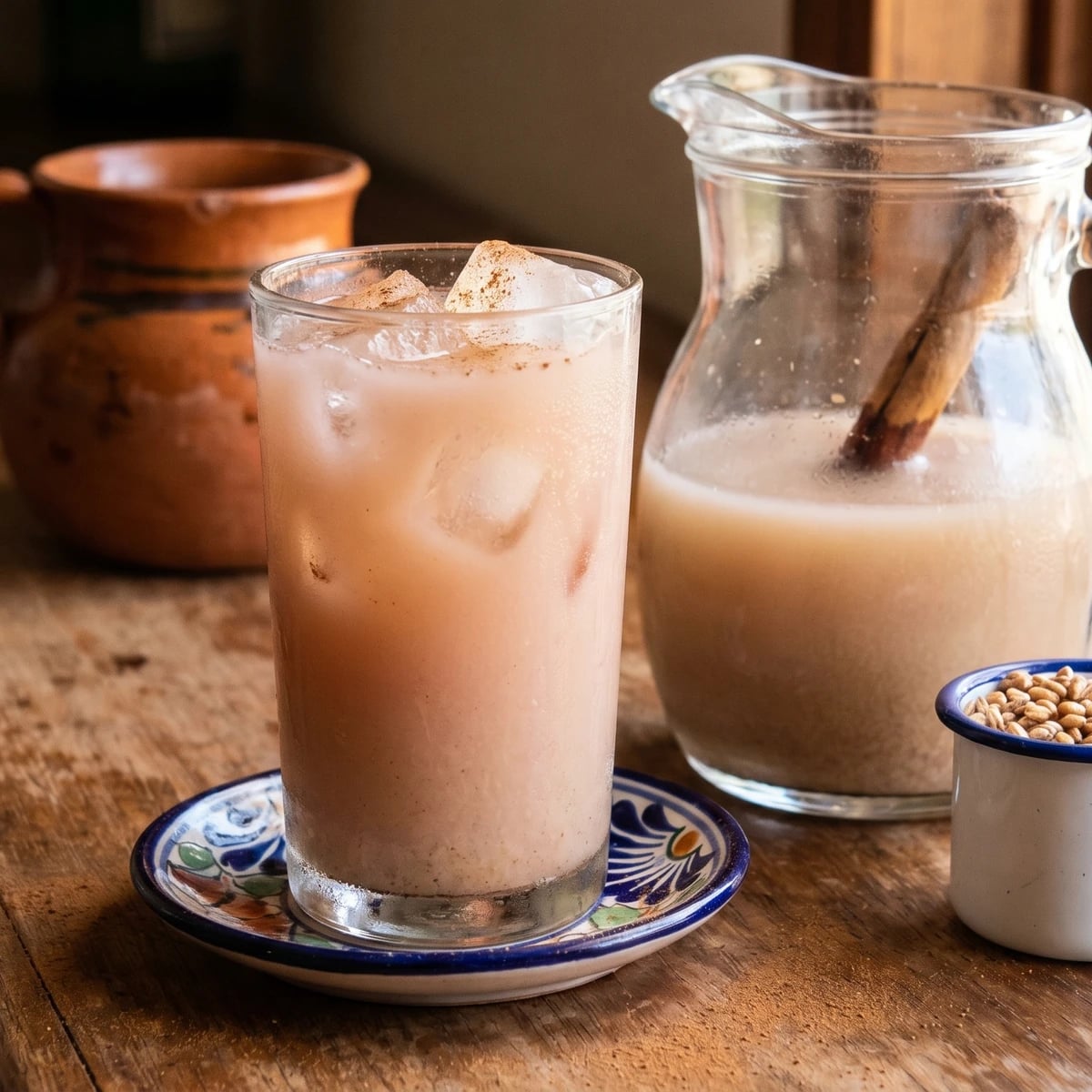
Sonora and Sinaloa's creamy malted barley water, built on toasted cebada perla, Mexican canela, vanilla from Papantla, and evaporated milk. Pink-beige, rich, and served cold over heavy ice in a heavy glass tumbler. Liquid cookie comfort the northwest way.
Beverages
Mexican
Outdoor Dining
BBQ
Weeknight
15 min
Active Time
25 min cook•8 hr 40 min total
Yield8 servings (about 2.5 liters)
Agua de cebada belongs to the northwest. Sonora and Sinaloa, principally, with cousins in Baja California and pockets of Chihuahua. This is wheat tortilla country, dairy country, ranchero country. The agua frescas of the rest of Mexico tend toward fruit and water, jamaica, tamarindo, horchata thinned with water. The northwest version of cebada is different. It is creamy. It is rich. It carries milk without apology. Esto no es comida de un solo Mexico.
The color is the giveaway. A proper agua de cebada sonorense pours pink-beige, the shade of a sand dune at dusk. That color comes from two places: the deep toast on the barley and the evaporated milk that finishes the drink. La leche evaporada is not a shortcut. It is the ingredient. Norteño cooks have built this drink on evaporated milk since the dairy industries of the Sonoran and Sinaloan valleys grew through the early twentieth century, and trying to make it with almond milk or oat milk gives you a drink, but not this drink.
I collected three versions of agua de cebada on my Sonora trip in 2019, from a senora in Magdalena de Kino, from a marisqueria in Guaymas where they served it alongside aguachile, and from a panaderia in Hermosillo that sold it by the liter in repurposed milk jugs. They argued about the canela. They argued about the vanilla. They all agreed on the toast and the evaporated milk. Those are the bones. Everything else is the cook's hand. Cada estado, su propia cocina, and this one belongs to the desert and the coast.
Barley arrived in Mexico with the Spanish in the 16th century and never displaced corn or wheat as a primary grain, but it found a foothold in the northwestern states where Jesuit missions in 17th and 18th century Sonora cultivated it alongside wheat for use in breads, soups, and fermented drinks. Agua de cebada as a sweet cold beverage developed in the late 19th and early 20th centuries when the Sonoran and Sinaloan dairy industries expanded under Porfirian-era agricultural modernization and evaporated milk became a pantry staple in northwestern homes. The drink remains a regional signature, rarely found south of Jalisco, and its survival is closely tied to home cooks and family-run aguas frescas stands rather than commercial production; it has resisted the bottling and industrialization that horchata and jamaica long ago accepted.
The technique, the tradition, and the story behind every dish.
rinsed under cold water until the water runs clear
cold water
Quantity
8 cups, plus more for soaking
Mexican canela (Ceylon cinnamon)
Quantity
1 stick, about 4 inches
evaporated milk
Quantity
1 can (12 ounces)
whole milk
Quantity
1 cup
granulated sugar
Quantity
3/4 cup, plus more to taste
Mexican vanilla extract
Quantity
1 tablespoon
from Papantla or San Jose de Acateno, not imitation
fine sea salt
Quantity
1/4 teaspoon
ground Mexican canela (optional)
Quantity
1 pinch
for finishing
heavy ice cubes
Quantity
for serving
Ingredient
Quantity
pearled barley (cebada perla)rinsed under cold water until the water runs clear
1 cup
cold water
8 cups, plus more for soaking
Mexican canela (Ceylon cinnamon)
1 stick, about 4 inches
evaporated milk
1 can (12 ounces)
whole milk
1 cup
granulated sugar
3/4 cup, plus more to taste
Mexican vanilla extractfrom Papantla or San Jose de Acateno, not imitation
1 tablespoon
fine sea salt
1/4 teaspoon
ground Mexican canela (optional)for finishing
1 pinch
heavy ice cubes
for serving
Equipment Needed
•Cast iron comal or heavy dry skillet for toasting the barley
•Heavy 4-quart pot for simmering
•High-powered blender
•Fine-mesh strainer
•Clean cotton manta or two layers of cheesecloth
•Large glass jarra or 3-quart pitcher
•Heavy glass tumblers (vaso jarocho) for serving
Instructions
1
Toast the barley
Heat a dry comal or heavy skillet over medium. Add the rinsed barley and spread it in a single layer. Toast for 8 to 10 minutes, shaking the pan often, until the grains turn a deep golden color and the kitchen smells like a panaderia after the morning bake. This is the malted character that gives agua de cebada its identity. Skip the toast and you have boiled barley water. Toast it properly and you have the drink Sonora knows.
Watch for the moment the grains turn from pale beige to a warm caramel color. Past that point they scorch and the agua tastes bitter. There is no fixing burned barley.
2
Soak overnight
Transfer the toasted barley to a large bowl. Cover with cold water by three inches. Drop in the canela stick. Cover the bowl and refrigerate for at least 8 hours, preferably overnight. The grains plump and the water turns the color of weak tea. The canela steeps cold so it perfumes the water without turning aggressive. Senoras in Hermosillo do this the night before, every time. No me vengas con atajos.
3
Simmer to soften
Pour the barley, soaking water, and canela stick into a heavy pot. Add 4 more cups of fresh water. Bring to a gentle simmer over medium heat. Cook uncovered for 25 minutes, stirring now and then so the grains do not stick to the bottom. The barley should be very soft and the water should turn a pale tan. The starch the grains release is the body of the drink. That cloudy water is the recipe, not a problem to fix.
4
Cool and blend
Pull the pot off the heat. Fish out the canela stick and discard. Let the barley and its cooking water cool until you can handle it without burning yourself, about 30 minutes. Pour the whole pot, grains and all, into a blender in batches. Blend each batch on high for a full minute. The grains break down completely and the liquid turns thick and creamy. This is where the body comes from. Underblend and the texture is gritty.
5
Strain through cloth
Set a fine-mesh strainer lined with a clean cotton manta or two layers of cheesecloth over a large pitcher. Pour the blended barley through in batches, pressing on the solids with the back of a ladle to extract every drop. Discard the pulp. What you have now is the cebada base: silky, pale tan, smelling faintly of toasted grain and canela.
A second pass through the strainer makes it silkier. Sonoran cooks who serve agua de cebada in a jarra at the table strain twice. The texture is the difference between a homemade drink and one you would buy from a senora at the mercado.
6
Build the cream and sugar
Whisk the evaporated milk, whole milk, sugar, vanilla, and salt into the strained cebada base. Agua de cebada norteña takes evaporated milk. Not almond milk, not oat milk, not condensed milk. La leche evaporada is what gives this drink its signature pink-beige color and its rich, slightly malted finish. This is northwest Mexico, where the dairy is part of the cuisine and nobody apologizes for it. Asi se hace y punto.
7
Chill and adjust
Refrigerate the pitcher for at least 2 hours, preferably 4. The flavors marry as it sits. The barley starch and the canela settle in and the drink develops its proper character. Taste before serving. The sugar should read sweet but not cloying. If it tastes flat, another tablespoon of sugar or a few more drops of vanilla will bring it forward. Stir well, the cebada settles to the bottom of the pitcher and needs to be roused before pouring.
8
Serve over ice
Fill heavy glass tumblers with ice. Stir the pitcher one more time. Pour generously. Dust the surface of each glass with a pinch of ground canela. Serve immediately, while the glass is cold and the drink is cold and the pink-beige color reads exactly the way it does in every cocina sonorense at lunchtime. Saber cocinar es saber vivir.
Chef Tips
•Use pearled barley, cebada perla, not hulled barley or pot barley. Pearled barley is the standard in Mexican grocery stores and it breaks down properly in the blender. Hulled barley stays tough and the texture suffers.
•The Mexican canela, Ceylon cinnamon, is non-negotiable. Cassia cinnamon, the supermarket kind, is harsh and the bark does not soften properly during the cold soak. If you cannot find canela mexicana at a Latin grocery, order it. It keeps for years.
•Mexican vanilla from Papantla in Veracruz is the standard. Imitation vanilla destroys this drink. A bottle of real Mexican extract costs more, but it lasts forever and the difference is on every sip.
•Do not skip the overnight soak. The grains need cold time with the canela to develop their flavor. Trying to push through the same day gives you barley water with cinnamon, not agua de cebada. La cocina no es decoracion, es trabajo.
•If you want it richer, replace the cup of whole milk with another half can of evaporated. If you want it lighter, hold back a quarter cup of the evaporated and add cold water at serving. The base recipe is the Hermosillo middle, neither thin nor heavy.
Advance Preparation
•The toasted barley can be made up to one week ahead and stored in a sealed jar at room temperature. Toasting a double batch at once saves time on the next round.
•The finished agua de cebada keeps refrigerated for 3 days in a covered pitcher. Stir well before each pour, the barley starch settles to the bottom and the drink needs to be roused.
•Do not freeze. The dairy separates and the texture is ruined past the point of recovery.
Frequently Asked Questions
Nutrition Information
1 serving (about 310g)
Calories
185 calories
Total Fat
4 g
Saturated Fat
3 g
Trans Fat
0 g
Unsaturated Fat
1 g
Cholesterol
16 mg
Sodium
125 mg
Total Carbohydrates
31 g
Dietary Fiber
1 g
Sugars
25 g
Protein
5 g
Where cooking meets culture.
Culinary guides, cultural storytelling, and the editorial depth that makes cooking meaningful.