
Chef Lupita
Agua de Chaya con Piña
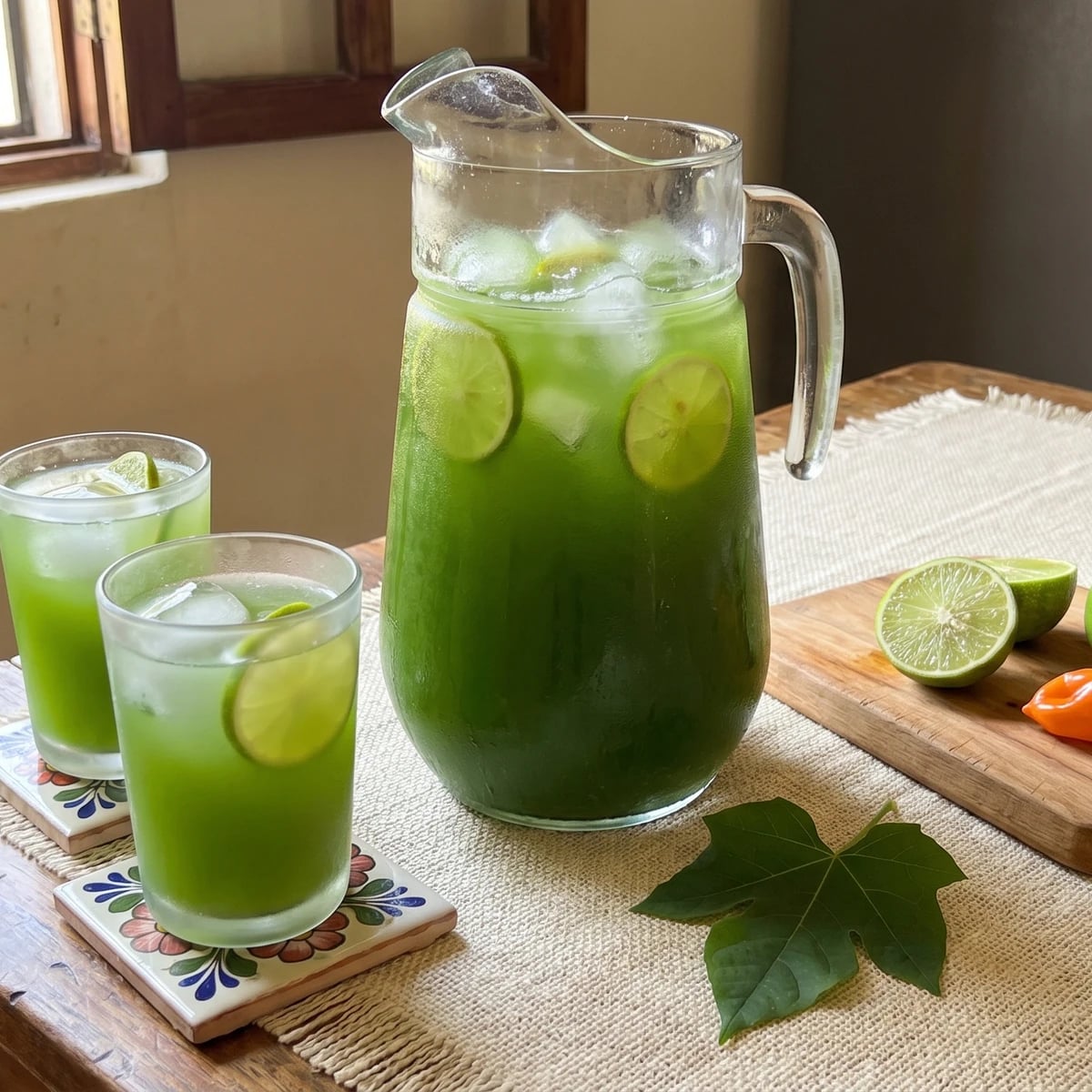
Yucatán's signature green agua fresca, chaya leaves blanched and blended with ripe pineapple and lima agria, served ice-cold from a sweating glass jarra against the Mérida heat.
A cooking platform built around craft, culture, and the stories behind what we eat.
Created by
Yucatán's everyday tonic of boiled chaya leaves blended with lima agria, sugar, and ice. The bright green jarra that sits on every Peninsula table from Mérida to Valladolid.
Chaya is a Yucatán plant. Not a Mexican plant in the abstract sense, a Yucatán one. The Maya cultivated it for centuries before the Spanish arrived, planted it in their solares, and used the leaves for everything from soup to medicine. The plant grows in the Peninsula's calcium-rich limestone soil the way nopal grows in the Bajío. Outside Yucatán, Campeche, and Quintana Roo, most Mexicans have never tasted it. That is its own kind of tragedy.
This is the everyday agua of the Peninsula. Not horchata, not jamaica, not tamarindo. Chaya. You see it in the jarras of glass on the counters at the comida corrida in Mérida, next to a bowl of habaneros and a pile of warm tortillas. The boiled chaya gives the drink its mineral backbone, deep and herbaceous, almost vegetal in a way that surprises people who expect agua fresca to taste like fruit. The lima agria, the sour lime of the Peninsula with its bitter peel oil, cuts through the green with a sharpness no Persian lime can imitate. Together they make a drink that does what the climate demands: cools you down, replaces what the heat took out of you, and tastes like nowhere else.
A warning that is not a warning, just a fact. Chaya leaves must be boiled. The raw leaf contains hydrocyanic compounds that the heat neutralizes. The señoras in the Mérida mercados will tell you this without ceremony, the way they tell you not to use an aluminum pot. Boil the chaya ten minutes. Use stainless steel or clay. Do not drink it raw. After that, the leaf is one of the most nutritious greens grown in Mexico and the base of one of the Peninsula's quietest, most distinctive contributions to the table. Cada estado, su propia cocina, and chaya belongs to Yucatán.
Chaya (Cnidoscolus aconitifolius), known to the Maya as 'chay' or 'tree spinach,' has been cultivated on the Yucatán Peninsula for at least 1,500 years and appears in the Madrid Codex among the plants tied to Maya household gardens. The Spanish chroniclers of the 16th century, including Fray Diego de Landa, noted its use in soups and tonics but never exported it the way they did chocolate or vanilla, which is part of why chaya remained a regional ingredient even within Mexico. The lima agria (Citrus × aurantiifolia 'Mexicana' in its Yucatecan form, sometimes called lima de Castilla in the Peninsula) is itself a regional citrus shaped by the limestone soil and humid climate, and the pairing of chaya with lima agria in agua form is a postcolonial creation that joined a pre-Columbian leaf to a Spanish-introduced fruit on Yucatecan terms.
Quantity
15 to 20 (about 2 packed cups)
stems trimmed
Quantity
8 cups
divided
Quantity
3/4 cup (about 6 to 8 lima agrias)
Quantity
3/4 cup, plus more to taste
Quantity
1 pinch
Quantity
for serving
Quantity
for garnish
Quantity
for garnish
| Ingredient | Quantity |
|---|---|
| fresh chaya leavesstems trimmed | 15 to 20 (about 2 packed cups) |
| waterdivided | 8 cups |
| fresh lima agria juice | 3/4 cup (about 6 to 8 lima agrias) |
| granulated sugar | 3/4 cup, plus more to taste |
| fine sea salt | 1 pinch |
| ice | for serving |
| lima agria slices (optional) | for garnish |
| chaya leaf (optional) | for garnish |
Chaya is not spinach. The raw leaf contains hydrocyanic compounds and must be cooked before you drink it. Rinse the leaves under cold water. Trim the thicker stems. Do not tear the leaves with your bare hands if your skin is sensitive; the fine hairs on the underside can irritate. The women in Yucatán handle them by the stem or with a cloth. Así se hace.
Bring 4 cups of the water to a rolling boil in a stainless steel or enamel pot. Drop in the chaya leaves and boil for a full 10 minutes. Not five. Not eight. Ten. The water will turn a deep grass-green and the leaves will soften and darken. This boil is non-negotiable, it neutralizes the cyanogenic glycosides and unlocks the mineral flavor of the leaf.
Pull the pot off the heat. Let the chaya and its cooking water cool to room temperature, about 20 minutes. Do not drain the leaves. The cooking water carries the chlorophyll and the minerals. That green liquid is the base of the agua. Throw it out and you have thrown out the drink.
Pour the cooled chaya and all of its cooking water into a blender. Add the sugar and the pinch of salt. Blend on high for a full minute until the leaves are pulverized and the liquid is uniformly bright green. The salt is not optional, it sharpens the lime and rounds the grassiness of the chaya. A pinch only. You are not seasoning soup.
Pour the blended chaya through a fine-mesh strainer into a 2-liter glass jarra. Press on the solids with the back of a spoon to extract every drop of green liquid. Discard the spent leaves. Stir in the remaining 4 cups of cold water and the lima agria juice. The color should be a clear, vivid green, somewhere between jade and chartreuse.
Taste the agua. Lima agria is sharper and more floral than regular lime, with a bitter edge from the peel oils that ends up in the juice. The agua should be bracing, slightly sweet, with the lime forward and the chaya as the herbaceous backbone. Add more sugar by the tablespoon if it is too sharp. Add more lime if it is flat. Recetas probadas y garantizadas, but the lima agria you find today will not taste exactly like the one you found last week. Adjust.
Refrigerate the jarra for at least 30 minutes before serving. Fill tall glasses with plenty of ice. Pour the agua over the ice. Drop a slice of lima agria into each glass. The drink should sweat the moment it leaves the refrigerator. In Mérida, this is what sits on the table at the comida corrida from one in the afternoon until the dishes are cleared. Saber cocinar es saber vivir.
1 serving (about 250g)
Culinary guides, cultural storytelling, and the editorial depth that makes cooking meaningful.
Discover Culinary Explorer
Chef Lupita
Yucatán's signature green agua fresca, chaya leaves blanched and blended with ripe pineapple and lima agria, served ice-cold from a sweating glass jarra against the Mérida heat.

Chef Lupita
Yucatán's hibiscus agua, flor de jamaica steeped off the heat with canela and pimienta gorda, sweetened with piloncillo, and chilled until the deep ruby color is the most-poured drink on the Peninsula.

Chef Lupita
The Peninsula's floral sour-lime refresher, juiced cold and perfumed with a single strip of peel. The aroma is what makes it Yucatecan, and a Persian lime will not get you there.

Chef Lupita
Yucatán's summer agua fresca, made from cactus-fruit pitaya, cold water, lima agria, and just enough sugar to lift the magenta pulp. The drink that turns Mérida's afternoon heat bearable.