
Chef Lupita
Agua de Chaya con Limón
Yucatán's everyday tonic of boiled chaya leaves blended with lima agria, sugar, and ice. The bright green jarra that sits on every Peninsula table from Mérida to Valladolid.
A cooking platform built around craft, culture, and the stories behind what we eat.
Created by
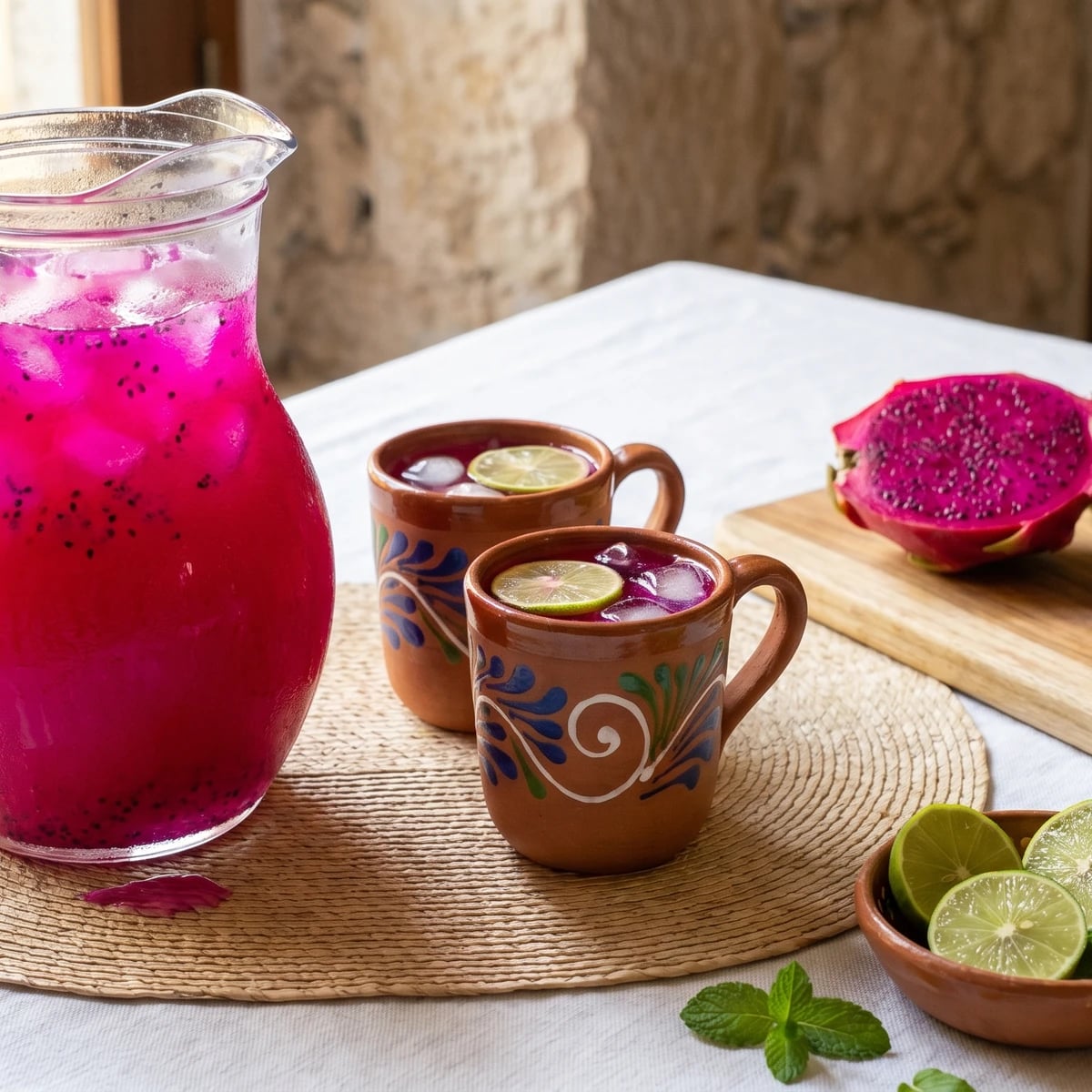
Yucatán's summer agua fresca, made from cactus-fruit pitaya, cold water, lima agria, and just enough sugar to lift the magenta pulp. The drink that turns Mérida's afternoon heat bearable.
This is from Yucatán. The pitaya that makes it is not the Asian dragon fruit you see in supermarket displays. It is the fruit of the pitahaya cactus that grows wild and cultivated across the peninsula, magenta-fleshed, full of tiny black seeds, in season from late May through August and then gone until next year.
You will see this agua in every sorbetería and lonchería from Mérida to Valladolid during the summer months. It sits in tall glass jarras on the counter, neon-pink against the white tile, sweating in the heat. The women who make it do not measure. They scoop the pulp, they pour the water, they squeeze the lima agria that grows in their own patios, and they sweeten it just enough to bring the fruit forward without burying it. The lima agria is the detail that makes this Yucateco and not generic. Regular lime is sharper and one-note. Lima agria is fragrant, almost floral, with a bitter edge that the fruit needs to balance the sweetness.
My mother did not make this. She was from Jalisco and pitaya did not grow there the same way. I learned this agua from a woman named Doña Ofelia who has run a juice stand inside the Mercado Lucas de Galvez in Mérida for over forty years. She told me two things and made me write them down: do not strain the seeds, and do not over-sweeten. The fruit is the show. Everything else is support. Recetas probadas y garantizadas.
If you cannot find pitaya right now because it is not the season, do not make this. Make agua de jamaica or agua de tamarindo instead. Mexican grandmothers cook with what the mercado is selling today.
The pitaya, fruit of the Stenocereus and Hylocereus cactus species, is native to Mexico and Central America and was cultivated by the Maya long before the Spanish arrived in the Yucatán Peninsula in the 16th century. Aguas frescas as a category emerged from the pre-Columbian practice of mixing seasonal fruit pulp with water in clay vessels, a method documented in Aztec and Mayan codices, and refined after the introduction of cane sugar by the Spanish. Yucatán's particular use of the lima agria, a citrus introduced from the Persian Gulf via Spanish colonial trade routes and grown extensively in the peninsula's limestone soil, distinguishes its aguas frescas from those of central and northern Mexico, where regular lime or no acid at all is more typical.
Quantity
3 (about 1.5 pounds total)
preferably the magenta-fleshed variety from the Yucatán Peninsula
Quantity
8 cups, divided
Quantity
1/2 cup, plus more to taste
Quantity
1/4 cup (about 3 to 4 limas agrias)
or substitute a mix of fresh lime and orange juice
Quantity
1 pinch
Quantity
for serving
Quantity
for serving
Quantity
a few, for serving
| Ingredient | Quantity |
|---|---|
| ripe pitayas (dragon fruit)preferably the magenta-fleshed variety from the Yucatán Peninsula | 3 (about 1.5 pounds total) |
| cold water | 8 cups, divided |
| granulated sugar | 1/2 cup, plus more to taste |
| fresh lima agria juiceor substitute a mix of fresh lime and orange juice | 1/4 cup (about 3 to 4 limas agrias) |
| fine sea salt | 1 pinch |
| ice (optional) | for serving |
| thin slices of lima agria (optional) | for serving |
| fresh mint leaves (optional) | a few, for serving |
Pick fruit that gives slightly when you press it, with skin that is bright magenta and leaves at the tip that are starting to dry but not blackened. A hard pitaya is an unripe pitaya and the agua will taste like nothing. In Mérida, the women at the Lucas de Galvez market will press each one before they hand it to you. Do the same. If the fruit is rock-hard, leave it on the counter for two days and try again.
Cut each pitaya in half lengthwise. With a large spoon, scoop the magenta flesh away from the skin in one piece. Drop the pulp into the blender. Save the empty skins on the side; they make a beautiful serving vessel for the table if you want to use them. Do not strain the tiny black seeds. They belong in the agua. They give it that fine specked texture that tells anyone drinking it that this came from real fruit and not a powder.
Add the pulp, four cups of the cold water, and the sugar to the blender. Blend on medium for about 20 seconds. Not longer. You want to break the pulp open and dissolve the sugar, not pulverize the seeds. If you blend too hard the seeds crack and the agua turns slightly bitter. Short pulses. La cocina no es decoración, es trabajo, but it is also knowing when to stop the machine.
Pour the blended base into a large glass jarra or pitcher. Add the remaining four cups of cold water and stir. Add the lima agria juice and the pinch of salt. The salt is not a flavor you will taste. It lifts the fruit and rounds the lima. Taste. If your pitayas were perfectly ripe you may need less sugar. If they were closer to the edge of the season you may need a tablespoon more. Adjust now.
Refrigerate the jarra for at least 30 minutes before serving. Agua de pitaya needs to be very cold. Mérida sits at sea level in tropical heat and a lukewarm agua fresca is an insult to the cook. Serve in tall glasses over plenty of ice with a thin slice of lima agria floating at the top. Stir each glass before drinking. The pulp settles fast. Así se hace y punto.
1 serving (about 390g)
Culinary guides, cultural storytelling, and the editorial depth that makes cooking meaningful.
Discover Culinary Explorer
Chef Lupita
Yucatán's everyday tonic of boiled chaya leaves blended with lima agria, sugar, and ice. The bright green jarra that sits on every Peninsula table from Mérida to Valladolid.

Chef Lupita
Yucatán's signature green agua fresca, chaya leaves blanched and blended with ripe pineapple and lima agria, served ice-cold from a sweating glass jarra against the Mérida heat.

Chef Lupita
Yucatán's hibiscus agua, flor de jamaica steeped off the heat with canela and pimienta gorda, sweetened with piloncillo, and chilled until the deep ruby color is the most-poured drink on the Peninsula.

Chef Lupita
The Peninsula's floral sour-lime refresher, juiced cold and perfumed with a single strip of peel. The aroma is what makes it Yucatecan, and a Persian lime will not get you there.