
Chef Juliette
Smelt (Éperlans)
Tiny éperlans, lightly floured and fried until their tails stand crisp, arrive in a generous heap on a napkin with fried parsley and grooved lemon, a weeknight lesson in heat and restraint.
A cooking platform built around craft, culture, and the stories behind what we eat.
Created by Chef Juliette
Based on No. 998, Barquettes de Laitances à la Florentine, from Le Guide Culinaire (1907) by Auguste Escoffier
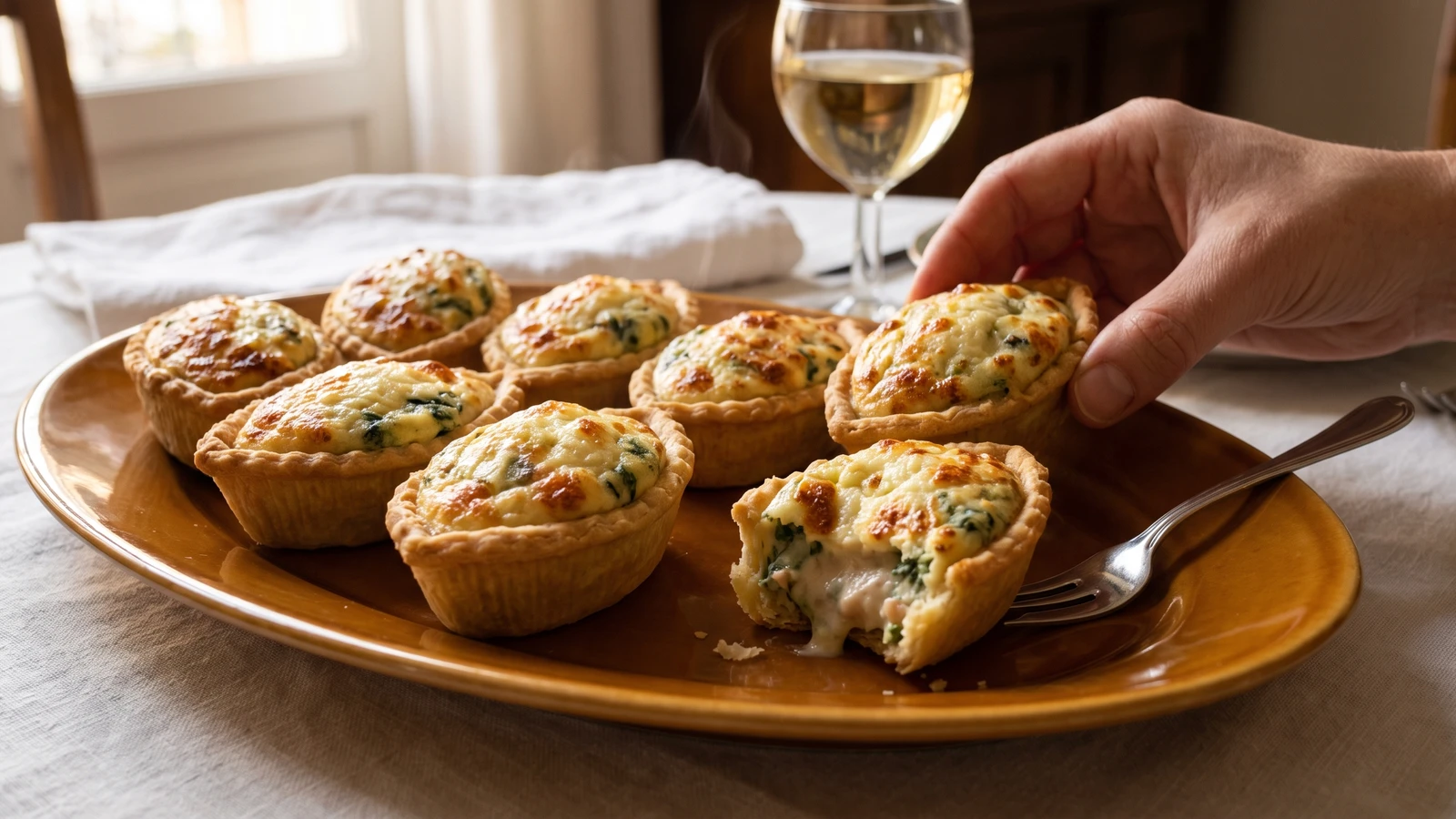
Eight crisp pastry boats carry tender slices of poached milt beneath domed Parmesan soufflé. Pastry and topping finish in one oven moment, a small hot hors d'oeuvre built on timing rather than display.
Barquettes de Laitances à la Florentine (pastry boats of fish milt with Parmesan soufflé) teach coordination. Cold, thin pastry, milt poached just until set, and a fresh soufflé crown must meet the oven together. The one true thing to know before touching a pan is this: warm or wet filling steals lift from the soufflé and crispness from the pastry, so the laitances must be cool and thoroughly dry.
The original assumed a pastry hand supplying Barquettes (No. 314), an entremetier with a large batch of Soufflé au Parmesan (No. 2295a), and an oven watched throughout service. A saucier, a stockpot never off the fire, and a salamander belong elsewhere in the brigade; this entry calls for none of them. At home, eight small molds, a preheated baking sheet, and one cup of the same soufflé mixture do the work. The volume is reduced, not the ratios or sequence. The folded serving napkin was brigade presentation scaffolding and can go; the gentle poach, cold raw shells, fresh soufflé, and simultaneous bake are the dish and must stay. One cook, one stove, one evening.
When the barquettes are right, the pastry is butter-gold underneath, the laitances remain delicate, and each Parmesan dome stands bronzed and lightly glazed. Crown them without pressing out the air, then move them directly into the oven. That immediate passage from bowl to heat is the step that matters most.
These barquettes belong to the Parisian grand-kitchen table of hot hors d'oeuvres, where small pastry croustades carried delicate garnishes from the pastry station to the dining room. Laitances are the soft roe, or milt, of male fish, valued as seasonal market produce for their mild flavor and custard-like tenderness. The title is a revealing exception to French menu grammar: à la florentine ordinarily signals spinach, but this particular formula specifies Parmesan soufflé alone, so adding spinach would rewrite the dish rather than complete it.
Quantity
6 oz (170 g)
rinsed, with any dark veins carefully trimmed
Quantity
4 cups (950 ml / 950 g)
Quantity
1 tablespoon (15 ml / 18 g)
Quantity
8 Barquettes (No. 314), each about 3 inches (7.5 cm)
formed in their molds, unbaked and thoroughly chilled
Quantity
1 cup (240 ml / 220 g) Soufflé au Parmesan (No. 2295a)
unbaked
| Ingredient | Quantity |
|---|---|
| fresh fish milt sacs (laitances), preferably cod or carprinsed, with any dark veins carefully trimmed | 6 oz (170 g) |
| cold water | 4 cups (950 ml / 950 g) |
| fine sea salt | 1 tablespoon (15 ml / 18 g) |
| prepared pastry boatsformed in their molds, unbaked and thoroughly chilled | 8 Barquettes (No. 314), each about 3 inches (7.5 cm) |
| freshly prepared Parmesan soufflé mixtureunbaked | 1 cup (240 ml / 220 g) Soufflé au Parmesan (No. 2295a) |
Combine the cold water and salt in a shallow saucepan and bring it just to a simmer. Lower in the laitances with a slotted spoon, keeping their fine outer membranes intact, then reduce the heat until the water barely trembles. Poach for 6 to 8 minutes, turning once, until the sacs are opaque, gently springy, and reach 145°F (63°C) at the center. Boiling makes them grainy and can split their membranes, so pull the pan off the heat for thirty seconds if the water surges. If a sac does break, don't discard it. Ça se rattrape: collect the pieces gently, chill them, and arrange them compactly in the shells.
Lift the laitances onto a plate lined with a clean towel. Let them cool for 5 minutes, then refrigerate for about 15 minutes, just until firm enough to cut cleanly. Remove any loose outer membrane, pat every surface dry, and cut the sacs lengthwise into small, narrow slices about 1/4 inch (6 mm) thick. If they crumble beneath the knife, they are still too warm; chill them for another 10 minutes and begin again with a thin, sharp blade.
Set a rack in the lower-middle of the oven and place a heavy rimmed baking sheet on it. Heat the oven to 375°F (190°C), or 340°F (170°C) with a fan, for at least 20 minutes. The hot sheet is the home equivalent of a well-managed pastry oven: it gives the raw shells immediate heat underneath while the soufflé sets above.
Keep the chilled, unbaked Barquettes (No. 314) in their molds. Divide the sliced laitances among them in one snug layer, laying the pieces lengthwise and leaving the pastry rim clear. Don't mound the filling above the edge; the soufflé needs that space. If moisture beads on the slices, lift them out and pat them dry again before filling. Wet laitances turn the pastry beneath them to paste.
Work immediately with the freshly prepared Soufflé au Parmesan (No. 2295a). Spoon about 2 tablespoons over each filled shell and shape it into a modest dome with one light pass of the spoon. Don't smooth or press it repeatedly, since every stroke removes air the oven cannot replace. If one dome slumps, set a fresh spoonful lightly on top and leave it alone; it may rise less proudly, but it will remain tender.
Set the filled molds on the preheated baking sheet and bake for 18 to 22 minutes. Keep the oven door closed for the first 12 minutes. The barquettes are ready when the pastry rims and undersides are deep gold, while the soufflé domes are risen, set at the edges, and mottled with Parmesan bronze. If the tops color before the pastry is cooked, shield them loosely with foil and continue baking. If the pastry is crisp but the domes remain pale, give them 20 to 30 seconds beneath the broiler, watching without looking away. That brief finish is the home salamander, used for rescue only.
Rest the barquettes for 1 minute, no longer, then loosen only where necessary with the tip of a small knife and lift them carefully from their molds. Arrange them on a warm, dry platter without the old folded napkin, which can trap moisture beneath the pastry at a home table. Carry them out immediately, while the crust is crisp and the soufflé still holds its dome. À table!
1 serving (about 110g)
Culinary guides, cultural storytelling, and the editorial depth that makes cooking meaningful.
Discover Culinary ExplorerChef Juliette
Tiny éperlans, lightly floured and fried until their tails stand crisp, arrive in a generous heap on a napkin with fried parsley and grooved lemon, a weeknight lesson in heat and restraint.

Chef Juliette
Brandade de Morue turns salt cod, warm olive oil, and milk into a pale, silky emulsion: keep everything warm and add the oil slowly, then crown the generous dome with butter-fried bread.

Chef Juliette
Salt cod worked warm with cream, one patient spoonful at a time, until the rough flakes become a glossy Nîmes paste, domed generously and ringed with butter-fried croutons for the table.

Chef Juliette
Wine-poached char packed in its earthenware crock beneath butter gold: a make-ahead first course that turns careful cooling, thorough boning, and one unbroken seal into quiet abundance.