Chef Juliette
Bouillabaisse à la Marseillaise
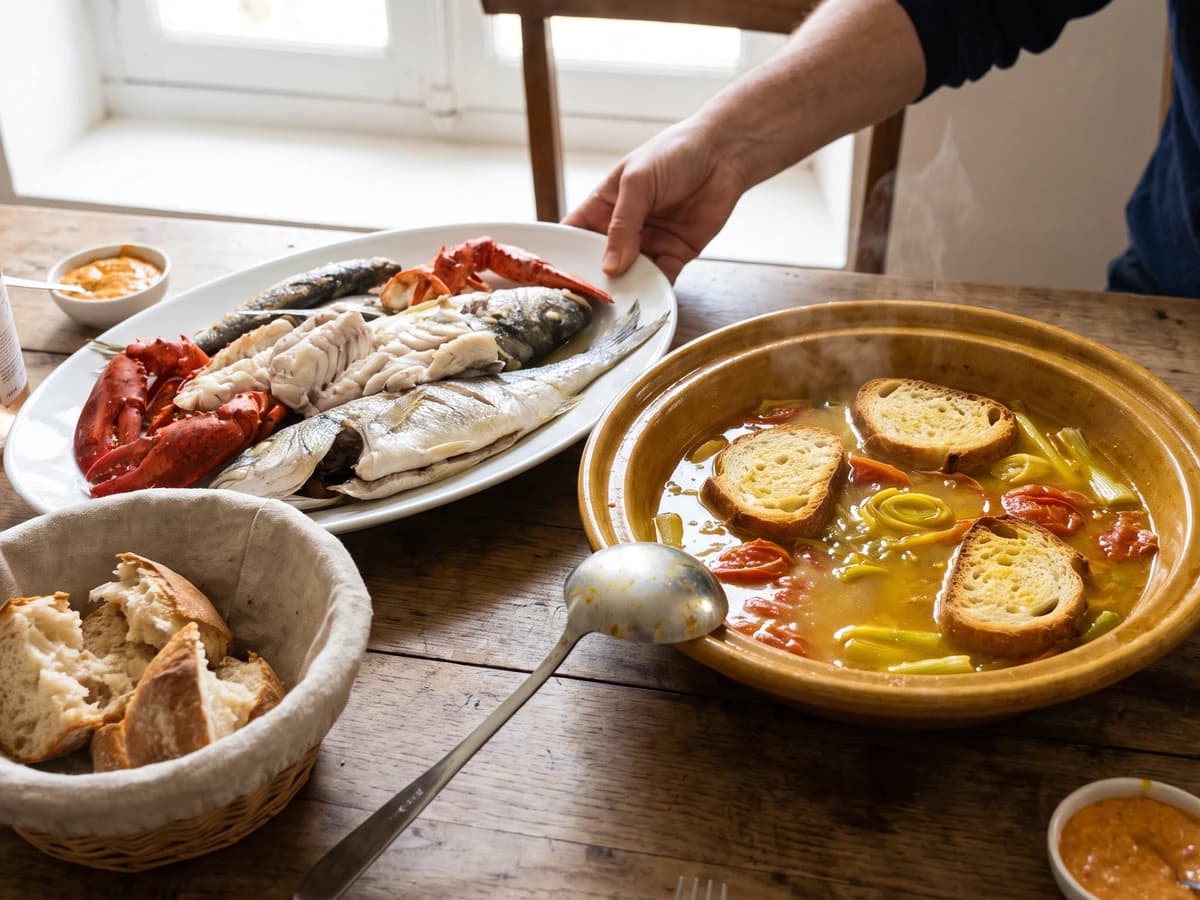
Marseille's great fish stew, saffron-gold and garlic-scented, proves that a hard boil can be the careful choice: it binds olive oil into broth before the whole pot meets bread.
A cooking platform built around craft, culture, and the stories behind what we eat.
Created by Chef Juliette
Based on No. 587, Consommé Monte Carlo, from Le Guide Culinaire (1907) by Auguste Escoffier
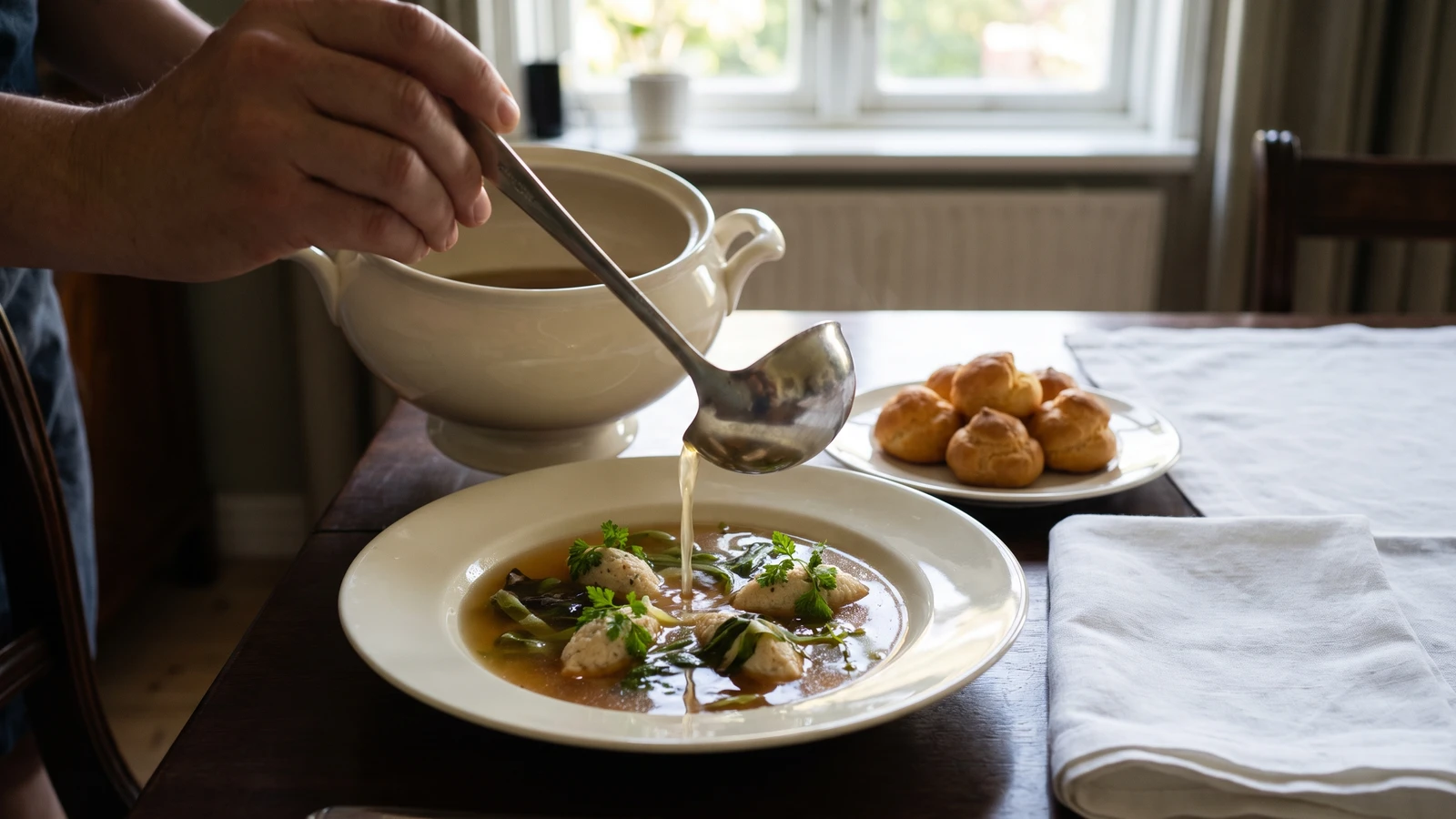
Crystal-clear consommé, tender chicken quenelles, buttered lettuce, and crisp profiterolles served apart: a lesson in protecting clarity while keeping every garnish true to its own texture.
Consommé Monte Carlo (a clarified chicken soup with chicken dumplings, buttered lettuce ribbons, and crisp choux puffs) teaches a severe little lesson: once clarity is won, every garnish must be cooked elsewhere and added without disturbing it. That is the one true thing to know before touching a pan. Quenelles bring tenderness, lettuce brings buttery green softness, and the little puffs stay dry beside the tureen so the consommé remains itself.
The original entry assumed a saucier beside a consommé pot, stock never off the fire, and a pastry station able to send hazelnut-size choux at the instant of service. A home kitchen needs one processor, one poaching pot, one saucepan, and an ordinary oven; the oven replaces the pastry station's holding heat, and no salamander is needed. Continuous brigade holding is scaffolding and goes. This batch doubles the entry's one-quart proportions into a useful two-quart tureen, keeping its ratio exactly: 60 quenelles, two lettuce hearts, and 24 little puffs. One cook, one stove, one evening.
What stays is the dish: true consommé, quenelles poached at a tremble, lettuce cisel (cut into fine ribbons) and stewed in real butter, chervil pluches, and crisp puffs served quite apart. The bowl should look like amber glass scattered with ivory and green. The step that matters most is the final pour: drain every garnish thoroughly, bring the consommé to a clean boil, and unite them only in the warmed tureen.
Consommé Monte Carlo belongs to the codified French grand-kitchen repertory rather than to a regional household soup; its name points to Monte Carlo in Monaco and the cosmopolitan hotel table that prized named consommé garnishes. The combination traveled into formal home menus because each part could be prepared ahead, while the tureen still arrived with ceremony and precision. The small puffs are served apart for a practical reason, not pomp: once they enter the broth, crispness vanishes and clarity is cluttered.
Quantity
6 ounces (170 g)
very cold and cut into ½-inch cubes
Quantity
1
very cold
Quantity
½ cup (120 ml / 120 g)
Quantity
¾ teaspoon (3.75 ml / 4.5 g)
Quantity
⅛ teaspoon (0.6 ml / 0.25 g)
Quantity
8 cups (1.9 L / 1.9 kg)
Quantity
1 tablespoon (15 ml / 18 g)
Quantity
2 hearts (about 10 ounces / 280 g) prepared as Chiffonade (No. 215)
Quantity
3 tablespoons (45 ml / 43 g)
Quantity
8 cups (1.9 L / 1.9 kg)
Quantity
24 Profiterolles for Soups (No. 218), made with Ordinary Pâte à Choux (No. 2373)
Quantity
2 tablespoons (30 ml / 4 g)
| Ingredient | Quantity |
|---|---|
| boneless, skinless chicken breastvery cold and cut into ½-inch cubes | 6 ounces (170 g) |
| large egg whitevery cold | 1 |
| cold heavy cream | ½ cup (120 ml / 120 g) |
| fine salt for the forcemeat | ¾ teaspoon (3.75 ml / 4.5 g) |
| ground white pepper | ⅛ teaspoon (0.6 ml / 0.25 g) |
| water for poaching | 8 cups (1.9 L / 1.9 kg) |
| fine salt for the poaching water | 1 tablespoon (15 ml / 18 g) |
| tender butter lettuce hearts | 2 hearts (about 10 ounces / 280 g) prepared as Chiffonade (No. 215) |
| unsalted butter | 3 tablespoons (45 ml / 43 g) |
| very clear, well-seasoned chicken consommé | 8 cups (1.9 L / 1.9 kg) |
| hazelnut-size, unfilled soup profiterolles | 24 Profiterolles for Soups (No. 218), made with Ordinary Pâte à Choux (No. 2373) |
| chervil pluches, the tender leaf shreds | 2 tablespoons (30 ml / 4 g) |
Chill the food-processor bowl and blade for ten minutes. Pulse the chicken with the salt and white pepper until finely ground and tacky. Reserve one teaspoon of the egg white, then process in the remainder until smooth. With the machine running, add the cold cream in a thin stream and stop as soon as the farce mousseline de volaille, the chicken mousseline forcemeat, looks glossy and holds a soft peak. Heat breaks this emulsion, so return it to the cold at once.
Bring the water and poaching salt to 175 to 180°F (79 to 82°C), where the surface barely trembles. Dip two teaspoons in the water and use them to shape 60 small quenelles de volaille, about one teaspoon each. Lower them into the water in batches of 12 to 15 and poach for four to five minutes, turning once, until they float and reach 165°F (74°C) at the centre. A hard boil makes them coarse and ragged. Lift them out with a slotted spoon and drain them thoroughly on a rack or clean towel.
Melt the butter in a wide sauté pan over medium-low heat without letting it colour. Add the prepared Chiffonade (No. 215), already cisel into fine, even ribbons, and turn until every strand gleams. Cover and stew gently for five minutes, then uncover and cook until supple but still green, about three minutes more. Do not brown it. If the lettuce releases a puddle, raise the heat briefly to evaporate it, then drain the chiffonade in a fine sieve; loose cooking liquid would dull the consommé.
Heat the oven to 325°F (165°C). Set the 24 Profiterolles for Soups (No. 218), made with Ordinary Pâte à Choux (No. 2373), on a baking sheet and dry them for six to eight minutes, until crisp clear through. If their centres still feel soft, switch off the oven and leave them inside for five minutes with the door slightly ajar. Keep them unfilled: this entry calls for crisp little choux served separately, and a filling would soften them.
Fill a 2½ to 3-quart soup tureen and the serving bowls with boiling water and leave them for five minutes. Drain and dry them just before assembly. This quiet bit of preparation replaces the brigade's heated service cupboard and prevents cold porcelain from stealing the consommé's heat.
Pour the chicken consommé into a clean saucepan and bring it promptly to a full boil without prolonged reduction. Do not whisk or stir sediment up from the bottom. If fat beads appear, lift them away with the edge of a clean paper towel; if suspended specks disturb the clarity, pass the consommé once through a rinsed fine cloth into another clean pan. Ça se rattrape. A fundamentally cloudy stock cannot be corrected at this final moment, so the finished consommé must begin truly clarified.
Arrange the drained chicken quenelles and buttered lettuce in the warmed tureen. Pour the boiling consommé over them in one steady stream, without stirring, then scatter in the chervil pluches. Cover the tureen and carry it straight to the table so the garnishes warm through without cooking further.
Pass the profiterolles separately and very hot, allowing three or four per person. Do not float them in the tureen. Their dry, crisp shell beside the delicate consommé is the final contrast, and the source is quite right to defend it. À table!
1 serving (about 310g)
Culinary guides, cultural storytelling, and the editorial depth that makes cooking meaningful.
Discover Culinary ExplorerChef Juliette
Marseille's great fish stew, saffron-gold and garlic-scented, proves that a hard boil can be the careful choice: it binds olive oil into broth before the whole pot meets bread.
Chef Juliette
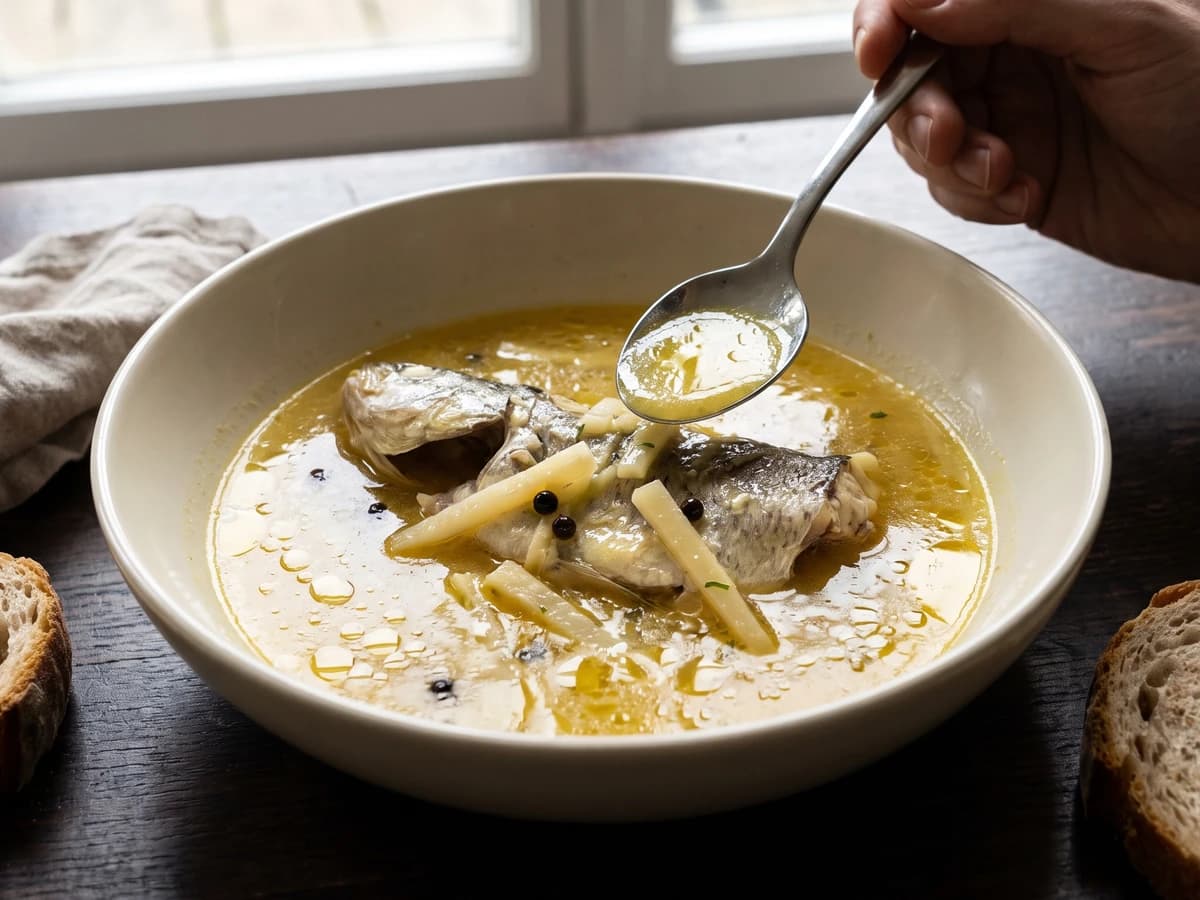
Waterzoi asks fresh, bone-in river fish to thicken its own buttery broth, with parsley root and pepper for company. No flour, no stockpot, just a brisk simmer watched closely.
Chef Juliette
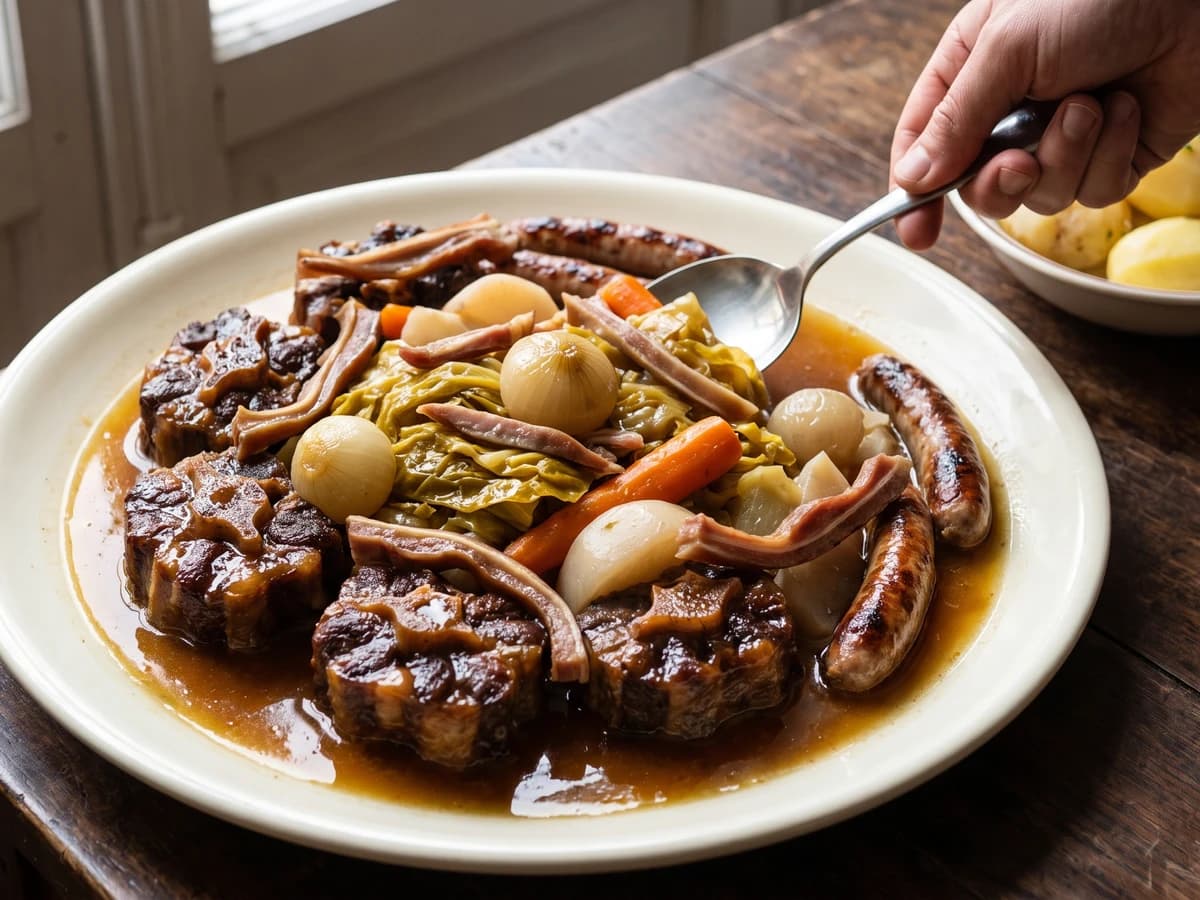
Queue de Bœuf en Hochepot gathers oxtail, pig's trotter and ear, cabbage, roots, and grilled chipolatas around a clear, gelatin-rich broth whose quiet simmer keeps every piece tender and distinct.
Chef Juliette
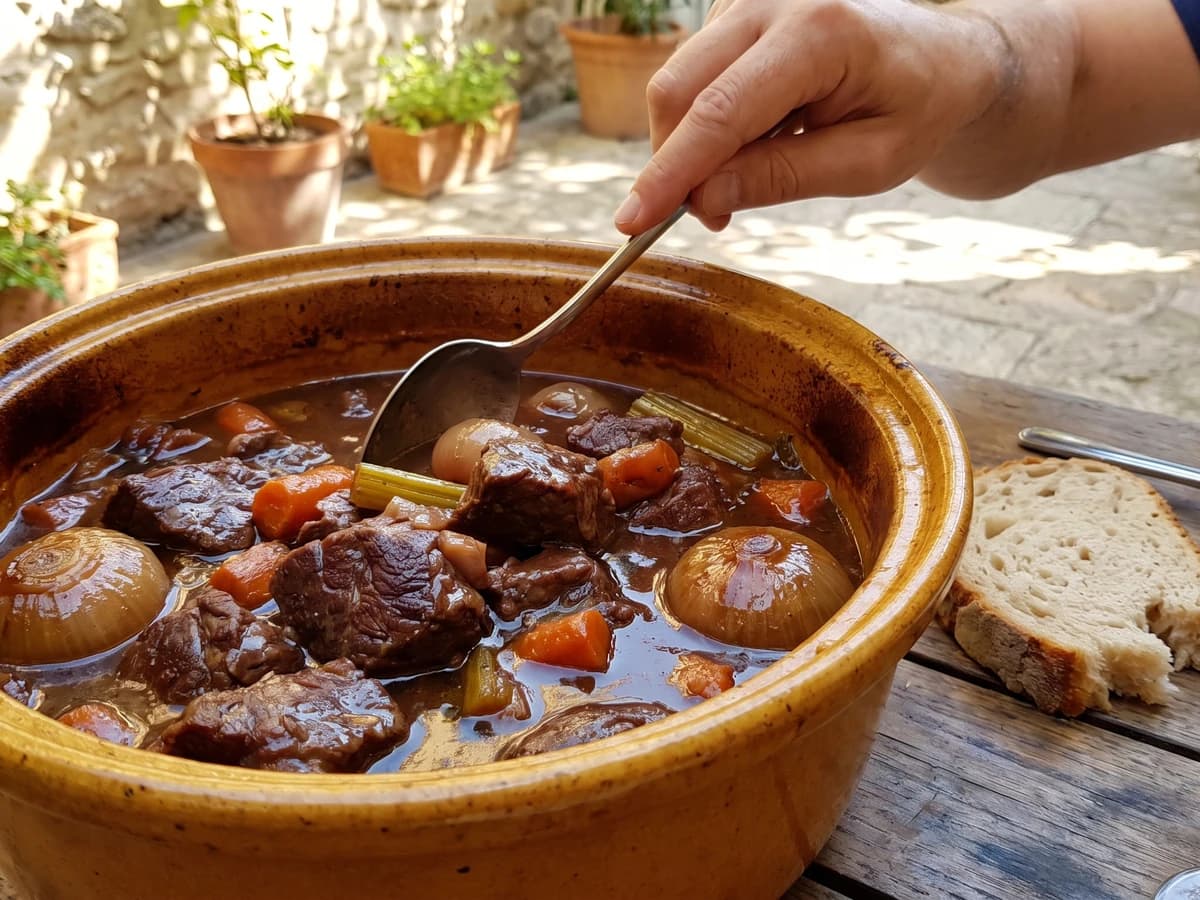
Beef shoulder larded with bacon, sharpened by red wine and vinegar, then sealed with garlic, vegetables, and dry lemon peel until the low oven turns it yielding and the gravy darkly glossy.