
Chef Juliette
Smelt (Éperlans)
Tiny éperlans, lightly floured and fried until their tails stand crisp, arrive in a generous heap on a napkin with fried parsley and grooved lemon, a weeknight lesson in heat and restraint.
A cooking platform built around craft, culture, and the stories behind what we eat.
Created by Chef Juliette
Based on No. 437, Hard-boiled Eggs in Rissoles, from Le Guide Culinaire (1907) by Auguste Escoffier
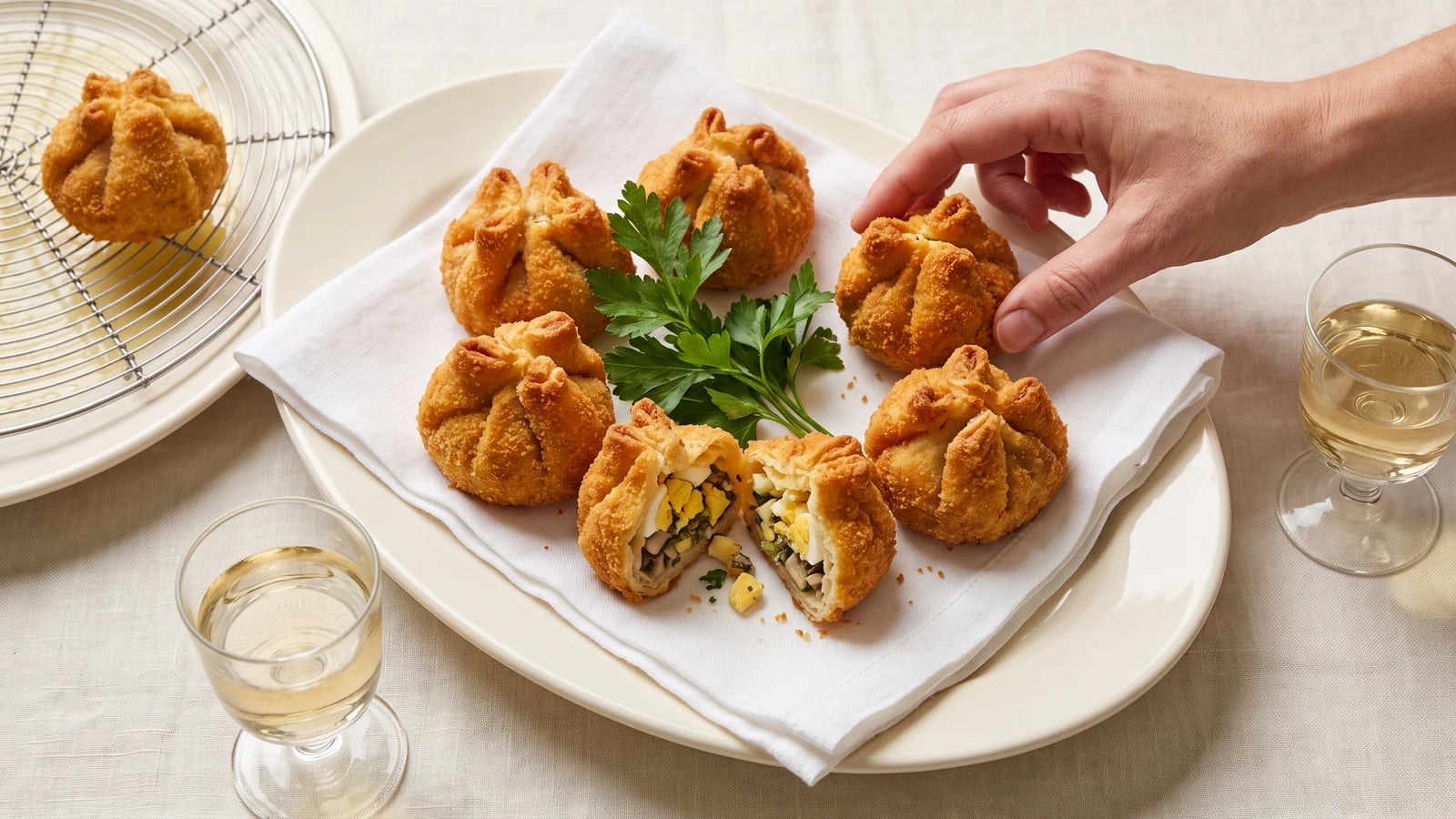
Egg and mushroom mince tucked into puff-paste purses, sealed firmly, panés à l’anglaise, and fried until crisp and butter-gold: a dinner-party first course with thrift in its bones.
Rissoles d’œufs durs (hard-boiled egg rissoles) teach one true thing: the seal is the dish. Inside each little purse sits a supple mince of egg and mushroom bound with just enough sauce; outside, puff paste and a panure à l’anglaise form the crisp enclosure that keeps the filling where it belongs. Let sauce or grease touch the seam and the purse opens in the fat. Keep it clean, cold, and firmly pressed.
The formula assumed a pastry bench producing puff-paste trimmings, an egg-croquette mixture already cold, a bowl of Anglaise (for Egg-and-bread-crumbing) (No. 174) held ready, and deep fat waiting for service. Your honest equivalent is one package of all-butter puff pastry, a small mushroom and roux-bound filling made in a saucepan, and a heavy pot with a thermometer. The pastry station is brigade scaffolding and can go. The quarter-inch paste, purse fold, panure, and full frying stay because they are the dish. One cook, one stove, one evening.
Make the filling a little softer than croquette paste, as the source directs, then chill it until it holds neatly on a spoon. Press every overlapping fold as though the filling were determined to escape, because it is. That careful seal matters more than ornament, and it is the step to watch before you ever heat the fat.
Rissoles d’œufs durs belong to the French bourgeois and Parisian classical hors-d’œuvre table, where cooks turned cooked fillings and puff-paste trimmings into a crisp first course rather than waste either. Their name is tied to rissoler, to brown, while the purse shape served a practical purpose by enclosing a moist, croquette-style filling during frying. Unlike a croquette, this version keeps puff paste beneath its panure à l’anglaise; the double enclosure is its identity, not needless decoration.
Quantity
4
Quantity
1¼ cups (300 ml / 100 g)
very finely chopped
Quantity
2 tablespoons (30 ml / 28 g)
divided
Quantity
2 tablespoons (30 ml / 16 g)
Quantity
⅓ cup (80 ml / 82 g)
Quantity
2 tablespoons (30 ml / 30 g)
Quantity
½ teaspoon (2.5 ml / 3 g)
Quantity
¼ teaspoon (1.25 ml / 0.6 g)
Quantity
14 ounces (400 g)
well chilled
Quantity
1 tablespoon (15 ml / 15 g)
for sealing
Quantity
½ cup (120 ml / 60 g)
for dredging
Quantity
½ cup (120 ml / 120 g) Anglaise (for Egg-and-bread-crumbing) (No. 174)
Quantity
2 cups (480 ml / 200 g)
Quantity
6 cups (1.4 liters / 1.3 kg)
Quantity
1 small bunch (1 ounce / 30 g)
for serving
| Ingredient | Quantity |
|---|---|
| large eggs | 4 |
| white button mushroomsvery finely chopped | 1¼ cups (300 ml / 100 g) |
| unsalted butterdivided | 2 tablespoons (30 ml / 28 g) |
| all-purpose flour | 2 tablespoons (30 ml / 16 g) |
| whole milk | ⅓ cup (80 ml / 82 g) |
| heavy cream | 2 tablespoons (30 ml / 30 g) |
| fine salt | ½ teaspoon (2.5 ml / 3 g) |
| finely ground white pepper | ¼ teaspoon (1.25 ml / 0.6 g) |
| all-butter puff-paste trimmings or all-butter puff pastrywell chilled | 14 ounces (400 g) |
| cold waterfor sealing | 1 tablespoon (15 ml / 15 g) |
| all-purpose flourfor dredging | ½ cup (120 ml / 60 g) |
| Anglaise (for Egg-and-bread-crumbing) | ½ cup (120 ml / 120 g) Anglaise (for Egg-and-bread-crumbing) (No. 174) |
| fine dry breadcrumbs | 2 cups (480 ml / 200 g) |
| neutral frying oil | 6 cups (1.4 liters / 1.3 kg) |
| flat-leaf parsleyfor serving | 1 small bunch (1 ounce / 30 g) |
Set the eggs in a small saucepan and cover them with cold water by 1 inch. Bring to a full boil, cover the pan, remove it from the heat, and leave the eggs for 11 minutes. Cool them thoroughly in cold water, peel, and chop them into small, distinct pieces rather than crushing them into paste. Pat them dry if their surfaces are wet; extra water loosens the filling.
Melt half the butter in a saucepan over medium heat. Add the mushrooms and cook until they have surrendered their water and the pan looks dry, 5 to 7 minutes; moisture left here will later push at the pastry seams. Add the remaining butter, stir in the flour, and cook this roux for 1 minute without browning. Add the milk gradually, stirring smooth after each addition, then add the cream. Cook until the sauce is glossy and a spoon drawn across the pan leaves a trail that closes slowly. If it remains loose, cook it another minute; if it becomes stiff, loosen it with a teaspoon of milk.
Remove the sauce from the heat and fold in the chopped eggs, salt, and white pepper. The mixture should be saucier than croquette paste but still sit in a mound on the spoon. Taste and correct the seasoning, then spread it in a shallow dish, cover its surface, and chill for at least 30 minutes. Warm filling melts the pastry butter and prevents a sound seal, so let it become cold throughout.
On a lightly floured surface, roll the chilled puff paste to a true ¼ inch (6 mm) thickness. Stamp out 20 rounds with a 2½-inch (6.5 cm) fluted cutter. Stack any trimmings without kneading them, roll them once more, and cut the remaining rounds. Keep half the rounds chilled while you work with the rest; warm puff paste becomes sticky and loses its layers.
Set a small tablespoonful of cold filling in the middle of each round, leaving a clean border. Brush that border very lightly with cold water. Bring the outside edge upward in several overlapping folds so the pastry closes like a purse, then pinch every meeting edge firmly together. No filling or mushroom fat may sit in the seam. If a seam feels slippery, blot it, dust your fingertips with flour, and press again; patch a thin spot with a scrap of cold pastry. Ça se rattrape. Set the purses seam-side up on a tray and chill for 15 minutes.
Arrange the dredging flour, the Anglaise (for Egg-and-bread-crumbing) (No. 174), and the fine breadcrumbs in three shallow dishes. Roll each cold purse lightly in flour and shake off the excess. Coat it completely in the Anglaise, let the surplus drain, then roll it in breadcrumbs, pressing just firmly enough to make an unbroken coat without flattening the pastry. Chill the breaded rissoles for another 15 minutes while the oil heats.
Pour the oil into a heavy pot, leaving the vessel no more than half full, and heat it to 350°F (175°C). Keep a lid nearby and make certain no water approaches the pot. The fat must be hot enough to set the Anglaise coat immediately; cool oil soaks into the crumbs before a crust forms.
Begin frying eight minutes before you mean to serve. Lower four or five rissoles into the fat and cook for 6 to 8 minutes, turning them gently, until they are evenly deep gold and crisp. Hold the oil between 340°F and 350°F (170°C and 175°C). If they darken before the pastry has expanded, lower the heat; if they sit pale and greasy, let the oil recover before adding another batch. Should one open, lift it out at once, skim away escaped filling, and recheck every remaining seam before it enters the pot.
Lift the rissoles onto a wire rack and let them drain for 1 minute, blotting only their undersides so the crumb remains crisp. Arrange them on a folded napkin set over a warmed platter, with a generous cluster of parsley in the centre, exactly as the dish asks. Serve immediately while the purses are crisp and the egg filling is creamy. À table!
1 serving (about 325g)
Culinary guides, cultural storytelling, and the editorial depth that makes cooking meaningful.
Discover Culinary ExplorerChef Juliette
Tiny éperlans, lightly floured and fried until their tails stand crisp, arrive in a generous heap on a napkin with fried parsley and grooved lemon, a weeknight lesson in heat and restraint.

Chef Juliette
Brandade de Morue turns salt cod, warm olive oil, and milk into a pale, silky emulsion: keep everything warm and add the oil slowly, then crown the generous dome with butter-fried bread.

Chef Juliette
Salt cod worked warm with cream, one patient spoonful at a time, until the rough flakes become a glossy Nîmes paste, domed generously and ringed with butter-fried croutons for the table.

Chef Juliette
Wine-poached char packed in its earthenware crock beneath butter gold: a make-ahead first course that turns careful cooling, thorough boning, and one unbroken seal into quiet abundance.