
Chef Juliette
Smelt (Éperlans)
Tiny éperlans, lightly floured and fried until their tails stand crisp, arrive in a generous heap on a napkin with fried parsley and grooved lemon, a weeknight lesson in heat and restraint.
A cooking platform built around craft, culture, and the stories behind what we eat.
Created by Chef Juliette
Based on No. 436, Hard-boiled Eggs in Croquettes, from Le Guide Culinaire (1907) by Auguste Escoffier
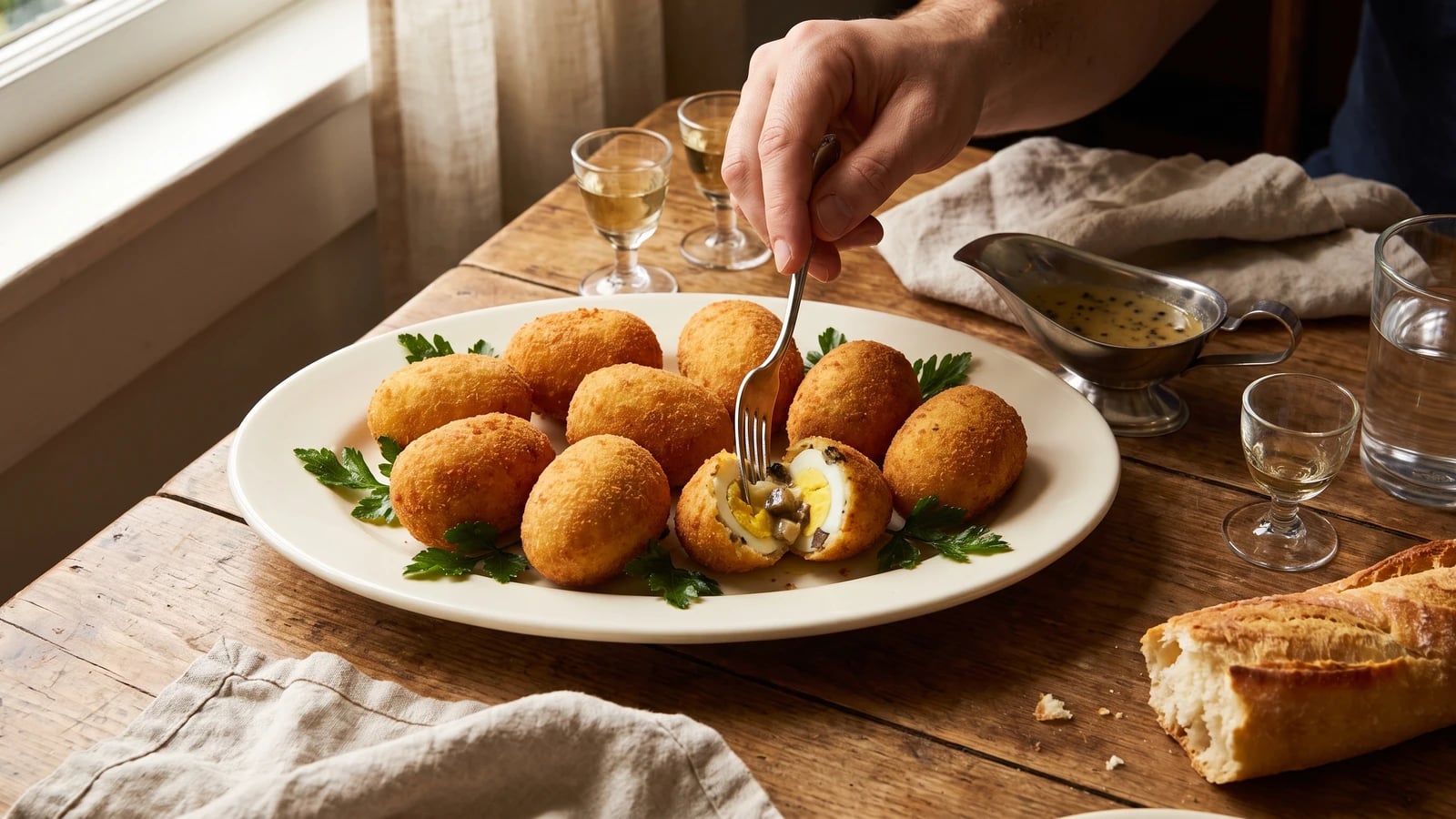
Croquettes d’œufs durs turn humble eggs into a truffle-scented first course, with a creamy diced center, a close golden crust, and warm sauce crème passed at the table.
Croquettes d’œufs durs (hard-boiled egg croquettes) teach the strictest law of croquette-making: the filling must be cold enough to hold a clean shape before it ever meets the fat. Inside, diced white and yolk, mushroom, and truffle stay distinct in a tight Béchamel; outside, panure à l’anglaise, a flour, egg-coating, and breadcrumb jacket, seals them beneath a crisp golden shell.
The original formula assumed a saucier with reduced Béchamel and sauce crème (cream sauce) ready, a truffle larder, a cook attending the fry station, and a platter dressed at the instant of service. A home kitchen needs one small saucepan, a heavy pot, a thermometer, and a refrigerator. The batch stops at the formula’s six-egg proportion, giving ten croquettes instead of a service tray; one Béchamel supplies both filling and sauce because duplicate saucepans are brigade scaffolding. The cold filling, complete à l’anglaise coating, and last-minute frying are the dish and must stay. The folded serving napkin goes too, since a rack drains better, but the green fried parsley remains.
This is one cook, one stove, one evening, provided the chilling begins before the guests arrive. Give the mixture its full rest, then press a finger gently into the center: it must feel firm, not merely cold on top. That deep chill is the one step that decides whether the croquettes arrive whole or open themselves in the frying pot.
Croquettes d’œufs durs belong to the Parisian classical and bourgeois table, where a croquette meant a finely diced filling bound with sauce, chilled, coated, and fried, not merely mashed potato in crumbs. The name follows croquer, to crunch, and the panure à l’anglaise made that promise possible by sealing a soft, sauce-bound interior beneath a close crust. Mushrooms, truffle, fried parsley, and cream sauce show the dish’s passage into grand-kitchen service, but eggs kept it rooted in the economical household larder.
Quantity
6
Quantity
About 3 cups raw (710 ml / 225 g), to yield 1 cup cooked (240 ml / 140 g)
cut into 3 mm dice
Quantity
¼ cup (60 ml / 28 g)
fresh or preserved whole, drained and cut into 3 mm dice
Quantity
¼ cup (60 ml / 56 g)
divided
Quantity
¼ cup (60 ml / 30 g)
Quantity
1½ cups (360 ml / 370 g)
divided and warmed
Quantity
½ cup (120 ml / 120 g)
Quantity
1½ teaspoons (7.5 ml / 9 g), plus a little for finishing
divided
Quantity
½ teaspoon (2.5 ml / 1 g)
divided
Quantity
1 small pinch
Quantity
½ cup (120 ml / 60 g)
Quantity
¾ cup (180 ml / 170 g) Anglaise (for Egg-and-bread-crumbing) (No. 174)
Quantity
2 cups (480 ml / 180 g)
Quantity
6 cups (1.4 L / about 1.3 kg), or enough to fill the pot no more than halfway
Quantity
12 large sprigs
washed and dried completely
| Ingredient | Quantity |
|---|---|
| large eggs | 6 |
| white button mushroomscut into 3 mm dice | About 3 cups raw (710 ml / 225 g), to yield 1 cup cooked (240 ml / 140 g) |
| black trufflefresh or preserved whole, drained and cut into 3 mm dice | ¼ cup (60 ml / 28 g) |
| unsalted butterdivided | ¼ cup (60 ml / 56 g) |
| all-purpose flour for the reduced Béchamel | ¼ cup (60 ml / 30 g) |
| whole milkdivided and warmed | 1½ cups (360 ml / 370 g) |
| heavy cream | ½ cup (120 ml / 120 g) |
| fine saltdivided | 1½ teaspoons (7.5 ml / 9 g), plus a little for finishing |
| ground white pepperdivided | ½ teaspoon (2.5 ml / 1 g) |
| freshly grated nutmeg | 1 small pinch |
| all-purpose flour for coating | ½ cup (120 ml / 60 g) |
| Anglaise (for Egg-and-bread-crumbing) | ¾ cup (180 ml / 170 g) Anglaise (for Egg-and-bread-crumbing) (No. 174) |
| fine fresh white breadcrumbs | 2 cups (480 ml / 180 g) |
| neutral high-heat frying oil | 6 cups (1.4 L / about 1.3 kg), or enough to fill the pot no more than halfway |
| flat-leaf parsleywashed and dried completely | 12 large sprigs |
Bring a saucepan of water to a boil and lower in the eggs with a spoon. Adjust the heat to maintain a gentle boil and cook for 10 minutes, then transfer them directly to iced water. Leave them for 10 minutes, peel, and chill until cold throughout. Cut both whites and yolks into neat 5 mm dice. Keep the knife moving straight down instead of dragging it through the yolks; the filling should show pieces of egg, not become a paste.
Melt 2 tablespoons (30 ml / 28 g) of the butter in a small heavy saucepan over medium-low heat. Stir in the ¼ cup (60 ml / 30 g) flour and cook this roux blanc, a white roux, for 2 minutes without letting it color. Gradually whisk in 1¼ cups (300 ml / 310 g) of the warm milk. Bring it to the gentlest bubbling simmer and cook for 8 to 10 minutes, stirring into every corner, until the Béchamel is thick enough to hold a furrow left by the spatula. Season with ½ teaspoon of the salt, half the white pepper, and the nutmeg. If it forms lumps, take it off the heat, whisk firmly, and pass it through a fine sieve if necessary. Measure a scant ⅔ cup (140 ml / about 145 g) for the croquettes, then cover the remaining Béchamel directly on its surface and reserve it for the sauce crème.
Melt 1 tablespoon (15 ml / 14 g) butter in a wide frying pan over medium-high heat. Add the diced mushrooms with a pinch of salt and cook, stirring regularly, until they release their water, the pan becomes dry again, and their edges only begin to color. The cooked mushrooms must not carry loose liquid into the filling. Measure 1 cup (240 ml / 140 g) of cooked mushroom dice and let it cool; save any small excess for another supper.
Combine the diced eggs, 1 cup (240 ml / 140 g) cooked mushrooms, and ¼ cup (60 ml / 28 g) diced truffle in a broad bowl. Fold in the scant ⅔ cup (140 ml / about 145 g) reduced Béchamel while it is warm and supple but no longer bubbling. Season with another ½ teaspoon salt and the remaining white pepper. Fold only until everything is evenly bound; the Béchamel should cling tightly around the dice rather than pool beneath them. Spread the mixture about 1.5 cm thick on a parchment-lined tray and press another sheet of parchment directly onto the surface.
Let the tray stand only until it is no longer hot, about 20 minutes, then refrigerate for at least 3 hours or overnight. The mixture is ready when it feels firm at the center and a spoonful can be lifted without slumping. If it remains soft, do not stiffen it with breadcrumbs, which would change the filling. Ça se rattrape: place the tray in the freezer for 15 to 20 minutes, just until firm enough to shape.
Divide the cold filling into 10 portions of about 2 ounces (55 to 60 g) each. Dust a board and your hands very lightly with some of the coating flour. Roll each portion first into a compact ball, then taper both ends between your palms to make a small egg shape. Close every crack with a pinch of cold filling. If the croquettes begin sticking or softening, return them to the refrigerator for 15 minutes before continuing.
Arrange three shallow dishes containing the ½ cup (120 ml / 60 g) coating flour, the finished Anglaise (for Egg-and-bread-crumbing) (No. 174), and the fine fresh breadcrumbs. Roll each croquette in flour and tap off the excess, coat it completely in the Anglaise, then roll it in crumbs. Use the crumbs and your palms to finish the egg shape. Inspect every croquette for bald spots or seams, patching them with a dab of Anglaise and more crumbs, then refrigerate uncovered for 30 minutes so the coating sets.
Whisk the reserved Béchamel with the heavy cream over low heat and simmer gently for 3 to 5 minutes, until the sauce reaches nappe and coats the back of a spoon in an even veil. Remove it from the heat and whisk in the remaining 1 tablespoon (15 ml / 14 g) butter. Taste for salt. If it tightens while waiting, loosen it with the reserved warm milk, one tablespoon at a time. Keep it warm without boiling and pour it into a warmed sauceboat just before serving.
Pour the frying oil into a heavy pot, filling it no more than halfway, and heat it to 165°C (330°F). Make certain the parsley is completely dry, since even a few drops of water will spit fiercely in hot fat. Lower the sprigs with a spider and stand back; fry for 5 to 10 seconds, just until crisp and vividly green. Drain on a rack or absorbent paper, season lightly, and raise the oil to 180°C (355°F).
Lower the chilled croquettes into the 180°C (355°F) oil in batches of three or four. Fry for 3 to 4 minutes, turning once, until evenly deep gold and crisp. Let the oil return to temperature between batches. If the first croquette leaks, lift it out, restore the oil temperature, patch any weak coating on the remaining croquettes with Anglaise (for Egg-and-bread-crumbing) (No. 174) and fresh crumbs, then chill them for 20 minutes before trying again. Drain on a rack, salt moderately, and serve within 7 or 8 minutes, arranged around the fried parsley with the sauce crème passed separately. À table!
1 serving (about 300g)
Culinary guides, cultural storytelling, and the editorial depth that makes cooking meaningful.
Discover Culinary ExplorerChef Juliette
Tiny éperlans, lightly floured and fried until their tails stand crisp, arrive in a generous heap on a napkin with fried parsley and grooved lemon, a weeknight lesson in heat and restraint.

Chef Juliette
Brandade de Morue turns salt cod, warm olive oil, and milk into a pale, silky emulsion: keep everything warm and add the oil slowly, then crown the generous dome with butter-fried bread.

Chef Juliette
Salt cod worked warm with cream, one patient spoonful at a time, until the rough flakes become a glossy Nîmes paste, domed generously and ringed with butter-fried croutons for the table.

Chef Juliette
Wine-poached char packed in its earthenware crock beneath butter gold: a make-ahead first course that turns careful cooling, thorough boning, and one unbroken seal into quiet abundance.