
Chef Juliette
Smelt (Éperlans)
Tiny éperlans, lightly floured and fried until their tails stand crisp, arrive in a generous heap on a napkin with fried parsley and grooved lemon, a weeknight lesson in heat and restraint.
A cooking platform built around craft, culture, and the stories behind what we eat.
Created by Chef Juliette
Based on No. 392, Tomatoes à la Monégasque, from Le Guide Culinaire (1907) by Auguste Escoffier
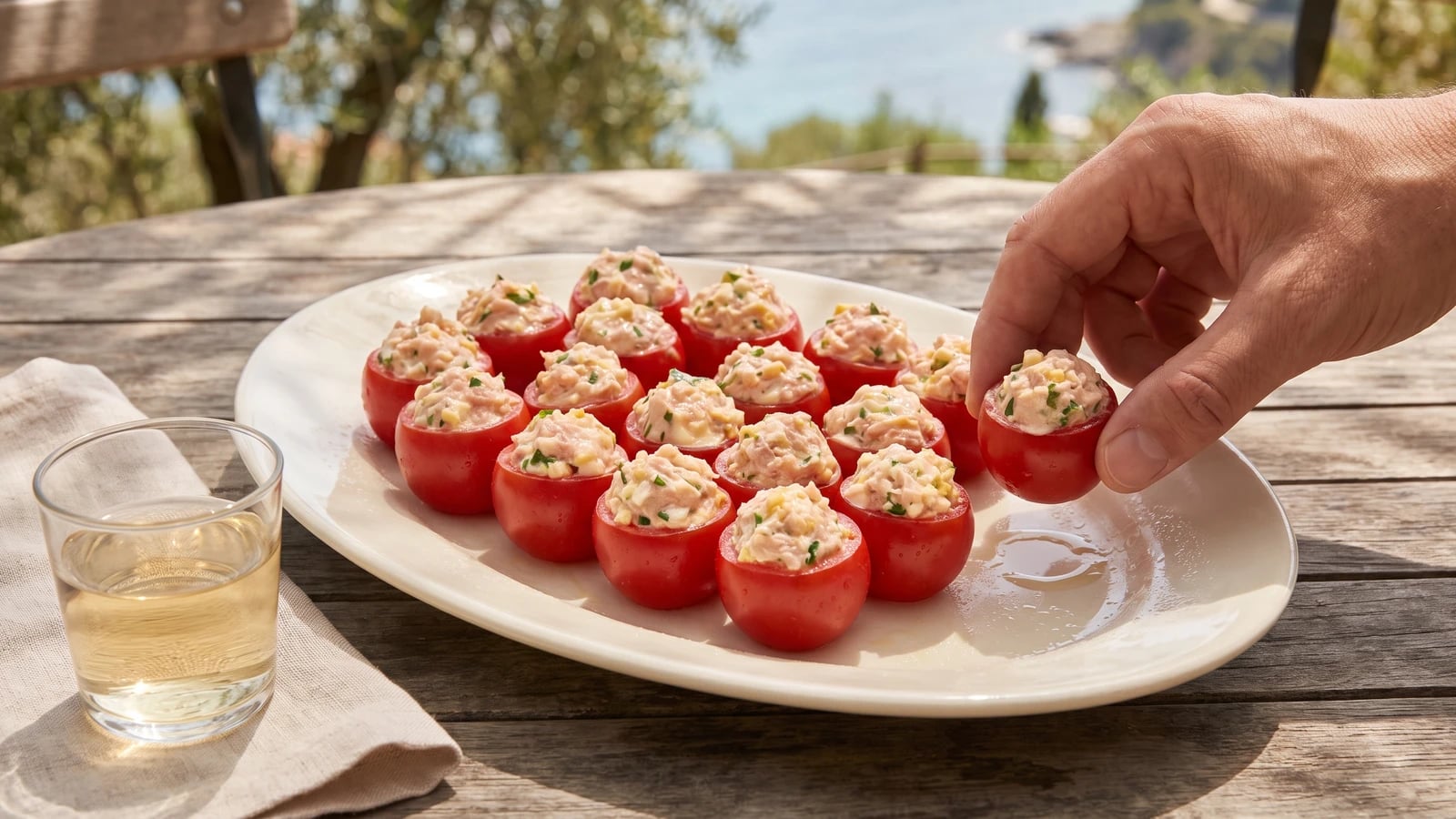
A Riviera hors-d'oeuvre of little marinated tomatoes crowned with a cool, herb-bright tuna and egg mince, held by thick mayonnaise and piped high enough to make each two-bite morsel generous.
Tomates à la Monégasque (Monaco-style stuffed tomatoes) teach the discipline of cold hors-d'oeuvre work: remove water before you add richness. The tomatoes must be hollowed, marinated, and drained until their interiors are seasoned but no longer wet; otherwise the tuna mince slides and the mayonnaise loosens. That is the one true thing to know before touching a pan.
The brigade formula assumed a garde-manger (cold station) with five quarts of Cooked Marinade for Venison (No. 168) already strained and cold, oeufs durs (hard-boiled eggs) ready on the prep table, and a bag fitted with a plain pipe. Your kitchen needs only ¾ cup of that finished referenced preparation, two eggs cooked here, and a small piping bag. The five-quart batch and service staging are scaffolding; the twenty-minute interior marinade, exact tuna-to-egg proportion, thick mayonnaise, and proud dome are the dish, so they stay. One cook, one stove, one evening.
Serve them cool: red shells with pale rose filling, green herbs through the mince, each bite sharp from the marinade and round from the emulsion. Drain the tomatoes cut side down and blot the cavities before filling; that single step decides whether every dome stands cleanly.
Tomates à la Monégasque belong to Monaco and the neighboring Riviera table, where small ripe tomatoes, preserved tuna, herbs, and cold emulsions meet naturally in hors-d'oeuvre service. In the French classical repertoire, the dish traveled through the garde-manger as a precisely hollowed, cold-marinated, piped bite, not the hot baked tomates farcies with which it is sometimes confused. Its surprising detail is the use of Cooked Marinade for Venison (No. 168) inside the tomatoes; the title sounds bound to game, but the finished sweet-sour, herb-scented preparation also served the cold kitchen.
Quantity
16
each about the size of a walnut
Quantity
¾ cup (180 ml / 180 g) Cooked Marinade for Venison (No. 168)
completely cold
Quantity
⅔ cup (160 ml / 115 g / 4 oz)
drained for 5 minutes but not pressed dry
Quantity
1 tablespoon (15 ml / 10 g)
very finely chopped
Quantity
2 tablespoons (30 ml / 6 g)
finely chopped, using half parsley and one-quarter each chervil and tarragon
Quantity
2 (about 75 g shelled after cooking)
Quantity
2 tablespoons (30 ml / 28 g)
chilled
| Ingredient | Quantity |
|---|---|
| firm, ripe cocktail tomatoeseach about the size of a walnut | 16 |
| Cooked Marinade for Venisoncompletely cold | ¾ cup (180 ml / 180 g) Cooked Marinade for Venison (No. 168) |
| oil-packed tunadrained for 5 minutes but not pressed dry | ⅔ cup (160 ml / 115 g / 4 oz) |
| onionvery finely chopped | 1 tablespoon (15 ml / 10 g) |
| mixed fresh parsley, chervil, and tarragonfinely chopped, using half parsley and one-quarter each chervil and tarragon | 2 tablespoons (30 ml / 6 g) |
| small eggs | 2 (about 75 g shelled after cooking) |
| thick mayonnaisechilled | 2 tablespoons (30 ml / 28 g) |
Put the eggs in a small saucepan, cover them with cold water by 1 inch, and bring just to a boil. Lower the heat and simmer gently for 9 minutes, then cool them immediately in cold water. Peel the cold oeufs durs and chop them very finely; the white and yolk should disappear evenly into the tuna rather than sit in large pieces.
Wash and dry the tomatoes. Cut a thin slice from each at the stalk end, then loosen the seeds and watery partitions with a narrow measuring spoon. Cup each tomato in your palm and squeeze with great restraint until the loose seeds and water fall out, keeping the walls intact. Do not salt them; the marinade will season the cavities without drawing out another flood of juice.
Stand the tomatoes upright in a shallow dish and divide the completely cold Cooked Marinade for Venison (No. 168) among their cavities, tilting each tomato so the interior is fully coated. Leave them for exactly 20 minutes. Pour out and discard the used marinade, then invert the tomatoes on a rack or clean towel for 10 minutes and blot each cavity. If a puddle reappears, give them another 5 minutes upside down and blot again. Ça se rattrape. Filling a wet tomato only thins the mayonnaise.
Let the tuna shed its excess packing oil for 5 minutes without pressing it dry, then mince it finely with a knife. Combine it in a cold bowl with the onion, parsley, chervil, tarragon, and chopped oeufs durs. Chop each element finely enough to pass through the piping tip, but keep the mixture granular. A food processor turns it to paste, and this filling should still taste of tuna, egg, and herbs separately.
Fold in the thick mayonnaise until the mince holds together and keeps the ridge left by the spoon. The mayonnaise is the emulsion that binds the filling, not a sauce meant to flood it. If the mixture slumps or beads oil, chill it for 15 minutes; if it is still loose, leave it in a fine-mesh sieve over a bowl for 5 minutes, then fold it once more. Do not add extra mayonnaise, which only makes the filling softer.
Fit a small piping bag with a 12 mm plain tip, or cut an opening of the same size from a sturdy food bag. Fill the drained tomatoes generously, piping enough mince above each rim to form a smooth dome. If the opening clogs, widen it slightly instead of squeezing harder and splitting the tomato. Arrange the tomates à la Monégasque on a chilled platter, cover loosely, and refrigerate for at least 30 minutes and no more than 6 hours. Let them stand for 10 minutes before serving so the herbs speak clearly. À table!
1 serving (about 160g)
Culinary guides, cultural storytelling, and the editorial depth that makes cooking meaningful.
Discover Culinary ExplorerChef Juliette
Tiny éperlans, lightly floured and fried until their tails stand crisp, arrive in a generous heap on a napkin with fried parsley and grooved lemon, a weeknight lesson in heat and restraint.

Chef Juliette
Brandade de Morue turns salt cod, warm olive oil, and milk into a pale, silky emulsion: keep everything warm and add the oil slowly, then crown the generous dome with butter-fried bread.

Chef Juliette
Salt cod worked warm with cream, one patient spoonful at a time, until the rough flakes become a glossy Nîmes paste, domed generously and ringed with butter-fried croutons for the table.

Chef Juliette
Wine-poached char packed in its earthenware crock beneath butter gold: a make-ahead first course that turns careful cooling, thorough boning, and one unbroken seal into quiet abundance.