
Chef Juliette
Smelt (Éperlans)
Tiny éperlans, lightly floured and fried until their tails stand crisp, arrive in a generous heap on a napkin with fried parsley and grooved lemon, a weeknight lesson in heat and restraint.
A cooking platform built around craft, culture, and the stories behind what we eat.
Created by Chef Juliette
Based on No. 386, Sprats, from Le Guide Culinaire (1907) by Auguste Escoffier
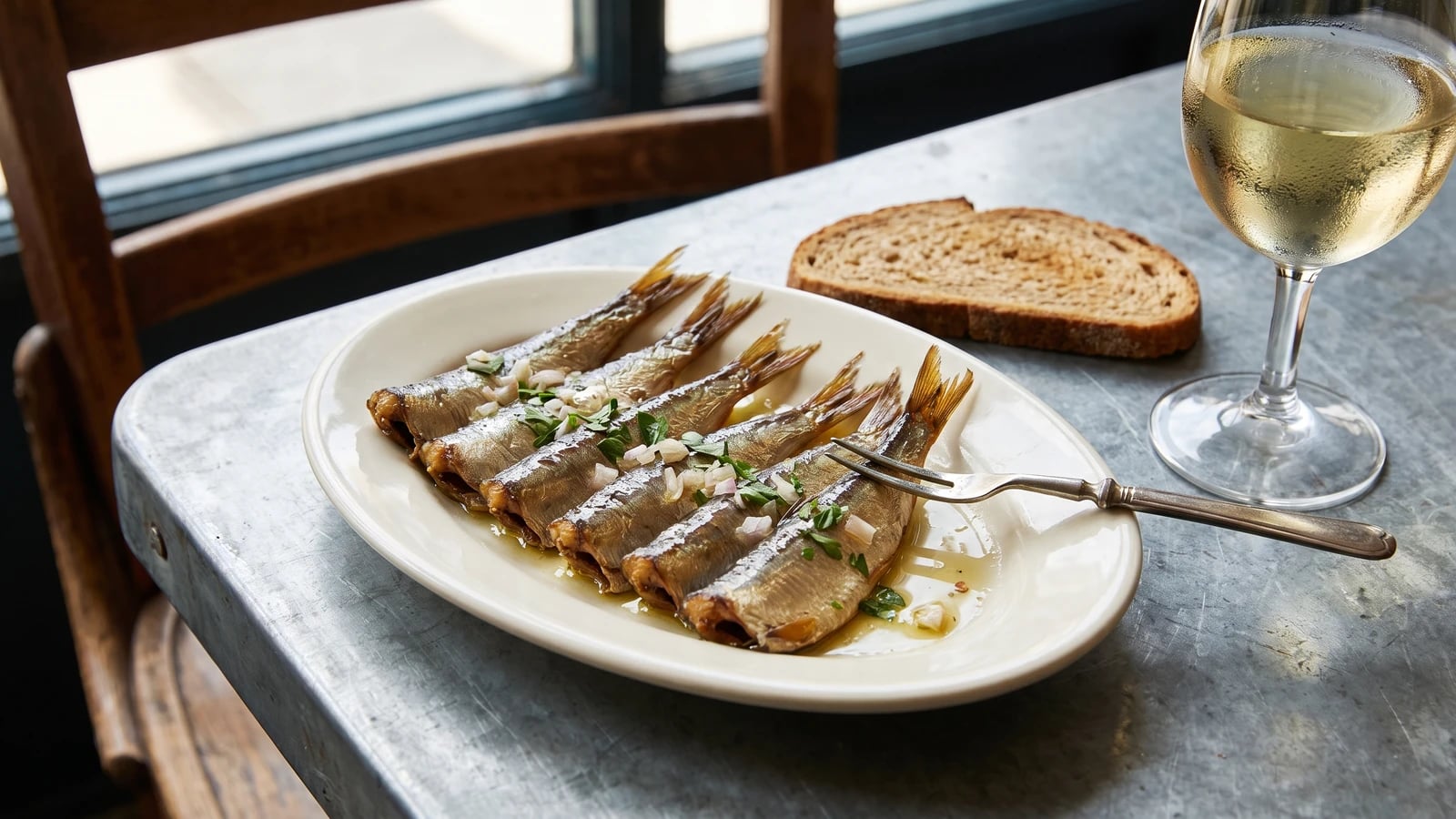
Sprats marinés teach the discipline of a cold marinade: choose plump smoked fish, use shallot, parsley, oil, and vinegar sparingly, then turn them patiently until every side gleams.
Sprats marinés teach the discipline of restraint in a cold marinade. The fish is already cured by smoke and salt, so your work is not to remake it but to wake it with shallot, parsley, oil, and vinegar. Choose plump sprats before you do anything else. A marinade can carry flavour over the flesh, but it cannot put richness back into a fish that began dry.
The book's kitchen kept Cooked Marinade for Venison (No. 168) in a larder quantity large enough for service. One cook does not need five quarts: reach for one spoonful of that finished, fully cooled preparation, then sharpen it with the small measures of fresh oil and vinegar the entry demands. Rebuilding the referenced marinade here is brigade scaffolding; heading the fish, dressing them lightly, and turning them through five or six hours are the dish, and those stay.
Arrange the sprats close enough to share the dressing but not piled so tightly that the bottom fish drown. Turn them gently and repeatedly. That is the one step that decides whether the shallot and vinegar reach every side. The finished fish should look supple and silver-bronze, with no puddle masquerading as a sauce. Cooking well is not cooking fancy.
Sprats marinés belong to the cold hors-d'œuvre tables of northern ports such as Boulogne-sur-Mer and to Parisian bistro assortments supplied by smoked-fish merchants. Smoked sprats traveled through North Sea and Baltic trade, and classical French service treated them as tiny smoked sardines because the same restrained dressing of oil, vinegar, shallot, and parsley suited them. Their place beside charcuterie is one of service rather than kinship: smoke, salt, acidity, and appetite open the meal.
Quantity
12 (about 7 oz / 200 g)
Quantity
2 tablespoons (30 ml / 20 g)
finely chopped
Quantity
1 tablespoon (15 ml / 4 g)
finely chopped
Quantity
1 tablespoon (15 ml / 14 g)
Quantity
2 teaspoons (10 ml / 10 g)
Quantity
1 tablespoon (15 ml / 15 g) Cooked Marinade for Venison (No. 168)
fully strained and chilled
| Ingredient | Quantity |
|---|---|
| plump ready-to-eat smoked sprats | 12 (about 7 oz / 200 g) |
| shallotfinely chopped | 2 tablespoons (30 ml / 20 g) |
| flat-leaf parsleyfinely chopped | 1 tablespoon (15 ml / 4 g) |
| neutral oil | 1 tablespoon (15 ml / 14 g) |
| red wine vinegar | 2 teaspoons (10 ml / 10 g) |
| Cooked Marinade for Venisonfully strained and chilled | 1 tablespoon (15 ml / 15 g) Cooked Marinade for Venison (No. 168) |
Choose fish that feel plump through the belly and bend slightly rather than snapping like dry twigs. Cut off each head just behind the gills with a small sharp knife. Leave the skins on for a firmer texture and fuller smoke, or ease them away from the head end if you prefer. If a skin pulls off in patches and tears the flesh, stop. Ça se rattrape: leave the remaining skin in place and lay that sprat damaged-side down on a shallow nonreactive dish. Arrange all the fish in one close layer.
Scatter the finely chopped shallot and parsley evenly over the sprats. Stir the neutral oil, red wine vinegar, and fully chilled Cooked Marinade for Venison (No. 168) together just until blended, then spoon the dressing sparingly over the fish. Very little is the point. The sprats should glisten, not float, and they need no added salt because the smoke has already supplied it.
Cover the dish and refrigerate the sprats for five to six hours. Every sixty to ninety minutes, slide a thin spatula beneath each fish, turn it gently, and spoon the shallot, parsley, and pooled dressing back over the exposed side. This turning is the dish: without it, one side drinks the marinade while the other stays dry. If a sprat begins to split, stop lifting it with your fingers. Use the spatula, settle the broken pieces together, and continue dressing them as one fish.
Take the sprats from the refrigerator about ten minutes before serving and turn them once more. Spoon the shallot and parsley over their tops, carrying only enough liquid to leave a clean gloss. If an oily puddle has formed, lift the fish onto a fresh platter and return the chopped seasoning with a teaspoon of the dressing. Serve cool, not numb from the refrigerator. À table!
1 serving (about 66g)
Culinary guides, cultural storytelling, and the editorial depth that makes cooking meaningful.
Discover Culinary ExplorerChef Juliette
Tiny éperlans, lightly floured and fried until their tails stand crisp, arrive in a generous heap on a napkin with fried parsley and grooved lemon, a weeknight lesson in heat and restraint.

Chef Juliette
Brandade de Morue turns salt cod, warm olive oil, and milk into a pale, silky emulsion: keep everything warm and add the oil slowly, then crown the generous dome with butter-fried bread.

Chef Juliette
Salt cod worked warm with cream, one patient spoonful at a time, until the rough flakes become a glossy Nîmes paste, domed generously and ringed with butter-fried croutons for the table.

Chef Juliette
Wine-poached char packed in its earthenware crock beneath butter gold: a make-ahead first course that turns careful cooling, thorough boning, and one unbroken seal into quiet abundance.