
Chef Juliette
Smelt (Éperlans)
Tiny éperlans, lightly floured and fried until their tails stand crisp, arrive in a generous heap on a napkin with fried parsley and grooved lemon, a weeknight lesson in heat and restraint.
A cooking platform built around craft, culture, and the stories behind what we eat.
Created by Chef Juliette
Based on No. 370, Lapwings’ Eggs à la Moderne, from Le Guide Culinaire (1907) by Auguste Escoffier
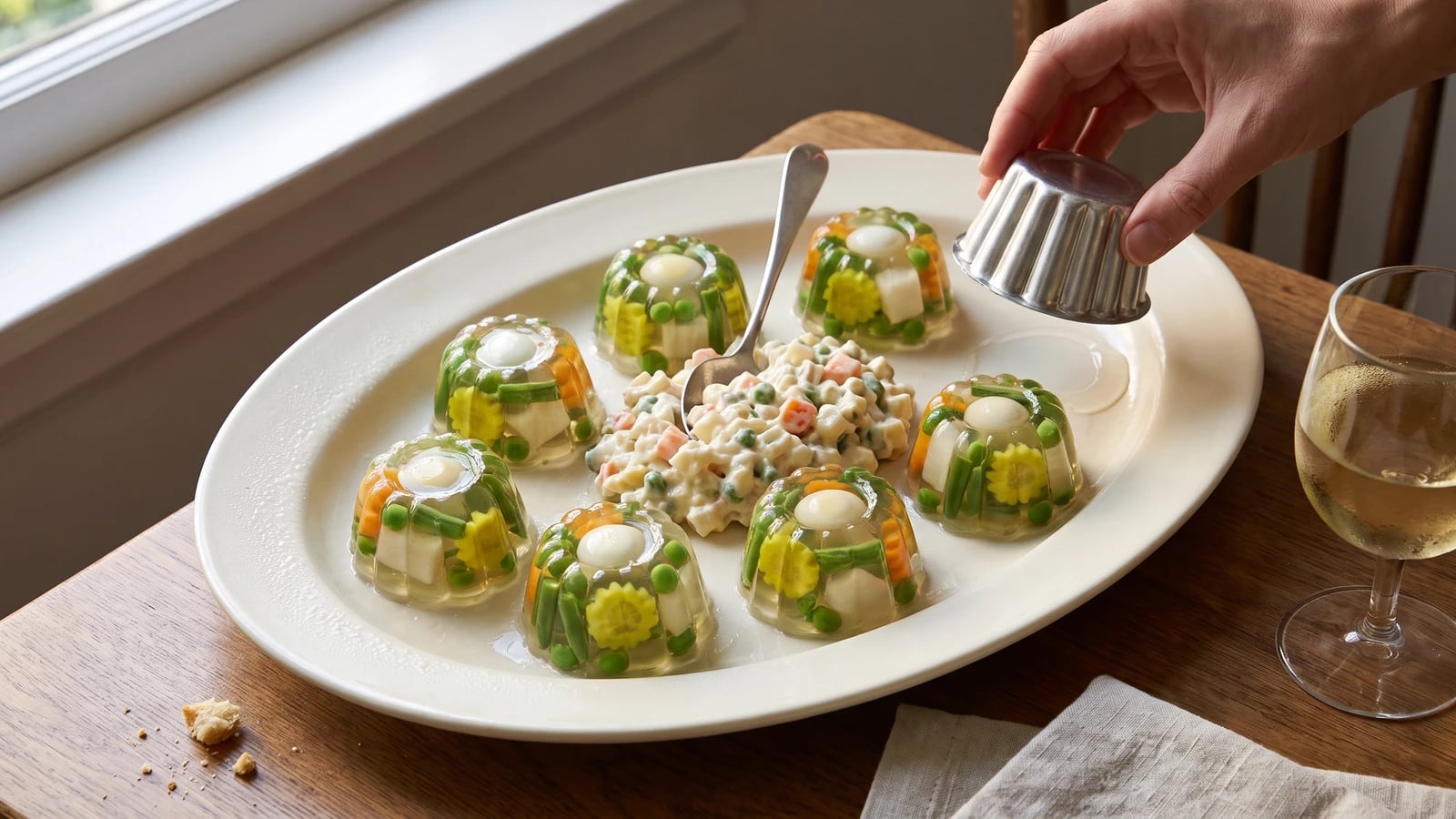
Eight cool aspic darioles, each holding a soft quail egg behind a mosaic of firm vegetables, circle a mayonnaise-bound salad: grand-kitchen geometry made workable for one careful home cook.
Œufs de Vanneau à la Moderne (lapwings’ eggs in Chartreuse-patterned aspic) teaches the discipline of cold work: everything that touches the jelly must be cold before the mould is lined. Done properly, each little dariole gleams like glass around a softly cooked egg, with firm vegetables showing through in tidy bands of colour.
The book assumed a garde-manger with clear meat jelly ready, a saucier drawing from a stockpot never off the fire, legally gathered lapwing eggs, and ranks of dariole-moulds, the small baba moulds of the cold station. At home, clear chicken stock strengthened with measured gelatin replaces the day-long jelly, farmed quail eggs replace protected wild eggs, and straight-sided demitasse cups can replace the special moulds. The clarification and ranks of tins were brigade scaffolding. The cold aspic coat, Chartreuse pattern, soft yolk, and true mayonnaise are the dish, so those stay. One cook, one stove, one evening, with four hours for the cold to do its work.
The decisive step is the first aspic coat. Let it thicken until it clings like raw egg white, then press the vegetable pattern into that tacky layer; too warm and everything slides, too firm and the lining peels away.
Œufs de vanneau à la moderne belongs to Parisian grand-kitchen cold service, not to a provincial farmhouse table; the rare spring eggs came from marshes and heaths farther north, then arrived in the city to be dressed for formal dinners. À la moderne describes the presentation: a soft egg enclosed in clear aspic, patterned in the manner of a Chartreuse, then set around a central macédoine, a diced vegetable salad bound with mayonnaise. Wild lapwings are protected across much of their range, so farmed quail eggs carry the dish’s scale and rich yolk without disguising what changed.
Quantity
10
8 for serving and 2 spare
Quantity
2 cups (480 ml / 480 g)
chilled and divided
Quantity
2½ teaspoons (12 ml / 8 g)
Quantity
½ cup (120 ml / 85 g) from Chartreuse de Ris de Veau (No. 1220)
chilled
Quantity
1½ cups (360 ml / 225 g)
peeled and cut into ¼-inch dice
Quantity
¾ cup (180 ml / 100 g)
peeled and cut into ¼-inch dice
Quantity
¾ cup (180 ml / 110 g)
peeled and cut into ¼-inch dice
Quantity
¾ cup (180 ml / 90 g)
trimmed and cut into ¼-inch pieces
Quantity
½ cup (120 ml / 70 g)
Quantity
1 large
Quantity
1 teaspoon (5 ml / 5 g)
Quantity
1 tablespoon (15 ml / 15 g)
divided
Quantity
½ cup (120 ml / 110 g)
Quantity
1 tablespoon (15 ml / 18 g)
divided
Quantity
⅛ teaspoon (0.6 ml / 0.3 g)
Quantity
1 tablespoon (15 ml / 15 g)
| Ingredient | Quantity |
|---|---|
| large farmed quail eggs8 for serving and 2 spare | 10 |
| clear unsalted chicken stockchilled and divided | 2 cups (480 ml / 480 g) |
| unflavoured powdered gelatin | 2½ teaspoons (12 ml / 8 g) |
| prepared firm-cooked vegetable garnishchilled | ½ cup (120 ml / 85 g) from Chartreuse de Ris de Veau (No. 1220) |
| waxy potatoespeeled and cut into ¼-inch dice | 1½ cups (360 ml / 225 g) |
| carrotspeeled and cut into ¼-inch dice | ¾ cup (180 ml / 100 g) |
| turnippeeled and cut into ¼-inch dice | ¾ cup (180 ml / 110 g) |
| fine French beanstrimmed and cut into ¼-inch pieces | ¾ cup (180 ml / 90 g) |
| fresh or frozen peas | ½ cup (120 ml / 70 g) |
| pasteurized egg yolk | 1 large |
| Dijon mustard | 1 teaspoon (5 ml / 5 g) |
| white wine vinegardivided | 1 tablespoon (15 ml / 15 g) |
| neutral oil | ½ cup (120 ml / 110 g) |
| fine sea saltdivided | 1 tablespoon (15 ml / 18 g) |
| ground white pepper | ⅛ teaspoon (0.6 ml / 0.3 g) |
| cool water (optional) | 1 tablespoon (15 ml / 15 g) |
Pour ½ cup of the cold stock into a bowl and sprinkle the gelatin evenly over its surface. Leave it for 5 minutes to bloom. Heat the remaining stock until it is hot and trembling at the edge, but never boiling, then remove it from the heat and stir in the bloomed gelatin with ¾ teaspoon of the salt. Strain through a fine sieve and set the bowl over ice, stirring occasionally, until the aspic flows like raw egg white and clings to a cold spoon. If it sets before you need it, lower the bowl briefly into warm water and stir until fluid again. Do not boil it.
Bring a small saucepan of water to a full boil. Lower in the quail eggs and cook for 2 minutes 30 seconds, then transfer them immediately to ice water for 5 minutes. Crack each shell all over and peel under cold water, working gently around the soft white. Choose the 8 best eggs, dry them, and chill them completely. A shallow nick will disappear behind the aspic; if the white splits through to the yolk, use one of the spares.
Arrange eight cold 2-ounce dariole-moulds on a tray. Spoon a thin layer of thickened aspic into each, turning the mould so the base and sides are coated, then chill for about 5 minutes until tacky. Take the chilled vegetable garnish from Chartreuse de Ris de Veau (No. 1220) and press the pieces into the lining in alternating bands of colour. Brush with another thin coat of aspic to lock the pattern in place. If the vegetables slide, the lining is too warm; chill it for another 3 minutes and reset them.
Place one cold quail egg upright in each lined mould. Pour in enough thickened aspic to surround the egg and reach the rim, tapping the tray lightly to free trapped bubbles. Everything must be cold here. A warm egg melts the first coat and sends the pattern adrift; if the lining begins to loosen, stop and chill the moulds for 10 minutes before filling them further. Refrigerate for at least 4 hours, until firmly set.
Put the diced potatoes in cold water seasoned with ½ teaspoon of salt, bring them gently to a simmer, and cook until tender but still holding clean edges. Drain and cool them in a single layer. Cook the carrots, turnips, French beans, and peas separately in simmering salted water, using 1½ teaspoons of the salt between them; each vegetable should be cooked according to its nature and kept somewhat firm. Chill them promptly, drain them thoroughly, and spread them on a clean towel. Wet vegetables loosen mayonnaise.
Whisk the egg yolk with the Dijon mustard, 2 teaspoons of the vinegar, and ¼ teaspoon of salt. Add the oil first by drops, whisking each addition fully into the yolk, then in a thin steady thread once the emulsion has gained body. Whisk in the remaining vinegar and the white pepper. The mayonnaise should hold a soft ridge without becoming stiff. If it breaks, put 1 teaspoon of the cool water in a clean bowl and whisk the broken mayonnaise into it drop by drop. Ça se rattrape.
Fold the cold, dry potatoes and vegetables together, then add enough mayonnaise to bind them thickly without burying their colours. Taste the salad properly chilled, because cold mutes seasoning, and add the remaining salt as needed. Cover and refrigerate while you turn out the darioles.
Heap the mayonnaise-bound vegetable salad in the middle of a chilled oval platter. Dip each dariole-mould in warm water for 2 seconds, dry its outside, and invert it around the salad. If it refuses to release, dip it for 1 second more; if the outer jelly begins to soften, return the mould to the refrigerator for 10 minutes before trying again. Arrange all 8 in a neat ring and serve at once while the aspic holds its clean lines. À table!
1 serving (about 350g)
Culinary guides, cultural storytelling, and the editorial depth that makes cooking meaningful.
Discover Culinary ExplorerChef Juliette
Tiny éperlans, lightly floured and fried until their tails stand crisp, arrive in a generous heap on a napkin with fried parsley and grooved lemon, a weeknight lesson in heat and restraint.

Chef Juliette
Brandade de Morue turns salt cod, warm olive oil, and milk into a pale, silky emulsion: keep everything warm and add the oil slowly, then crown the generous dome with butter-fried bread.

Chef Juliette
Salt cod worked warm with cream, one patient spoonful at a time, until the rough flakes become a glossy Nîmes paste, domed generously and ringed with butter-fried croutons for the table.

Chef Juliette
Wine-poached char packed in its earthenware crock beneath butter gold: a make-ahead first course that turns careful cooling, thorough boning, and one unbroken seal into quiet abundance.