
Chef Juliette
John Dory (St. Pierre)
John Dory has the delicacy of sole and the firmness of turbot. A light flouring, a quick butter sauté, and nut-brown beurre noisette show exactly why looks never mattered.
A cooking platform built around craft, culture, and the stories behind what we eat.
Created by Chef Juliette
Based on No. 1220, Chartreuse de Ris de Veau, from Le Guide Culinaire (1907) by Auguste Escoffier
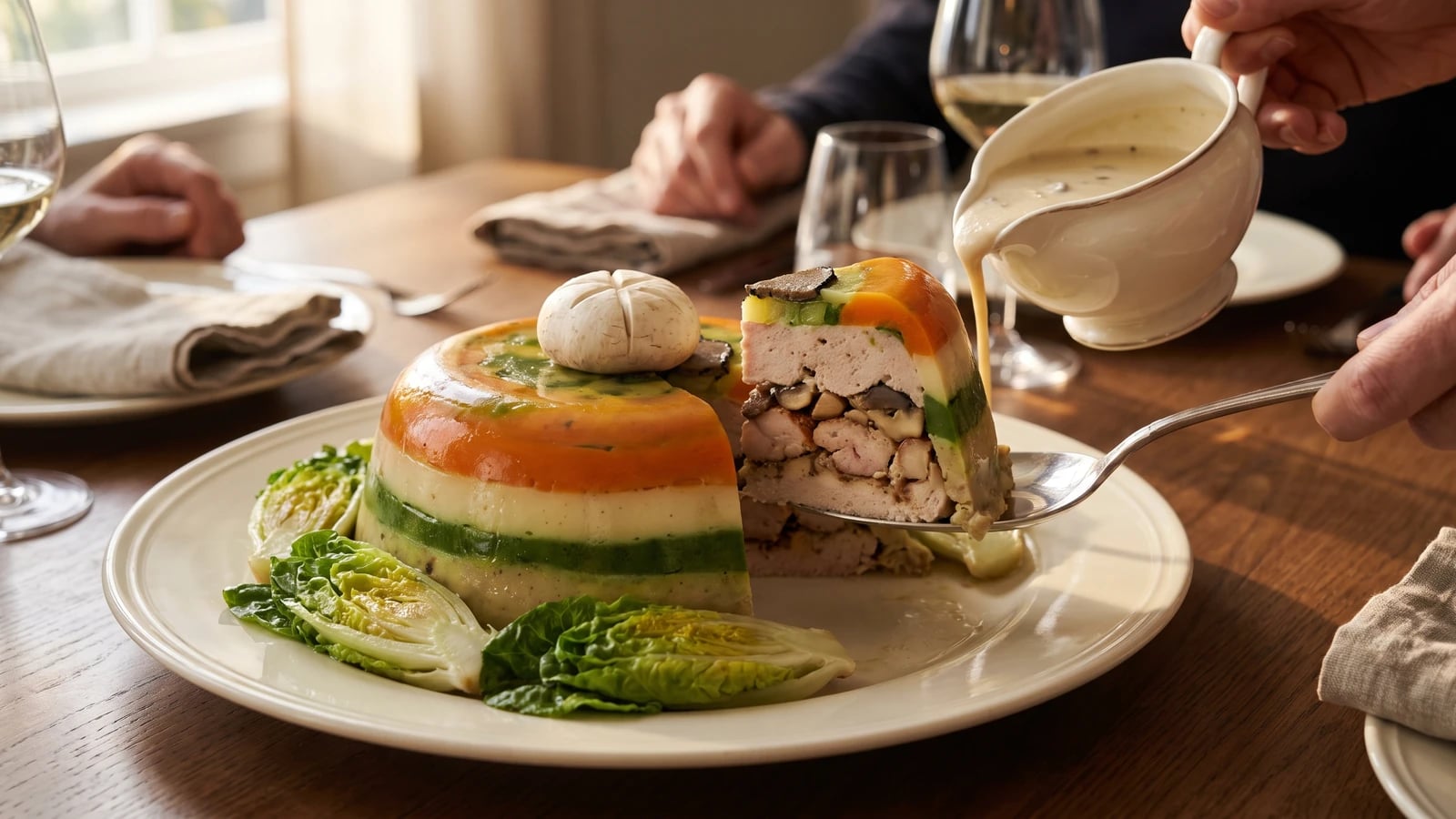
A vegetable mosaic around tender sweetbreads, cream forcemeat, mushroom, and truffle, gently set in a bain-marie and rested before unmoulding, with mushroom velouté served apart.
Chartreuse de ris de veau (vegetable-lined sweetbread mould) teaches edible architecture. The one true thing to know before touching a pan is this: every layer must be cold, firm, and dry before it enters the mould. Warm forcemeat slumps, wet vegetables slide, and a decorative chartreuse becomes a very expensive landslide.
The original assumed a garde-manger preparing the cream forcemeat, an entremetier cooking each vegetable separately, a saucier beside a stockpot that never went cold, and a drawer full of tube cutters. At home, make the referenced forcemeat first, reuse one saucepan for the vegetables, cut the roundels with a wide piping tip, and build the chartreuse in a 3-cup mould. The brigade quantities are halved because this is dinner for four, while the proportions and sequence remain intact. One cook, one stove, one evening.
The cutter and the extra hands were scaffolding. The cold forcemeat, distinct layers, gentle bain-marie, and settling rest are the dish itself. Keep those, and the chartreuse unmoulds in bands of carrot orange, turnip ivory, and green around tender sweetbread, mushroom, and truffle. Before you line the mould, touch every component and confirm that it is cold and dry. That is the step that decides everything.
Chartreuse belongs to the formal tables of Parisian grande cuisine, where decorative vegetable moulds became elaborate cases for poultry, game, and delicate offal. Its method passed into bourgeois kitchens because a Charlotte mould and a bain-marie could reproduce the grand kitchen's precise construction without its staff. Despite the shared name, no Chartreuse liqueur flavours the dish; in this register, chartreuse means the patterned moulded preparation itself.
Quantity
1, about 12 oz (340 g)
soaked, poached, trimmed, and pressed
Quantity
1¼ cups (300 ml / 285 g) Chicken Forcemeat with Panada and Cream (No. 194)
prepared and thoroughly chilled
Quantity
1½ cups (360 ml / 170 g raw, about 113 g cooked)
cut into large slices
Quantity
⅓ cup (80 ml / 43 g)
thinly sliced; fresh or whole preserved and drained
Quantity
½ cup (120 ml / 65 g)
cut ⅔ inch (17 mm) wide
Quantity
½ cup (120 ml / 75 g)
cut ⅔ inch (17 mm) wide
Quantity
⅓ cup (80 ml / 50 g)
fresh or frozen
Quantity
½ cup (120 ml / 55 g)
cut into ⅔-inch (17 mm) lengths
Quantity
2
trimmed and halved
Quantity
1
peeled and grooved
Quantity
5 tablespoons (75 ml / 70 g)
softened and divided
Quantity
1½ cups (360 ml / 360 g)
for serving
Quantity
to taste
for the cooking water and seasoning
| Ingredient | Quantity |
|---|---|
| veal throat sweetbreadsoaked, poached, trimmed, and pressed | 1, about 12 oz (340 g) |
| Chicken Forcemeat with Panada and Creamprepared and thoroughly chilled | 1¼ cups (300 ml / 285 g) Chicken Forcemeat with Panada and Cream (No. 194) |
| white button mushroomscut into large slices | 1½ cups (360 ml / 170 g raw, about 113 g cooked) |
| black trufflethinly sliced; fresh or whole preserved and drained | ⅓ cup (80 ml / 43 g) |
| carrot roundelscut ⅔ inch (17 mm) wide | ½ cup (120 ml / 65 g) |
| turnip roundelscut ⅔ inch (17 mm) wide | ½ cup (120 ml / 75 g) |
| peasfresh or frozen | ⅓ cup (80 ml / 50 g) |
| French beanscut into ⅔-inch (17 mm) lengths | ½ cup (120 ml / 55 g) |
| small butter lettucestrimmed and halved | 2 |
| large white mushroom cappeeled and grooved | 1 |
| unsalted buttersoftened and divided | 5 tablespoons (75 ml / 70 g) |
| prepared Velouté flavoured with mushroom essencefor serving | 1½ cups (360 ml / 360 g) |
| fine saltfor the cooking water and seasoning | to taste |
Soak the sweetbread in a bowl of cold water for 1 hour, changing the water twice, until it looks pale and clean. Cover it with fresh cold water in a saucepan, add a good pinch of salt, and bring it slowly to the barest simmer. Poach for 10 minutes, then transfer it to ice water. Remove the outer membrane, cords, and loose fat while it is cool but still pliable. Set it between two trays with a 2-pound (900 g) weight on top for 30 minutes, then chill and cut it into ¼-inch (6 mm) slices. Pat every slice dry.
Cook each vegetable separately in simmering salted water so each keeps its own proper texture. Give the carrot roundels 4 to 6 minutes, the turnips 3 to 5 minutes, the French beans 2 to 3 minutes, and the peas about 1 minute, or 30 seconds if frozen. They should be tender at the edges but firm through the centre. Cool them immediately in ice water, drain well, and spread them on clean towels until completely cold and dry.
Melt 1 tablespoon (15 ml / 14 g) butter in a wide pan over medium-high heat. Add the sliced mushrooms in one uncrowded layer and cook until their released liquid has evaporated and their edges are lightly golden. Transfer them to a tray, season sparingly, and chill. Pat the truffle slices dry, particularly if they came from a jar, and keep them cold beside the mushrooms and sweetbread.
Heat the oven to 325°F (160°C). Coat a 3-cup (700 ml) Charlotte mould generously with 2 tablespoons (30 ml / 28 g) softened butter, then arrange the carrot, turnip, pea, and French bean pieces over the bottom and sides in alternating coloured rows. Pipe or spoon a ½-inch (1.25 cm) coating of cold Chicken Forcemeat with Panada and Cream (No. 194) over the vegetables, smoothing it gently without disturbing the pattern. Add a close layer of sweetbread, cooked mushroom, and truffle, keeping the filling away from the mould's edge. Cover with more forcemeat, repeat the filling, and finish with a complete layer of forcemeat. Smooth the top and cover it with a round of buttered parchment.
Set the mould in a deep roasting tin and pour in very hot water to come halfway up its sides. This bain-marie, a hot-water bath, protects the forcemeat from harsh oven heat. Bake for 45 to 50 minutes, keeping the water below a hard boil, until the centre reaches 165°F (74°C) and feels resilient rather than liquid beneath the paper. If the centre has not reached temperature at 50 minutes, continue in 5-minute intervals. Do not raise the oven heat; gentleness preserves the fine texture.
While the chartreuse cooks, melt 1 tablespoon (15 ml / 14 g) butter in a shallow pan. Arrange the lettuce halves cut-side down, add ⅓ cup (80 ml / 80 g) water and a pinch of salt, cover, and braise gently for 10 to 12 minutes until tender but still intact. Drain and trim them neatly. Cook the grooved mushroom cap in the same pan with 1 teaspoon (5 ml / 5 g) butter and 2 tablespoons (30 ml / 30 g) water, covered, for 5 to 7 minutes, keeping it pale. Warm the Velouté flavoured with mushroom essence without boiling. If it has tightened, loosen it with a spoonful of hot water; if it is thin, let it reduce gently until it coats a spoon.
Lift the chartreuse from the bain-marie, remove the paper, and let it stand undisturbed for 8 minutes. The rest allows the forcemeat to settle around the filling, and turning it out early risks splitting the layers. Loosen only the top rim with a thin knife, place a warm round serving dish over the mould, and invert both together. Wait 30 seconds before lifting the mould. If it clings, wrap the outside briefly with a hot, well-wrung towel and try again. Replace any vegetable piece left behind in its proper space. Never apologize at your own table.
Set the cooked grooved mushroom cap on top and arrange the braised half-lettuces in a close crown around the base. Bring the hot mushroom velouté to the table separately in a sauceboat, as the source directs, so the vegetable pattern remains visible and each guest takes the sauce they want. Cut the chartreuse with a thin, sharp knife, wiping it between portions. À table!
1 serving (about 400g)
Culinary guides, cultural storytelling, and the editorial depth that makes cooking meaningful.
Discover Culinary ExplorerChef Juliette
John Dory has the delicacy of sole and the firmness of turbot. A light flouring, a quick butter sauté, and nut-brown beurre noisette show exactly why looks never mattered.

Chef Juliette
Fresh haddock proves its delicacy in the meunière pan: a fine flour crust, moist pearly flakes, and beurre noisette sharpened with lemon and parsley, ready from one skillet in half an hour.

Chef Juliette
Éperlans à l’Anglaise turns small fish into a lesson in disciplined coating: boned smelts under a close, crisp crumb, pan-fried in clarified butter and finished with bright, half-melted maître d’hôtel butter.

Chef Juliette
Tiny smelts, shallot, mushrooms, white wine, gratin sauce, and fine bread raspings meet a fierce oven, where the fish must turn tender in the same breath the buttered crust bronzes.