Chef Juliette
Suet Dumpling
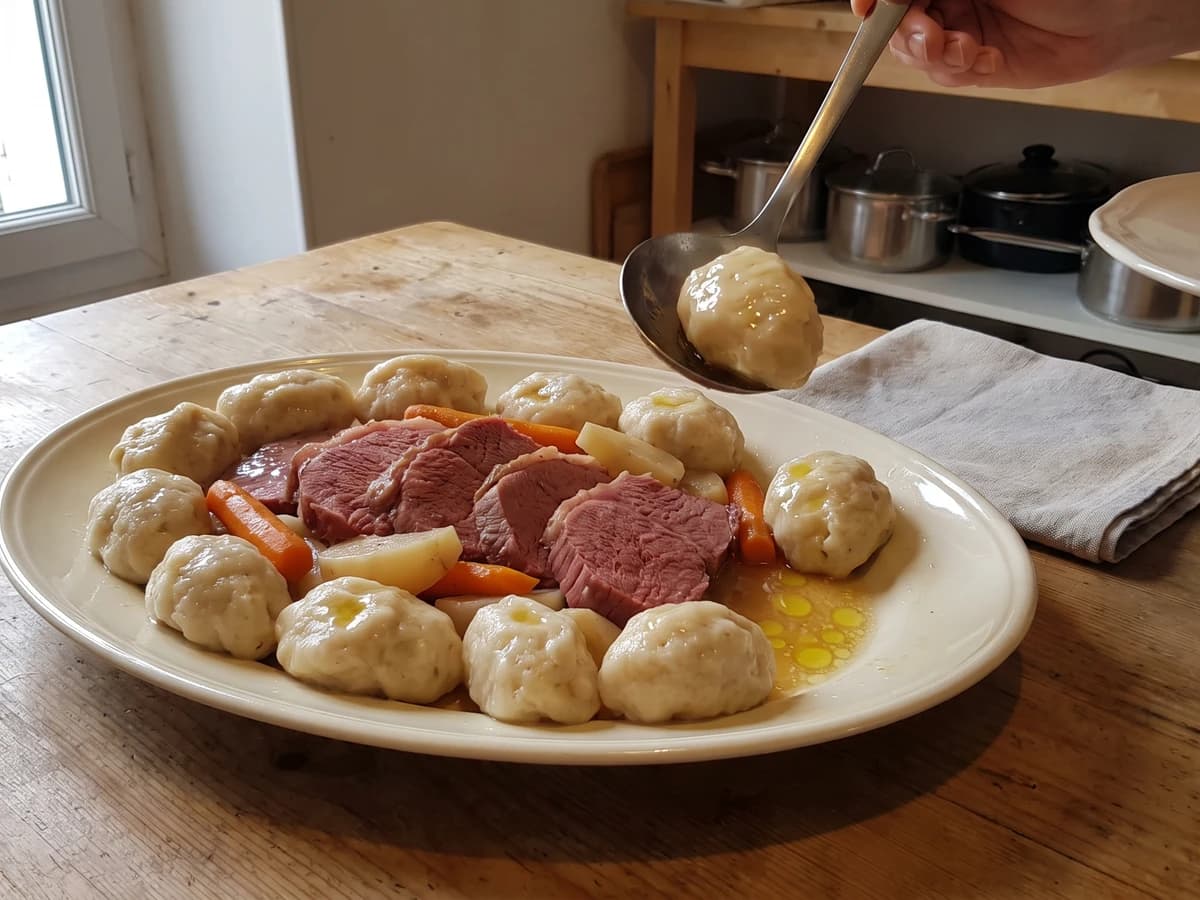
Boulettes au suif, poached beside salt beef, turn equal weights of flour and finely chopped suet into tender, rich dumplings. Keep the beef liquor at a bare tremble and the old garnish works beautifully at home.
A cooking platform built around craft, culture, and the stories behind what we eat.
Created by Chef Juliette
Based on No. 194, Chicken Forcemeat with Panada and Cream, from Le Guide Culinaire (1907) by Auguste Escoffier
Cold is the whole craft: chicken, panada, egg white, and cream worked over ice into a pale, supple farce that poaches into fine quenelles without losing its tenderness.
Farce de volaille à la panade et à la crème (chicken forcemeat with panada and cream) teaches the cold emulsion. The one true thing to know before touching the chicken is this: warmth breaks the bond between its proteins, water, and fat. Keep everything cold and the mixture becomes white, smooth, and tender; let it warm and the cream begins to separate.
The original needed neither a saucier's stockpot nor a salamander. Its brigade luxury was labor: a mortar and pestle, a fine tamis, a broad pan buried in ice, and enough hands to pound, sieve, and beat a full service batch. This version halves the formula, uses a food processor for the pounding, a sturdy fine-mesh sieve for the tamis, and one bowl nested over ice. The ratios and sequence remain intact. One cook, one stove, one evening.
The mortar is scaffolding and may go. The fine sieve, full hour of chilling, gradual addition of cream, and test poach are the dish and must stay. Above all, make each spoonful of cream disappear into the cold farce before adding the next. Guard that step and the mixture becomes pale, mellow, and ready to hold a fine quenelle.
Farce de volaille à la panade et à la crème belongs to the classical Paris kitchen, where fine forcemeats supplied quenelles, timbales, and delicate stuffings while cooks kept their bowls and sieves cold. Panade was not cheap filler: it controlled moisture and gave pounded meat a tender, shape-holding body, while cream lightened the mixture without erasing the chicken. Lyon is celebrated for quenelles, but chicken farce is not specifically Lyonnais; it traveled through the national repertoire wherever a pale, fine stuffing or poached garnish was wanted.
Quantity
1½ cups once diced (355 ml / 225 g; 8 oz)
all tendons and sinew removed
Quantity
⅝ teaspoon (3 ml / 3.5 g)
Quantity
⅛ teaspoon (0.6 ml / 0.3 g)
Quantity
1 small pinch, about 1/16 teaspoon (0.3 ml / 0.1 g)
Quantity
2 tablespoons (30 ml / 30 g; 1 oz)
very cold
Quantity
⅓ cup plus 1 tablespoon (95 ml / 100 g; 3½ oz) C. Frangipan Panada (No. 192)
completely cold
Quantity
1 cup (240 ml / 240 g)
very cold and unwhipped
Quantity
½ cup (120 ml / 120 g)
very cold, for whipping
Quantity
1 tablespoon (15 ml / 15 g)
very cold
Quantity
2 tablespoons (30 ml / 30 g)
very cold
Quantity
About 8 cups (1.9 L / about 1.3 kg)
Quantity
2 quarts (1.9 L / 1.9 kg)
| Ingredient | Quantity |
|---|---|
| boneless, skinless chicken breastall tendons and sinew removed | 1½ cups once diced (355 ml / 225 g; 8 oz) |
| fine salt | ⅝ teaspoon (3 ml / 3.5 g) |
| finely ground white pepper | ⅛ teaspoon (0.6 ml / 0.3 g) |
| freshly grated nutmeg | 1 small pinch, about 1/16 teaspoon (0.3 ml / 0.1 g) |
| egg whitevery cold | 2 tablespoons (30 ml / 30 g; 1 oz) |
| C. Frangipan Panadacompletely cold | ⅓ cup plus 1 tablespoon (95 ml / 100 g; 3½ oz) C. Frangipan Panada (No. 192) |
| heavy creamvery cold and unwhipped | 1 cup (240 ml / 240 g) |
| heavy creamvery cold, for whipping | ½ cup (120 ml / 120 g) |
| egg white for adjustment (optional)very cold | 1 tablespoon (15 ml / 15 g) |
| heavy cream for adjustment (optional)very cold | 2 tablespoons (30 ml / 30 g) |
| ice for the ice bath | About 8 cups (1.9 L / about 1.3 kg) |
| water for the test poach | 2 quarts (1.9 L / 1.9 kg) |
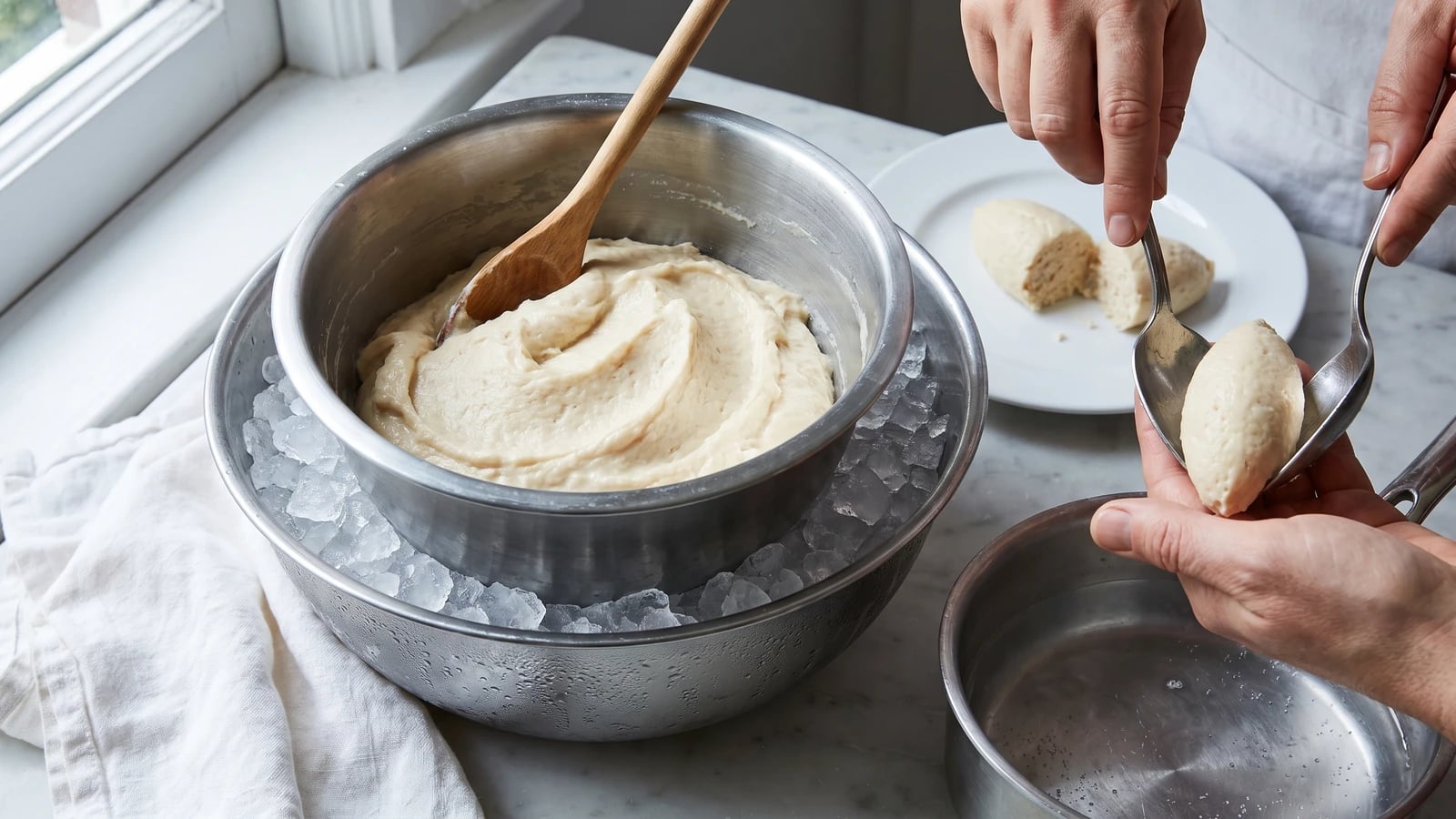
Chill the food processor bowl and blade, fine-mesh sieve, two metal mixing bowls, wooden spoon, and flexible scraper for 20 minutes. Fill the larger mixing bowl with ice and nest the smaller bowl inside it. Keep the chicken, egg white, panada, and both portions of cream at 40°F (4°C) or colder without freezing them. Cold is not ceremony here; it preserves the emulsion that gives the farce its fine, tender body.
Cut the trimmed chicken into ¾-inch pieces and combine it in the chilled processor with the salt, white pepper, and nutmeg. Process in short pulses, stopping frequently to scrape the bowl, until the meat becomes a fine, sticky paste with no visible pieces. If it starts feeling warm or rises above 50°F (10°C), spread it against the cold bowl and refrigerate it for 10 minutes before continuing. Speed saves the arm, but it must not warm the meat.
With the processor running, add the 2 tablespoons of cold egg white in four small additions, allowing each to disappear before the next. Break the C. Frangipan Panada (No. 192) into small pieces and add it gradually in the same fashion. Process only until the mixture is completely even, smooth, and tacky. The machine replaces the pestle, nothing more; adding everything at once would leave slippery pockets that the later cream cannot repair.
Set the fine-mesh sieve over the chilled bowl and force the farce through with a firm flexible scraper, working in small portions and scraping the underside clean. Tendons or coarse fibers left behind belong in the bin, not the quenelle. Spread the sieved farce in the bowl, press reusable wrap directly against its surface, and refrigerate it for a full hour. The processor is the modern scaffolding; this sieving and rest are part of the dish.
Return the bowl to its ice bath and stir the farce vigorously for several seconds with the wooden spoon. Add the 1 cup of unwhipped cream about 2 tablespoons at a time, beating until each addition has vanished completely before adding more. The farce should grow paler, softer, and glossy without becoming loose. If cream begins to pool or leave oily streaks, stop and chill the mixture for 10 minutes before resuming. If it has already turned grainy and begun to weep, Ça se rattrape: blend 2 tablespoons of the cold mixture with 1 teaspoon of the reserved egg white in the chilled processor until tacky, then add the broken mixture back one spoonful at a time. Return it to the ice before continuing.
Whip the remaining ½ cup of cream in a chilled bowl just until it forms soft, drooping peaks. Fold it into the cold farce in three additions with a broad spatula, turning the bowl and lifting from underneath so the air remains in the cream. Do not beat vigorously now. The finished farce should be very pale, smooth, and mellow, holding a soft ridge when the spatula passes through it.
Bring the water to 180 to 185°F (82 to 85°C), with only a gentle tremble at the surface. Using two wet spoons, shape 1 tablespoon of farce into a small oval and poach it for 6 to 8 minutes, turning once, until it holds its form and reaches 165°F (74°C) at the center. Taste it. It should be tender and moist but cohesive. If it is too light, spreading or threatening to break, beat in cold egg white 1 teaspoon at a time, rest the farce over ice for 5 minutes, and test again. If it is too stiff or rubbery, beat in cold cream 1 tablespoon at a time and retest. This small poach is where you correct the body before the whole batch commits.
Press wrap directly against the finished farce and keep it refrigerated at or below 40°F (4°C), or hold the bowl over ice while shaping. Use it the same day for fine quenelles, timbales, or a delicate stuffing. This remains a raw chicken preparation after the test portion is removed, so cook every finished piece or stuffed dish to 165°F (74°C) at its center.
1 serving (about 175g)
Culinary guides, cultural storytelling, and the editorial depth that makes cooking meaningful.
Discover Culinary ExplorerChef Juliette
Boulettes au suif, poached beside salt beef, turn equal weights of flour and finely chopped suet into tender, rich dumplings. Keep the beef liquor at a bare tremble and the old garnish works beautifully at home.

Chef Juliette
Bread, flour, frangipane, and rice become four cool, supple panades for binding forcemeats, each changing body and flavor while preserving tenderness. The finest Mousselines need none, and knowing that distinction is the lesson.

Chef Juliette
Panade au pain is bread, milk, salt, heat, and attention: stir until the paste releases cleanly, butter it against a skin, and you have the quiet binder behind tender French farces.

Chef Juliette
Panade de farine teaches the drying stroke behind pâte à choux: flour meets boiling buttered water, then stays over the fire until the paste gathers, smooths, and quits the pan cleanly.