
Chef Juliette
John Dory (St. Pierre)
John Dory has the delicacy of sole and the firmness of turbot. A light flouring, a quick butter sauté, and nut-brown beurre noisette show exactly why looks never mattered.
A cooking platform built around craft, culture, and the stories behind what we eat.
Created by Chef Juliette
Based on No. 1003, Éperlans à l’Anglaise, from Le Guide Culinaire (1907) by Auguste Escoffier
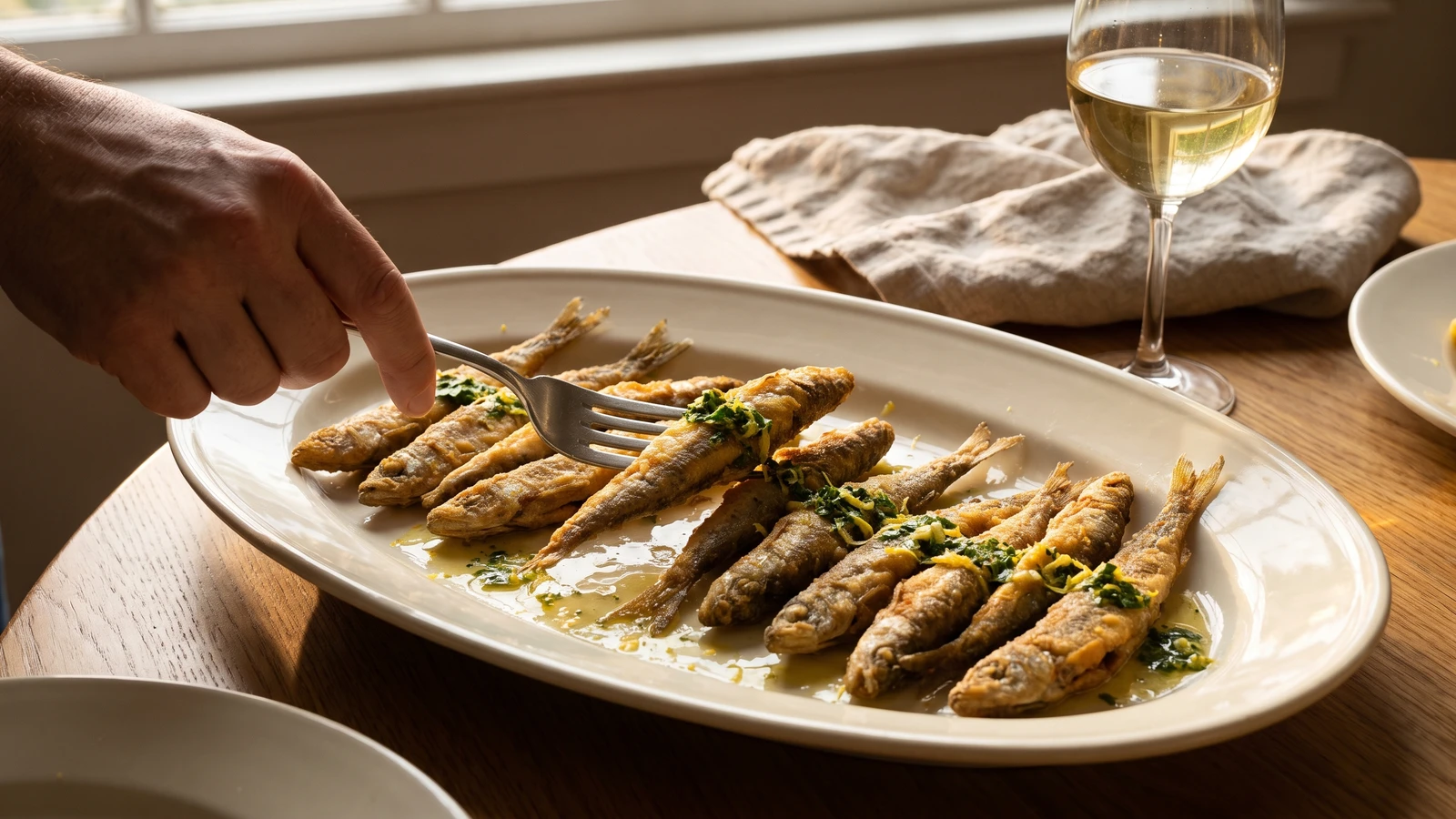
Éperlans à l’Anglaise turns small fish into a lesson in disciplined coating: boned smelts under a close, crisp crumb, pan-fried in clarified butter and finished with bright, half-melted maître d’hôtel butter.
Éperlans à l’Anglaise (smelts in a close egg-and-breadcrumb crust) teaches one true thing: the coating only becomes a fine, resistant shell when the fish is dry and the clarified butter is properly hot. Begin with damp fish or timid heat and the crumbs drink fat, loosen, and turn heavy. Begin correctly and each smelt comes out golden, delicate within, and ready for its parsley-flecked butter.
The grand canon often assumed a saucier at the elbow, stock never off the fire, and a salamander ready overhead. This entry needs none of them. It assumed instead a fish cook to bone a service pile without tearing it, clarified butter and two finished preparations waiting in the mise en place, and a long platter held hot. Here, the service pile becomes twenty medium smelts, enough for four as a generous main, while one wide skillet replaces the brigade pan and a low oven keeps the platter warm between batches. The quantities changed because four people are coming to dinner, not forty. The method did not.
The spare pair of hands is brigade scaffolding and can go. Opening the smelts down the back, lifting out the bones without spoiling their shape, coating them à l’anglaise, and frying in clarified butter are the dish itself, so all four stay. Pat the crumbs close with the flat of a knife before you approach the pan. That small gesture decides the crust.
Éperlans à l’Anglaise belongs to the Parisian classical table, where small smelts arriving from Channel and Atlantic estuaries were boned neatly and given the flour, egg, and fine-breadcrumb treatment French cooks call à l’anglaise. The fish is coastal rather than Parisian, but its orderly presentation on a long platter carried familiar fried smelts from market cookery into the grand repertoire. Despite the name, the preparation is not a claim that the dish is British: within the French canon, à l’anglaise names the close crumb coating that sets immediately in hot fat.
Quantity
20 fish (about 1¾ lb / 800 g)
cleaned and gutted through the gills if possible, kept cold
Quantity
¾ cup (180 ml / 90 g)
Quantity
¾ cup (180 ml / 180 g) Anglaise (for Egg-and-bread-crumbing) (No. 174)
Quantity
2 cups (480 ml / 200 g)
Quantity
1½ cups (360 ml / 340 g)
for shallow pan-frying
Quantity
½ cup (120 ml / 115 g) Butter à la Maître d’Hôtel (No. 150)
softened to a spoonable, half-melted consistency
| Ingredient | Quantity |
|---|---|
| medium whole smeltscleaned and gutted through the gills if possible, kept cold | 20 fish (about 1¾ lb / 800 g) |
| all-purpose flour | ¾ cup (180 ml / 90 g) |
| Anglaise (for Egg-and-bread-crumbing) | ¾ cup (180 ml / 180 g) Anglaise (for Egg-and-bread-crumbing) (No. 174) |
| fine dry white breadcrumbs | 2 cups (480 ml / 200 g) |
| clarified unsalted butterfor shallow pan-frying | 1½ cups (360 ml / 340 g) |
| Butter à la Maître d’Hôtelsoftened to a spoonable, half-melted consistency | ½ cup (120 ml / 115 g) Butter à la Maître d’Hôtel (No. 150) |
Heat the oven to 200°F (95°C) and place a long ovenproof serving platter inside. Keep the smelts cold as you work. Lay one fish belly-down and use the tip of a narrow flexible knife to cut along one side of the backbone from just behind the head to near the tail, then repeat along the other side. Open the fish through the back like a book without cutting through the belly skin. Snip the backbone near the head and tail, lift it out carefully, and remove any visible pin bones with tweezers. Close the fish so it regains its slender shape, then repeat with the remaining smelts. Blot every fish completely dry inside and out.
Arrange three shallow dishes in order: the flour, the Anglaise (for Egg-and-bread-crumbing) (No. 174), and the fine breadcrumbs. Work with four or five smelts at a time. Dust each lightly with flour and shake away every loose patch, coat it thoroughly in the Anglaise, let the excess drain, then lay it in the crumbs. Cover both sides and pat very lightly with the flat of a broad knife so the coating adheres without becoming thick or compacted. Rest the coated fish for 5 minutes. If a bare patch opens when you lift one, dab that spot with a little more Anglaise, cover it with crumbs, and rest it for another 2 minutes. Ça se rattrape.
Pour enough clarified butter into a 12-inch (30 cm) heavy skillet to form a layer about ⅛ inch (3 to 4 mm) deep, reserving the rest to replenish the pan. Heat it over medium-high heat to 350 to 360°F (175 to 182°C). Without a thermometer, drop in a pinch of crumbs: they should rise at once amid lively bubbles and turn gold gradually, not blacken on contact. If the butter smokes or the test crumbs darken immediately, pull the pan from the heat for 30 seconds. If the crumbs sink with barely a bubble, wait. Very hot fat sets the egg-and-crumb coat before it can absorb butter.
Lower four or five smelts into the hot clarified butter without crowding them. Fry undisturbed for 1½ to 2 minutes, until the underside is an even butter-gold and the edges of the crust look fixed. Turn each fish once with a thin fish slice and cook the second side for 1 to 1½ minutes, until crisp and golden; the flesh inside should be opaque and separate in moist flakes. If the coating remains pale and greasy, the butter cooled too far. Lift the fish out, restore the heat, and return them for 20 to 30 seconds per side. Drain each batch on a wire rack for half a minute, then transfer it to the warm platter. Replenish the clarified butter as needed and let it regain its heat before the next batch.
Set the Butter à la Maître d’Hôtel (No. 150) over a bowl of warm water and stir just until it resembles a soft cream with a little melted butter around its edges. It should be half-melted, not reduced to clear oil. If it liquefies completely, set the bowl briefly in cool water and whisk until creamy again. Spoon the butter over the arranged smelts in small glossy drops and loose ribbons so its parsley and lemon season the fish without drowning the crust. Carry the long platter directly to the table. À table!
1 serving (about 230g)
Culinary guides, cultural storytelling, and the editorial depth that makes cooking meaningful.
Discover Culinary ExplorerChef Juliette
John Dory has the delicacy of sole and the firmness of turbot. A light flouring, a quick butter sauté, and nut-brown beurre noisette show exactly why looks never mattered.

Chef Juliette
Fresh haddock proves its delicacy in the meunière pan: a fine flour crust, moist pearly flakes, and beurre noisette sharpened with lemon and parsley, ready from one skillet in half an hour.

Chef Juliette
Tiny smelts, shallot, mushrooms, white wine, gratin sauce, and fine bread raspings meet a fierce oven, where the fish must turn tender in the same breath the buttered crust bronzes.

Chef Juliette
Éperlans Grillés make delicacy from discipline: smelts opened along the back, partly boned, floured and buttered, then broiled in minutes and served with lemon, crisp parsley, and beurre maître d’hôtel.