
Chef Juliette
John Dory (St. Pierre)
John Dory has the delicacy of sole and the firmness of turbot. A light flouring, a quick butter sauté, and nut-brown beurre noisette show exactly why looks never mattered.
A cooking platform built around craft, culture, and the stories behind what we eat.
Created by Chef Juliette
Based on No. 1005, Éperlans Grillés, from Le Guide Culinaire (1907) by Auguste Escoffier
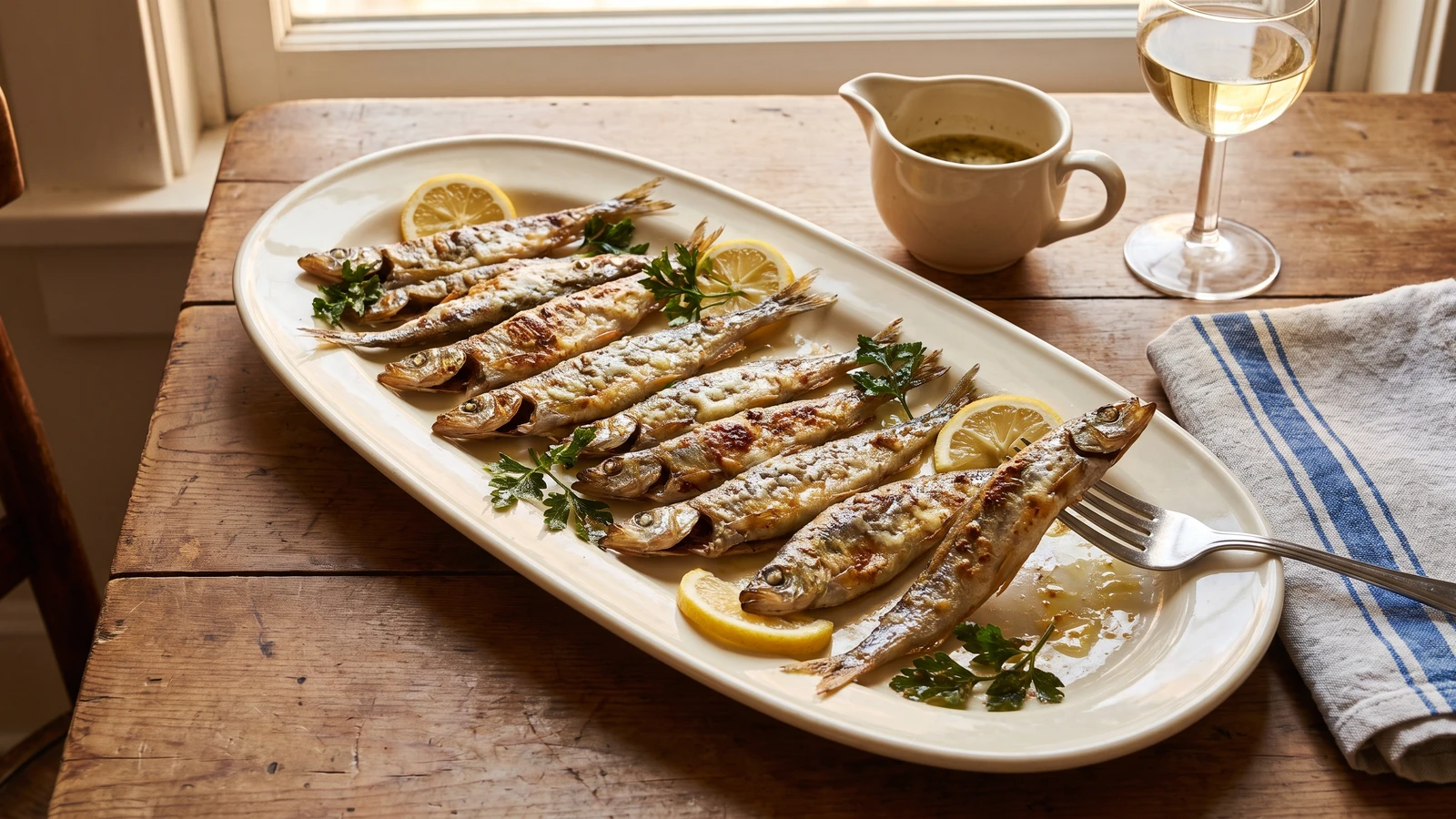
Éperlans Grillés make delicacy from discipline: smelts opened along the back, partly boned, floured and buttered, then broiled in minutes and served with lemon, crisp parsley, and beurre maître d’hôtel.
Éperlans Grillés (quickly grilled smelts) teach the clean discipline of small-fish cookery: dry fish, a veil of flour, real butter, and fierce heat for only a few minutes. The one true thing is speed. Once these little fish meet the heat, hesitation dries them before color arrives.
The source entry assumes a fish cook to open and partly bone every smelt, a brigade grill or salamander fierce enough for instant color, and, if its sauce option is chosen, a saucier with a finished fish sauce waiting. At home, the broiler supplies the honest overhead heat, while the entry’s other service, beurre maître d’hôtel (parsley-lemon butter), removes the separate sauce station without changing the dish’s intent. A pound and a quarter feeds four. One cook, one stove, one evening.
Only the brigade scaffolding goes: the extra hands and the separate fish sauce. The back opening, partial boning, flour, butter, fast grilling, lemon, and fried parsley all stay because they are the dish. Take your time opening the smelts, then blot them until the flour falls over them like dust rather than paste. That dry surface is the step that decides everything.
Éperlans belong to the brackish mouths of northern French rivers, especially the Seine estuary in Normandy, and their catches traveled through Paris fish markets into bistro and bourgeois kitchens. Most diners know them as friture d’éperlans, eaten whole and crisp, but this grilled service is deliberately more fastidious: the fish are opened along the back, most of the spine is removed, and butter with fierce heat replaces the frying bath.
Quantity
16 to 20 fish, about 1¼ pounds (560 g)
scaled if necessary
Quantity
1½ teaspoons (7.5 ml / 9 g)
divided
Quantity
½ teaspoon (2.5 ml / 1 g)
divided
Quantity
½ cup (120 ml / 60 g)
Quantity
4 tablespoons (60 ml / 56 g)
melted, for the smelts
Quantity
6 tablespoons (90 ml / 85 g)
softened, for the beurre maître d’hôtel
Quantity
1 tablespoon (15 ml / 4 g)
finely chopped
Quantity
2
1 cut into thin rounds and 1 reserved for juice
Quantity
12 small sprigs
washed and thoroughly dried
Quantity
1 cup (240 ml / 220 g)
| Ingredient | Quantity |
|---|---|
| whole smeltsscaled if necessary | 16 to 20 fish, about 1¼ pounds (560 g) |
| fine sea saltdivided | 1½ teaspoons (7.5 ml / 9 g) |
| freshly ground white pepperdivided | ½ teaspoon (2.5 ml / 1 g) |
| all-purpose flour | ½ cup (120 ml / 60 g) |
| unsalted buttermelted, for the smelts | 4 tablespoons (60 ml / 56 g) |
| unsalted buttersoftened, for the beurre maître d’hôtel | 6 tablespoons (90 ml / 85 g) |
| flat-leaf parsleyfinely chopped | 1 tablespoon (15 ml / 4 g) |
| lemons1 cut into thin rounds and 1 reserved for juice | 2 |
| curly parsley sprigswashed and thoroughly dried | 12 small sprigs |
| neutral frying oil | 1 cup (240 ml / 220 g) |
Beat the softened butter with the chopped flat-leaf parsley, 2 teaspoons (10 ml) lemon juice, ¼ teaspoon of the salt, and half the white pepper. Work it until evenly green-flecked and creamy, then cover and keep it cool but not hard. This butter will be half-melted just before serving, so it must begin supple enough to soften evenly.
Heat the neutral oil in a small deep saucepan to 350°F (175°C). The parsley must be absolutely dry because water makes hot oil spit. Lower in two or three sprigs at a time and fry for 10 to 15 seconds, just until bright green and crisp. Lift them onto paper, season with a small pinch of salt, and repeat. If the oil spits sharply, move the pan off the heat and let it settle before continuing; never reach over it.
Lay one smelt belly-down. Starting just behind the head, run the tip of a sharp flexible knife along one side of the backbone almost to the tail, then repeat on the other side. Open the fish from the back like a book without cutting through the belly skin, remove the viscera, and wipe the cavity clean. Snip through the backbone about ½ inch (1 cm) behind the head and the same distance before the tail, then lift out the long central section, leaving the two small anchors directed by the source. If the flesh begins to tear, stop pulling and snip the bone closer instead; a small tear can be laid closed on the rack and will barely show once floured. Repeat with the remaining fish, then blot every surface thoroughly dry.
Position an oven rack about 4 inches (10 cm) below the broiler and heat the broiler on high for at least 10 minutes. Line a large rimmed sheet pan with foil and set a lightly buttered wire rack over it. Season the opened smelts with the remaining salt and pepper, dredge them on both sides in the flour, and shake each one firmly so only a thin veil remains. Brush both sides generously with the melted butter. Flour left thick turns pasty under the broiler; the fish should look dusted, not breaded.
Arrange the smelts open and flesh-side up on the rack without overlapping. Broil for about 2 minutes, until the butter sputters and the flour takes small hazelnut-gold patches. Turn them gently with a thin fish spatula and broil for 1 to 2 minutes more, until the skins glisten, the flesh is opaque, and the finest edges are lightly crisp. If the butter darkens before the flour colors, lower the pan one rack level immediately. If chalky spots remain when the fish are nearly done, touch those spots with a little more melted butter and broil for only 20 seconds. Small fish have no patience.
Put the beurre maître d’hôtel in a small saucepan over the lowest heat. Stir just until roughly half the butter has melted and the rest remains soft, making a creamy, spoonable mixture rather than a pool of clear fat. If it separates, take it off the heat, set the base of the pan in a bowl of cool tap water, and whisk until it turns creamy again. Ça se rattrape. Transfer it to a warmed sauceboat.
Warm a long platter with hot tap water, dry it well, and arrange the Éperlans Grillés head-to-tail while they are still glossy from the broiler. Surround them with the lemon rounds and gather the fried parsley into small bunches along the platter. Serve the half-melted beurre maître d’hôtel separately, letting each person spoon it over the fish. À table!
1 serving (about 170g)
Culinary guides, cultural storytelling, and the editorial depth that makes cooking meaningful.
Discover Culinary ExplorerChef Juliette
John Dory has the delicacy of sole and the firmness of turbot. A light flouring, a quick butter sauté, and nut-brown beurre noisette show exactly why looks never mattered.

Chef Juliette
Fresh haddock proves its delicacy in the meunière pan: a fine flour crust, moist pearly flakes, and beurre noisette sharpened with lemon and parsley, ready from one skillet in half an hour.

Chef Juliette
Éperlans à l’Anglaise turns small fish into a lesson in disciplined coating: boned smelts under a close, crisp crumb, pan-fried in clarified butter and finished with bright, half-melted maître d’hôtel butter.

Chef Juliette
Tiny smelts, shallot, mushrooms, white wine, gratin sauce, and fine bread raspings meet a fierce oven, where the fish must turn tender in the same breath the buttered crust bronzes.