
Chef Juliette
Smelt (Éperlans)
Tiny éperlans, lightly floured and fried until their tails stand crisp, arrive in a generous heap on a napkin with fried parsley and grooved lemon, a weeknight lesson in heat and restraint.
A cooking platform built around craft, culture, and the stories behind what we eat.
Created by Chef Juliette
Based on No. 364, Natives with Caviare, from Le Guide Culinaire (1907) by Auguste Escoffier
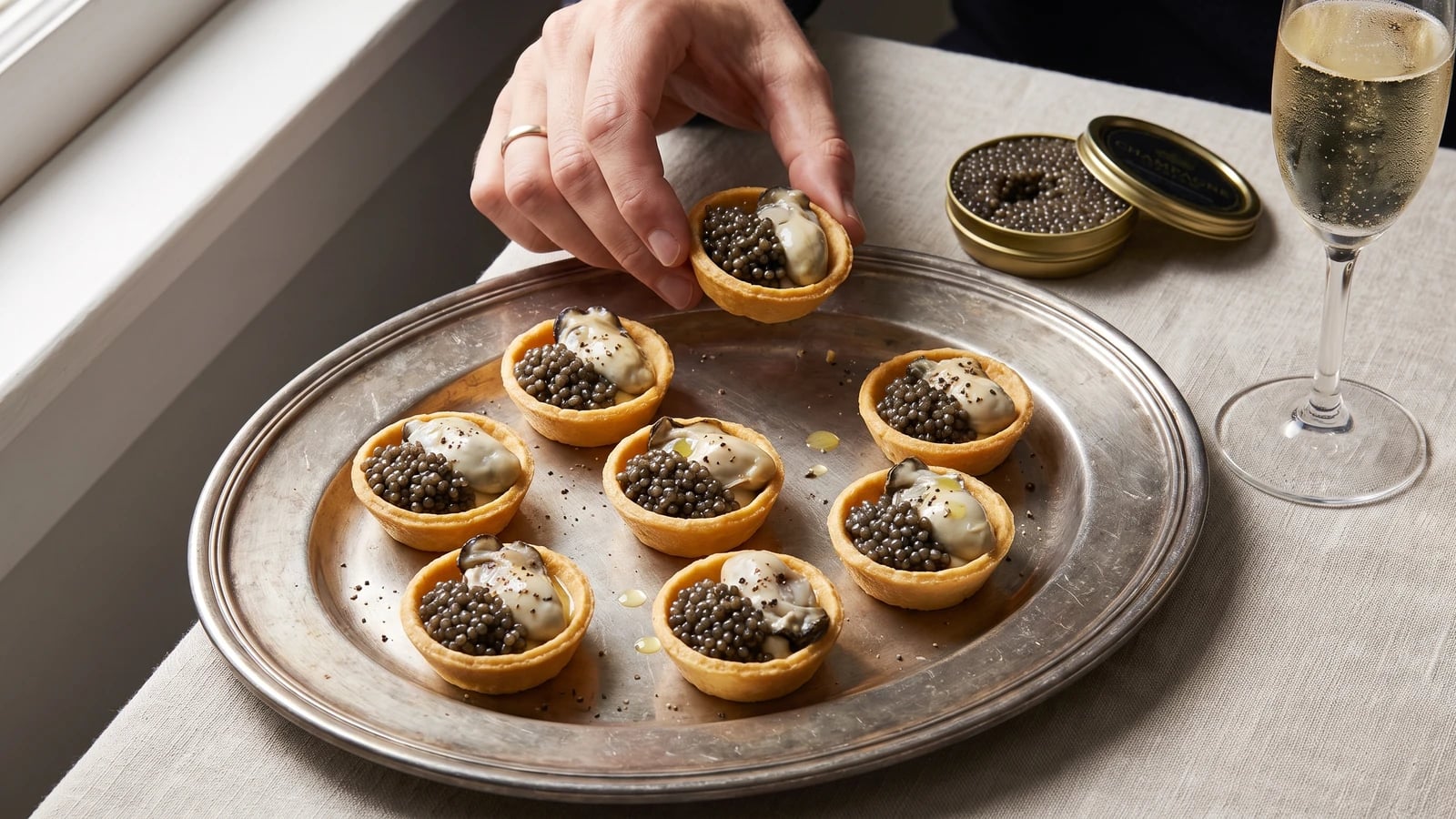
A crisp little shell, a spoonful of black caviar, and a cold Whitstable oyster: three textures held in balance, assembled at the last moment so pastry stays crisp and the sea tastes clear.
Tartelettes de caviar aux huîtres de Whitstable (caviar tartlets with Whitstable oysters) teach the discipline of contrast. Crisp butter pastry holds cool caviar that yields under the teeth, while the oyster stays plump, mineral, and barely sharpened by pepper and lemon. Before you touch a shell, know the one true thing: the tartlet must remain dry until the moment it is eaten.
No saucier, stockpot, or salamander belongs here. The original assumes a garde-manger, the cold station, with trays of tiny crusts ready, an oyster shucker working to order, and caviar portioned from a service tin. At home, that brigade batch becomes eight finished bites plus two spare cases, assembled by one cook. The trays and handoffs were scaffolding, so they go; the small crusts from Tartlets and Barquettes (No. 387), one tablespoon of caviar in each, the ébarbée oyster, pepper, and lemon are the dish, so none of them moves. One cook, one stove, one evening, though the stove has finished its work once the pastry cools.
Drain the oysters without pressing them, then fill the cases only when your guests are ready to take one. That last-minute assembly decides everything: dry oyster, crisp shell, no waiting.
Natives with Caviare belongs to the cosmopolitan French grand-kitchen hors-d’œuvre repertoire, but its geographic anchor is Whitstable on the Kent coast rather than a French oyster district. In the English service title, natives means the European flat oyster, Ostrea edulis, not simply whatever oyster happens to be local. The broader tartlet family often carried compound butter, mousse, or aspic; this version strips all that away and trusts pastry, fresh caviar, oyster, pepper, and lemon.
Quantity
10 from Tartlets and Barquettes (No. 387)
completely cooled and dry, with 8 for serving and 2 spare
Quantity
1/2 cup (120 ml / 125 g)
well chilled
Quantity
8
scrubbed and well chilled
Quantity
1/8 teaspoon (0.6 ml / 0.6 g)
Quantity
1 pinch (0.3 ml / 0.1 g)
| Ingredient | Quantity |
|---|---|
| small baked tartlet crustscompletely cooled and dry, with 8 for serving and 2 spare | 10 from Tartlets and Barquettes (No. 387) |
| fine fresh sturgeon caviarwell chilled | 1/2 cup (120 ml / 125 g) |
| live Whitstable native oystersscrubbed and well chilled | 8 |
| fresh lemon juice | 1/8 teaspoon (0.6 ml / 0.6 g) |
| finely powdered pepper | 1 pinch (0.3 ml / 0.1 g) |
Keep the unopened caviar and live oysters in the coldest part of the refrigerator until needed. Set eight completely cooled tartlet crusts from Tartlets and Barquettes (No. 387) on a dry board at room temperature, with two spares nearby. Do not refrigerate the pastry: a cold crust gathers condensation when it meets the room, and damp pastry has already lost the argument.
Wrap each oyster in a folded towel with its flatter shell uppermost and the hinge exposed. Work an oyster knife into the hinge, twist until the shell releases, then slide the blade beneath the top shell to sever the muscle. Lift away the shell, release the oyster from the lower cup, and remove any shell fragments. Ébarbez the oyster, meaning trim only the loose, ragged dark fringe from its edge with small scissors. Keep the creamy body whole. Lay each oyster on a clean folded cloth for 2 to 3 minutes so free liquor drains away, then cover and return it briefly to the refrigerator. Never rinse it or press it dry.
Open the caviar only when all eight oysters are ready. Spoon 1 level tablespoon into each tartlet crust from Tartlets and Barquettes (No. 387), carrying the caviar close to the pastry so the beads are not dropped or crushed. With the back of the spoon, coax the caviar toward the edge and form a shallow hollow in the centre. If a crust cracks, lift the caviar into a spare dry case instead of trying to patch it.
Nest one drained, ébarbée oyster in each hollow, cupped side downward so it sits securely without burying the caviar. Divide the powdered pepper among the oysters, then touch each with one small drop of lemon juice from the tip of a teaspoon. A squeeze would swamp the bite; the source asks for a drop, and it means it. If an oyster releases a puddle and the pastry begins to soften, transfer the oyster and caviar at once to a spare tartlet crust from Tartlets and Barquettes (No. 387). Ça se rattrape.
Arrange the tartlets on the dry serving platter and carry them directly to the table. They should be cool rather than numb with cold, and each should be eaten in one or two bites so crisp pastry, caviar, oyster, pepper, and lemon arrive together. À table!
1 serving (about 80g)
Culinary guides, cultural storytelling, and the editorial depth that makes cooking meaningful.
Discover Culinary ExplorerChef Juliette
Tiny éperlans, lightly floured and fried until their tails stand crisp, arrive in a generous heap on a napkin with fried parsley and grooved lemon, a weeknight lesson in heat and restraint.

Chef Juliette
Brandade de Morue turns salt cod, warm olive oil, and milk into a pale, silky emulsion: keep everything warm and add the oil slowly, then crown the generous dome with butter-fried bread.

Chef Juliette
Salt cod worked warm with cream, one patient spoonful at a time, until the rough flakes become a glossy Nîmes paste, domed generously and ringed with butter-fried croutons for the table.

Chef Juliette
Wine-poached char packed in its earthenware crock beneath butter gold: a make-ahead first course that turns careful cooling, thorough boning, and one unbroken seal into quiet abundance.