
Chef Juliette
Smelt (Éperlans)
Tiny éperlans, lightly floured and fried until their tails stand crisp, arrive in a generous heap on a napkin with fried parsley and grooved lemon, a weeknight lesson in heat and restraint.
A cooking platform built around craft, culture, and the stories behind what we eat.
Created by Chef Juliette
Based on No. 353, Fresh Herrings Marinaded in White Wine, from Le Guide Culinaire (1907) by Auguste Escoffier
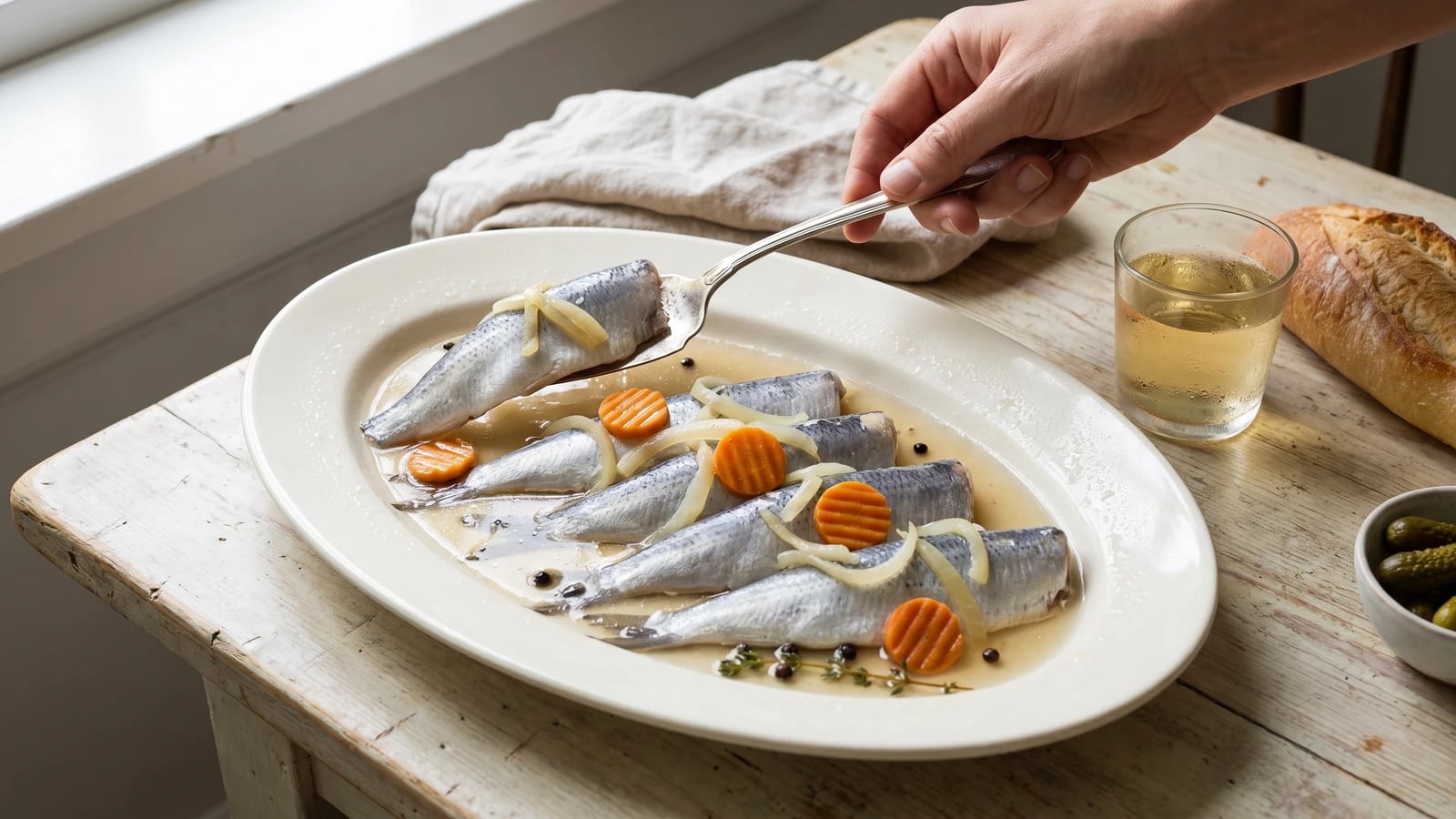
Harengs frais marinés au vin blanc teach acidulated poaching: cook the aromatic liquor first, let the fish barely tremble in it, then chill everything together until the flesh drinks in wine, vinegar, and herbs.
Harengs frais marinés au vin blanc (fresh herrings marinaded in white wine) teach one clean principle: cook the marinade before the fish ever sees it. Twenty gentle minutes soften the onion and carrot and draw the bouquet garni into the wine; only then does the herring enter, so its rich flesh stays moist while the liquor becomes bright, aromatic, and clear.
The source expected twelve herrings, a broad sauté-pan, a ready bouquet garni, and a cold larder. For one cook, one stove, one evening, four fish sit snugly in a 30 cm sauté pan and the refrigerator becomes the larder. The 4:1 ratio of wine to vinegar, the twenty-minute cooked marinade, the fifteen-minute poach, and the cooling in liquor stay untouched. Grooving the carrot is brigade decoration, not structure; make the roundels if you enjoy them, or slice the carrot plainly. Cooked Marinade for Venison (No. 168) supplies the parent model for the herb bundle, but this entry's lighter liquor governs the fish.
Served properly cold, the herrings are silvery and tender, with softened onion, bright carrot, and enough sharp liquor to balance their natural richness. The one step that decides the dish is the poach: after the boiling marinade meets the fish, let the liquid barely tremble, because a hard boil splits the skin, roughens the flesh, and muddies the liquor.
Harengs frais marinés au vin blanc belong to the Channel and North Sea coasts, particularly Normandy, Picardy, and French Flanders, where fresh herring joined salted and smoked fish on the cold table. The preparation traveled readily from port households to charcutiers' counters and bistro hors-d'oeuvre tables because oily herring improves after resting in acidulated wine. This is not a raw pickle: the marinade cooks first, the fish is fully poached, and only then does cold time season it through.
Quantity
4 (about 1½ lb / 680 g total)
scaled, gutted, and heads and gills removed
Quantity
¾ cup (180 ml / 180 g)
Quantity
3 tablespoons (45 ml / 45 g)
Quantity
⅓ medium (about 1.8 oz / 50 g)
cut into very thin strips
Quantity
1 small piece (about 0.7 oz / 20 g)
grooved if desired and cut into thin roundels
Quantity
1, prepared as in Cooked Marinade for Venison (No. 168)
Quantity
1 teaspoon (5 ml / 5 g)
Quantity
8
| Ingredient | Quantity |
|---|---|
| small whole fresh herringsscaled, gutted, and heads and gills removed | 4 (about 1½ lb / 680 g total) |
| dry white wine | ¾ cup (180 ml / 180 g) |
| white wine vinegar | 3 tablespoons (45 ml / 45 g) |
| yellow onioncut into very thin strips | ⅓ medium (about 1.8 oz / 50 g) |
| carrotgrooved if desired and cut into thin roundels | 1 small piece (about 0.7 oz / 20 g) |
| small bouquet garni (herb bundle) | 1, prepared as in Cooked Marinade for Venison (No. 168) |
| fine sea salt | 1 teaspoon (5 ml / 5 g) |
| black peppercorns | 8 |
Rinse the cleaned herrings briefly inside and out, then dry them well. Check each cavity for any remaining blood or gill fragments, which can make the liquor bitter. Lay the fish in a snug, nonreactive 30 cm sauté pan in a single layer. They may touch, but they must not overlap; close packing allows this small quantity of marinade to surround them properly.
Put the white wine, vinegar, onion, carrot, salt, and peppercorns into a small nonreactive saucepan. Add the small bouquet garni prepared as in Cooked Marinade for Venison (No. 168). Bring the liquor to a gentle boil, lower the heat, and cook for twenty minutes with the lid slightly ajar. Keep it bubbling quietly, not racing, so the vegetables soften and the herbs give up their perfume without the small volume evaporating away. At the end, the onion should be supple and the raw sting of vinegar should have rounded.
Pour the boiling marinade, vegetables and all, over the herrings. Set the sauté pan over low heat, cover it, and wait until the liquor shows only the faintest movement around the edges. Poach for fifteen minutes, spooning hot liquor over any exposed portions once or twice without turning the fragile fish. The flesh should be opaque beside the backbone and reach 63°C / 145°F at the thickest point. If the liquid begins to boil hard, pull the pan off the heat for a minute and lower the flame before continuing. If a skin has already split, don't move the fish; finish it in the residual heat and chill it in place. Ça se rattrape.
Take the pan from the heat and remove the bouquet garni, leaving the onion, carrot, and peppercorns with the fish. Let everything cool undisturbed for thirty minutes, then cover and refrigerate within one hour of leaving the stove. Chill for at least four hours, preferably overnight. Don't lift the herrings while warm; their flesh firms in the cold and will be much easier to move intact.
Spoon some onion strips and carrot roundels onto a chilled oval platter. Lift each herring with two broad spatulas, settle it onto the vegetables, and spoon over enough marinade to pool around the fish without drowning the platter. Scatter the remaining onion and carrot over the top. Serve one whole herring per person, with good bread and the understanding that the backbone and fine pin bones are removed at the table. À table!
1 serving (about 170g)
Culinary guides, cultural storytelling, and the editorial depth that makes cooking meaningful.
Discover Culinary ExplorerChef Juliette
Tiny éperlans, lightly floured and fried until their tails stand crisp, arrive in a generous heap on a napkin with fried parsley and grooved lemon, a weeknight lesson in heat and restraint.

Chef Juliette
Brandade de Morue turns salt cod, warm olive oil, and milk into a pale, silky emulsion: keep everything warm and add the oil slowly, then crown the generous dome with butter-fried bread.

Chef Juliette
Salt cod worked warm with cream, one patient spoonful at a time, until the rough flakes become a glossy Nîmes paste, domed generously and ringed with butter-fried croutons for the table.

Chef Juliette
Wine-poached char packed in its earthenware crock beneath butter gold: a make-ahead first course that turns careful cooling, thorough boning, and one unbroken seal into quiet abundance.