
Chef Juliette
Smelt (Éperlans)
Tiny éperlans, lightly floured and fried until their tails stand crisp, arrive in a generous heap on a napkin with fried parsley and grooved lemon, a weeknight lesson in heat and restraint.
A cooking platform built around craft, culture, and the stories behind what we eat.
Created by Chef Juliette
Based on No. 333, York Cones, from Le Guide Culinaire (1907) by Auguste Escoffier
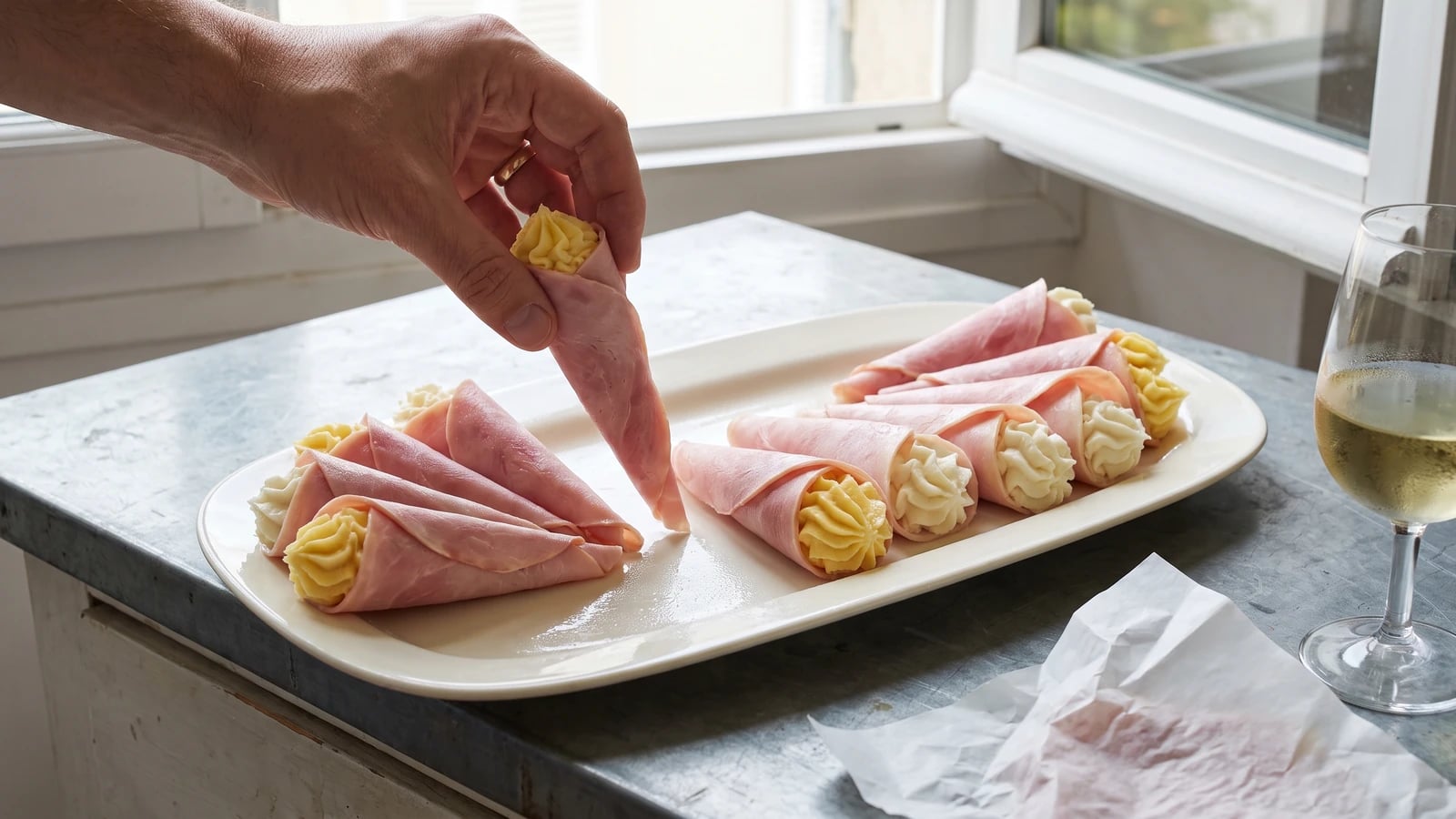
Paper-thin York ham becomes a proper cornet when its seam holds and its filling stays cool: two neat bites, one piped with savoury butter, the other with chicken cream.
Cornets de jambon d’York (York ham cones) teach the discipline of the cold hors-d'œuvre: structure comes from thinness and temperature, not cooking. The one true thing is simple. The ham must be sliced almost sheer. Too thick and it fights the roll; thin enough and it folds around the filling as neatly as paper without becoming tough under the teeth.
The original entry assumed a garde-manger with a whole ham sliced to order, a cold room, prepared bowls of butter and cream, and a piping bag already fitted with a grooved pipe. The honest home equivalent is the deli's slicing machine, a chilled platter, and two small bags with open-star tips. This version scales the buffet down to twelve cornets, six with each referenced filling. The brigade's separate preparation work remains in those linked formulas; that is scaffolding. The triangular cut, close roll, cool filling, and grooved piping stay, because they are the dish. One cook, one stove left entirely cold, one evening.
Before you begin, hold a slice toward the light. If you can see the shadow of your fingers and the ham bends without cracking, it is ready. That thin cut decides everything that follows.
Cornets de jambon d’York belong to the French garde-manger, the cold pantry responsible for hors-d'œuvres and buffet work, rather than to a regional Yorkshire snack. French cold kitchens valued York ham for its broad, firm slices, which could be cut nearly translucent and shaped around seasoned butters and creams without collapsing. The cornet passed easily from formal buffet service to the home apéritif platter because its polish comes from careful cutting and piping, not elaborate cooking.
Quantity
12 large slices (about 8 oz / 225 g)
cut paper-thin at the deli
Quantity
⅓ cup (80 ml / 75 g) Butters and Creams (No. 280)
cool but pliable
Chill the serving platter while you work. Keep the Chicken Cream (No. 299) in the refrigerator, and let the prepared hors-d'oeuvre butter selected from Butters and Creams (No. 280) stand only until it yields beneath a spatula without turning glossy. Both are finished preparations, so their separate methods remain in their own entries; here you are concerned only with seasoning them as directed and bringing them to a texture that will pass cleanly through the grooved pipe.
Lay the ham flat on a dry board and blot away any surface moisture. Using a parchment template if helpful, trim each slice into a triangle about 3½ inches (9 cm) across the base and 4½ inches (11 cm) from base to point. The ham must be almost sheer: thick ham springs open, while a fine slice bends into a smooth cornet and remains tender against the cool filling. If a slice tears, overlap the torn edges by ¼ inch (6 mm) rather than discarding it. Ça se rattrape. Keep the trimmings chilled for an omelette or croque monsieur.
Set one triangle with its point facing you and its broad base away. Bring one base corner toward the centre, wrap the opposite corner over it, and adjust the overlap until the point closes neatly and the mouth remains open. Place the cornet seam-side down and repeat, making six for each filling. If one springs apart, roll it a little more loosely and place a pea-sized dab of its assigned filling beneath the overlap; pressure from the piping will finish the work.
Taste and season the prepared butter from Butters and Creams (No. 280) and the Chicken Cream (No. 299) exactly as their entries direct, at the last possible moment. Fit two small piping bags with ½-inch (12 mm) open-star tips, or use one clean bag twice. If the butter breaks into rough ridges, it is too cold; knead the closed bag briefly between cool hands. If it gleams and slumps, chill it for 5 minutes. If the Chicken Cream softens, rest its sealed bag over ice for 5 minutes. Don't add crumbs or flour. The proper texture can be recovered without changing the filling.
Insert the tip nearly to the closed point of the first cornet. Squeeze steadily while withdrawing the bag so the filling rises from the bottom without leaving a hollow, then finish with one ridged rosette just above the rim. Fill six cornets with the prepared butter from Butters and Creams (No. 280), then six with the Chicken Cream (No. 299). Wipe any smears from the ham with the corner of a clean, barely damp cloth.
Arrange the cornets seam-side down on the chilled platter, alternating the pale butter and ivory cream fillings so guests can distinguish them. Keep them cold and covered until the table is ready, but serve promptly once the poultry cream has been piped. The ham should remain supple, the points neatly closed, and every grooved crest should hold its shape. À table!
1 serving (about 63g)
Culinary guides, cultural storytelling, and the editorial depth that makes cooking meaningful.
Discover Culinary ExplorerChef Juliette
Tiny éperlans, lightly floured and fried until their tails stand crisp, arrive in a generous heap on a napkin with fried parsley and grooved lemon, a weeknight lesson in heat and restraint.

Chef Juliette
Brandade de Morue turns salt cod, warm olive oil, and milk into a pale, silky emulsion: keep everything warm and add the oil slowly, then crown the generous dome with butter-fried bread.

Chef Juliette
Salt cod worked warm with cream, one patient spoonful at a time, until the rough flakes become a glossy Nîmes paste, domed generously and ringed with butter-fried croutons for the table.

Chef Juliette
Wine-poached char packed in its earthenware crock beneath butter gold: a make-ahead first course that turns careful cooling, thorough boning, and one unbroken seal into quiet abundance.