
Chef Juliette
Smelt (Éperlans)
Tiny éperlans, lightly floured and fried until their tails stand crisp, arrive in a generous heap on a napkin with fried parsley and grooved lemon, a weeknight lesson in heat and restraint.
A cooking platform built around craft, culture, and the stories behind what we eat.
Created by Chef Juliette
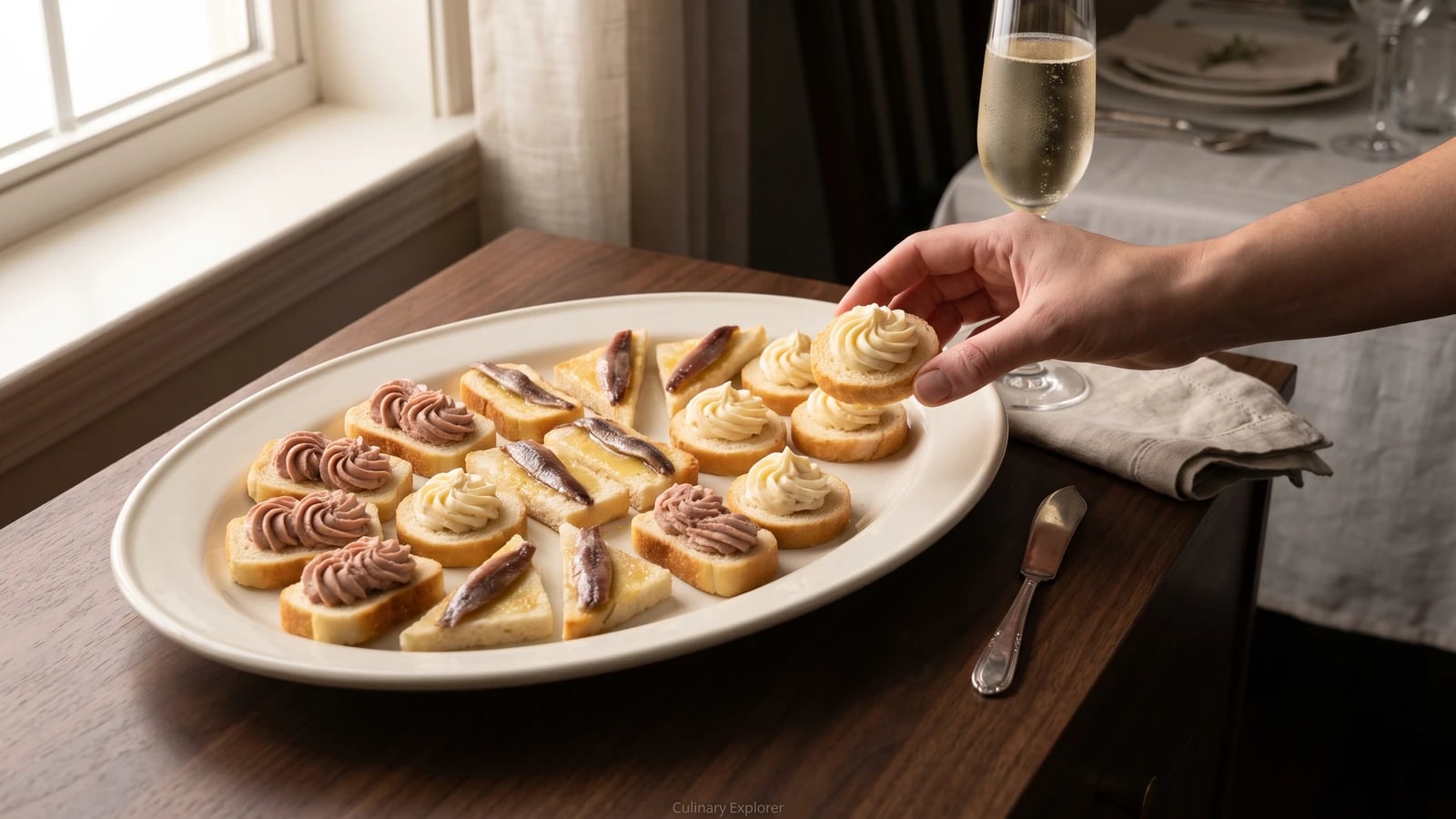
Based on No. 316, Canapés and Toast, from Le Guide Culinaire (1907) by Auguste Escoffier
Thin rounds of bread, barely toasted and buttered while hot, become the cold table's most useful foundation: tender beneath, neat at the edge, and ready for chicken butter, anchovy, or venison.
Canapés et toasts (small garnished toasts) teach the first law of the cold table: butter the bread while it is hot. That immediate coat sinks into the warm crumb and keeps the centre tender beneath its lightly toasted surface. Miss the moment and you have a dry little platform, no matter how splendid the garnish.
The grand cold table assumed a garde-manger with trays of compound butters, a salamander waiting for bread, and several hands cutting crescents, stars, and crosses to order. At home, one sheet pan replaces the salamander, three simple shapes distinguish the garnishes, and a small fluted piping tip does the work cleanly. The ornamental cutter cabinet was brigade scaffolding and can go. Thin crumb, restrained toasting, and immediate butter are the dish and must stay. One cook, one stove, one evening.
These canapés give you three expressions of the method: finely minced roast chicken worked into butter, anchovy laid over a well-buttered base, and venison prepared with the book's separate marinade before being minced into another compound butter. Have the softened butter beside you before the tray leaves the oven. That is the step that decides the dish.
Canapés belong to the Parisian hors-d'œuvre and cold-table tradition, where canapé and toast came to describe the same small foundation of lightly toasted bread carrying a savoury garnish. The name is borrowed from the French word for a sofa, a neat joke in which the garnish sits upon its bread as a guest sits upon a settee. Grand dining rooms multiplied the shapes and toppings, while household receptions kept the essential method: small portions, a tender buttered crumb, and garnishes chosen from whatever good things the cook had ready.
Quantity
6 slices, each ¼ inch (6 mm) thick (about 5 oz / 140 g total)
crusts removed
Quantity
9 tablespoons (135 ml / 128 g)
softened and divided
Quantity
2 ounces (57 g)
chilled and very finely minced
Quantity
4 ounces (115 g)
Quantity
½ cup (120 ml / 120 g) Cooked Marinade for Venison (No. 168)
completely cooled
Quantity
8 fillets (about 1½ oz / 40 g)
drained and patted dry
Quantity
¼ teaspoon (1.25 ml / 1.5 g)
divided
Quantity
⅛ teaspoon (0.6 ml / 0.3 g)
divided
| Ingredient | Quantity |
|---|---|
| fine-crumb pain de miecrusts removed | 6 slices, each ¼ inch (6 mm) thick (about 5 oz / 140 g total) |
| unsalted buttersoftened and divided | 9 tablespoons (135 ml / 128 g) |
| white meat from roast chickenchilled and very finely minced | 2 ounces (57 g) |
| venison loin or steak | 4 ounces (115 g) |
| Cooked Marinade for Venisoncompletely cooled | ½ cup (120 ml / 120 g) Cooked Marinade for Venison (No. 168) |
| anchovy filletsdrained and patted dry | 8 fillets (about 1½ oz / 40 g) |
| fine saltdivided | ¼ teaspoon (1.25 ml / 1.5 g) |
| freshly ground white pepperdivided | ⅛ teaspoon (0.6 ml / 0.3 g) |
Place the venison in a small nonreactive dish and pour over the completely cooled Cooked Marinade for Venison (No. 168). Cover and refrigerate for 2 hours, turning once. Drain it, discard every drop of marinade that touched the raw meat, and pat the venison thoroughly dry. Melt 1 tablespoon of the butter in a small skillet over medium-high heat; when its foam subsides, sear the venison until browned and the centre reaches 145°F (63°C), about 2 to 3 minutes per side depending on thickness. Rest it for 3 minutes, then chill it until firm enough to mince. If the butter darkens before the centre is ready, lower the heat and continue gently; the marinade contains sugar, so a poorly dried surface catches quickly.
Heat the oven to 350°F (180°C). From the crustless pain de mie, cut 8 rounds, 8 rectangles, and 8 triangles, keeping every piece no larger than 1½ inches (4 cm) across. The separate shapes will identify the three garnishes without labels. Save the trimmings for breadcrumbs; waste is not a classical technique.
Arrange the bread in one layer on an ungreased sheet pan. Bake for 4 to 5 minutes, turn each piece, then bake for another 3 to 4 minutes. Stop when the surfaces are dry and barely golden but the centres still yield beneath a finger. These are not meant to become brittle. Slightly toasted is the instruction, and restraint is what preserves the tender crumb.
Set 4 tablespoons of the softened butter beside the oven before you remove the tray. Butter one face of every toast generously within the first minute, working right to the edges. If the bread cools before you finish, return those pieces to the oven for 60 seconds and try again. If a few have gone too crisp, butter them lavishly and cover them loosely with a clean towel for 5 minutes. Ça se rattrape. Let the buttered pieces cool completely before adding the garnishes.
Mix the finely minced roast chicken with 2 tablespoons of the softened butter, half the salt, and half the white pepper until the mixture holds together as a smooth but textured paste. Mince the chilled venison just as finely, then combine it with the remaining 2 tablespoons of softened butter, salt, and pepper. If either compound butter looks oily, it has become too warm; refrigerate it for 5 to 10 minutes, then work it briefly against the side of the bowl until cohesive.
Fit a piping bag with a small grooved tip. Pipe the chicken butter neatly onto the 8 rounds, keeping the ridged band within the toast's edge. Clean the bag and pipe the venison butter onto the 8 rectangles. Lay one drained anchovy fillet in a simple curve over each of the 8 triangles. The piping bag stays because it is clean and quick; elaborate architecture does not. Cooking well is not cooking fancy.
Arrange the three shapes in loose groups on a platter and serve within an hour, while the bread remains tender and the compound butters are cool but not refrigerator-hard. If they were chilled for transport, let them stand for 15 minutes before serving so the butter regains its flavour and softness. Never apologize at your own table. À table!
1 serving (about 55g)
Culinary guides, cultural storytelling, and the editorial depth that makes cooking meaningful.
Discover Culinary ExplorerChef Juliette
Tiny éperlans, lightly floured and fried until their tails stand crisp, arrive in a generous heap on a napkin with fried parsley and grooved lemon, a weeknight lesson in heat and restraint.

Chef Juliette
Brandade de Morue turns salt cod, warm olive oil, and milk into a pale, silky emulsion: keep everything warm and add the oil slowly, then crown the generous dome with butter-fried bread.

Chef Juliette
Salt cod worked warm with cream, one patient spoonful at a time, until the rough flakes become a glossy Nîmes paste, domed generously and ringed with butter-fried croutons for the table.

Chef Juliette
Wine-poached char packed in its earthenware crock beneath butter gold: a make-ahead first course that turns careful cooling, thorough boning, and one unbroken seal into quiet abundance.