
Chef Juliette
Smelt (Éperlans)
Tiny éperlans, lightly floured and fried until their tails stand crisp, arrive in a generous heap on a napkin with fried parsley and grooved lemon, a weeknight lesson in heat and restraint.
A cooking platform built around craft, culture, and the stories behind what we eat.
Created by Chef Juliette
Based on No. 304, Anchovy Medallions, from Le Guide Culinaire (1907) by Auguste Escoffier
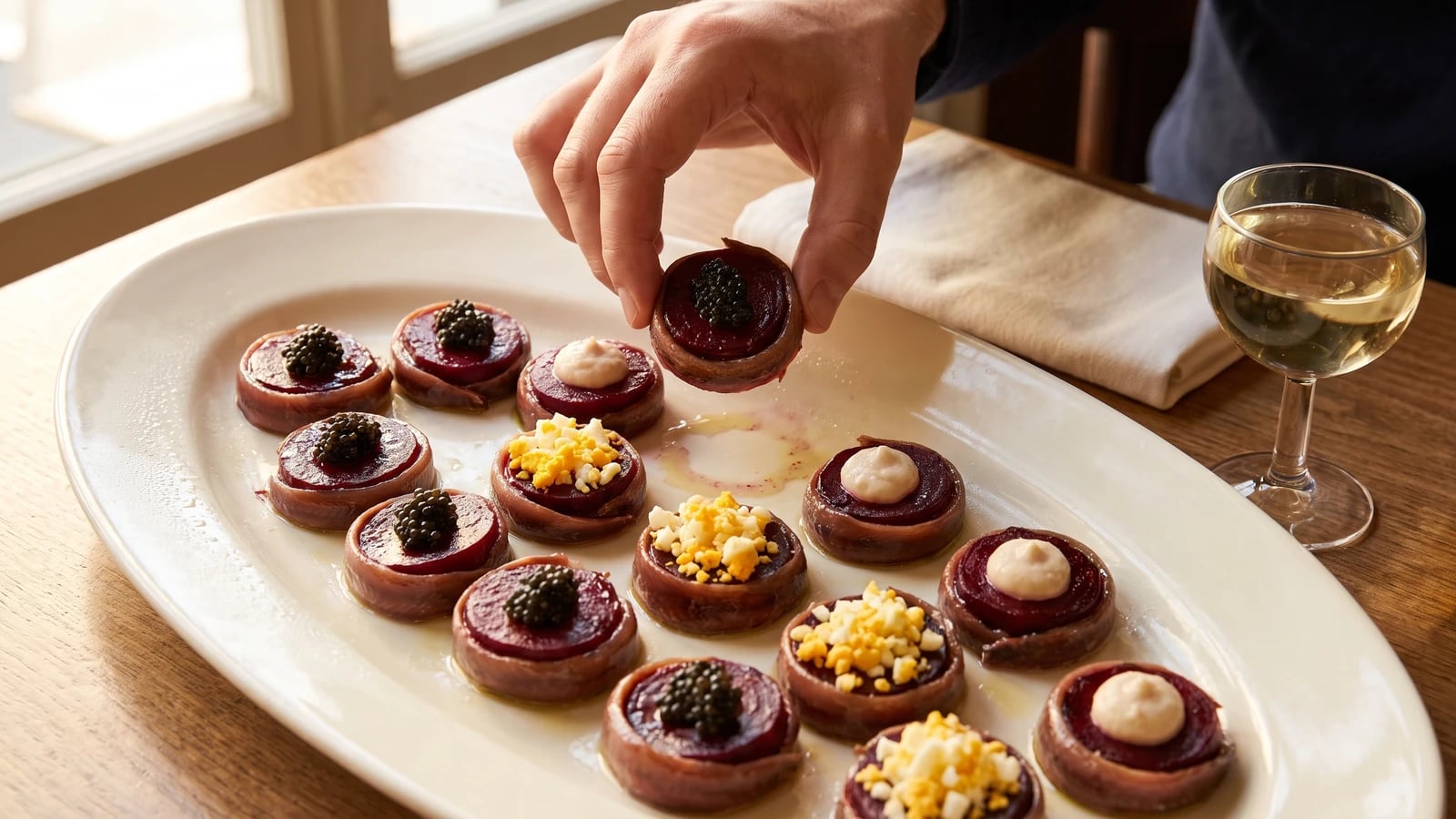
Chilled vegetable discs, anchovy fillets fitted neatly around the rim, and three classical centres: a small canapé that teaches proportion, clean shaping, and the discipline of seasoning cold food.
Médaillons d’Anchois (anchovy medallions) teach one true thing: in a cold canapé, proportion is the seasoning. The vegetable must be thick enough to carry the bite, the anchovy narrow enough to frame rather than conquer it, and the centre no larger than a generous teaspoon.
The original assumed a garde-manger station with several garnishes waiting, fine anchovies already resting in oil, and five quarts of Cooked Marinade for Venison (No. 168) close at hand. Your equivalent is sixteen medallions, one spoonful of that finished preparation, and a 3.2 cm cutter in place of the obsolete half-crown coin. Several toppings were useful abundance for a brigade; at home, choose one or divide the batch among them. That is scaffolding. The cold vegetable disc and its close anchovy border are the dish, and they stay.
Cut only when the potato or beet is completely cold, then dry every surface before fitting the anchovies. If the discs are warm or damp, the fillets slide and the centres bleed into them. Cold, dry, even discs are the step that decides everything.
These médaillons belong to the Parisian repertoire of hors-d’œuvre froids, where the garde-manger built small cold openings from prepared vegetables, cured fish, eggs, and roe. The name describes the coin-like shape rather than a cut of meat, while the anchovy border serves as both seasoning and structure. From grand cold platters, the form passed naturally to the home apéritif table, where a modest batch and one well-chosen centre make better sense.
Quantity
1 pound (450 g)
potatoes left whole and unpeeled, or beetroots scrubbed
Quantity
1 tablespoon (15 ml / 15 g) Cooked Marinade for Venison (No. 168)
fully chilled
Quantity
16 to 32 fillets (about 3 ounces / 90 g drained)
enough to circle each disc
Quantity
2 eggs (about 3½ ounces / 100 g without shells)
finely chopped
Quantity
¼ cup (60 ml / 50 g)
well chilled
Quantity
⅓ cup (80 ml / 80 g)
well chilled
| Ingredient | Quantity |
|---|---|
| waxy potatoes or medium beetrootspotatoes left whole and unpeeled, or beetroots scrubbed | 1 pound (450 g) |
| finished Cooked Marinade for Venisonfully chilled | 1 tablespoon (15 ml / 15 g) Cooked Marinade for Venison (No. 168) |
| fine anchovy fillets marinated in oilenough to circle each disc | 16 to 32 fillets (about 3 ounces / 90 g drained) |
| large hard-boiled eggs (optional)finely chopped | 2 eggs (about 3½ ounces / 100 g without shells) |
| caviare (optional)well chilled | ¼ cup (60 ml / 50 g) |
| prepared fully cooked fish milt purée (optional)well chilled | ⅓ cup (80 ml / 80 g) |
For potatoes, cover the whole unpeeled potatoes with cold water, bring them to a gentle simmer, and cook for 18 to 25 minutes, until a skewer enters with slight resistance. Drain immediately. For beetroot, bake the whole scrubbed roots at 375°F (190°C) for 45 to 70 minutes, until a skewer passes through without force. Let either vegetable cool completely, then refrigerate for at least 45 minutes. If a potato went slightly too far and feels fragile, don't cut it warm. Chill it until firm; ça se rattrape.
Choose chopped hard-boiled egg, caviare, prepared fully cooked milt purée, or divide the medallions among all three. Chop the egg finely enough to sit in a neat mound without becoming paste. Keep caviare and milt purée covered in the cold until assembly; warmth loosens both and makes clean portions difficult.
Peel the cold potatoes or beetroots. Slice them crosswise about ⅜ inch (8 mm) thick, then stamp out 1¼-inch (3.2 cm) rounds. This cutter is the honest equivalent of the half-crown named by the original recipe. Lay the discs between clean towels and blot both sides thoroughly. If an edge crumbles, chill the slice again and recut it with a slightly smaller cutter rather than pressing the damage together.
Arrange the dry discs in a single layer and brush them very sparingly with the fully chilled Cooked Marinade for Venison (No. 168), using the measured spoonful across the entire batch. Let them stand for 5 minutes, then blot away every visible bead. The marinade should season the vegetable, not soak it. If the surface looks glossy-wet, blot once more and chill for 10 minutes before continuing.
Drain the anchovy fillets while leaving them supple. Wrap one long fillet or two shorter fillets around the edge of each disc, matching the anchovy's width to the vegetable's thickness and overlapping the ends slightly. Press just firmly enough for the fillet to grip. If it slides, stop: blot the disc and anchovy, chill them for 10 minutes, and try again. Ça se rattrape. A wet surface is the culprit, not your hands.
Place about ½ teaspoon of the chosen centre on each medallion. Mound chopped egg lightly, spoon caviare without crushing the eggs, and smooth milt purée with the back of a small spoon. Keep every centre inside its anchovy border. Cover without touching the tops and chill for 30 minutes, then serve within 4 hours while the vegetables remain firm and the anchovies glossy. À table!
1 serving (about 105g)
Culinary guides, cultural storytelling, and the editorial depth that makes cooking meaningful.
Discover Culinary ExplorerChef Juliette
Tiny éperlans, lightly floured and fried until their tails stand crisp, arrive in a generous heap on a napkin with fried parsley and grooved lemon, a weeknight lesson in heat and restraint.

Chef Juliette
Brandade de Morue turns salt cod, warm olive oil, and milk into a pale, silky emulsion: keep everything warm and add the oil slowly, then crown the generous dome with butter-fried bread.

Chef Juliette
Salt cod worked warm with cream, one patient spoonful at a time, until the rough flakes become a glossy Nîmes paste, domed generously and ringed with butter-fried croutons for the table.

Chef Juliette
Wine-poached char packed in its earthenware crock beneath butter gold: a make-ahead first course that turns careful cooling, thorough boning, and one unbroken seal into quiet abundance.