
Chef Juliette
Smelt (Éperlans)
Tiny éperlans, lightly floured and fried until their tails stand crisp, arrive in a generous heap on a napkin with fried parsley and grooved lemon, a weeknight lesson in heat and restraint.
A cooking platform built around craft, culture, and the stories behind what we eat.
Created by Chef Juliette
Based on No. 301, Anchovy Fillets, from Le Guide Culinaire (1907) by Auguste Escoffier
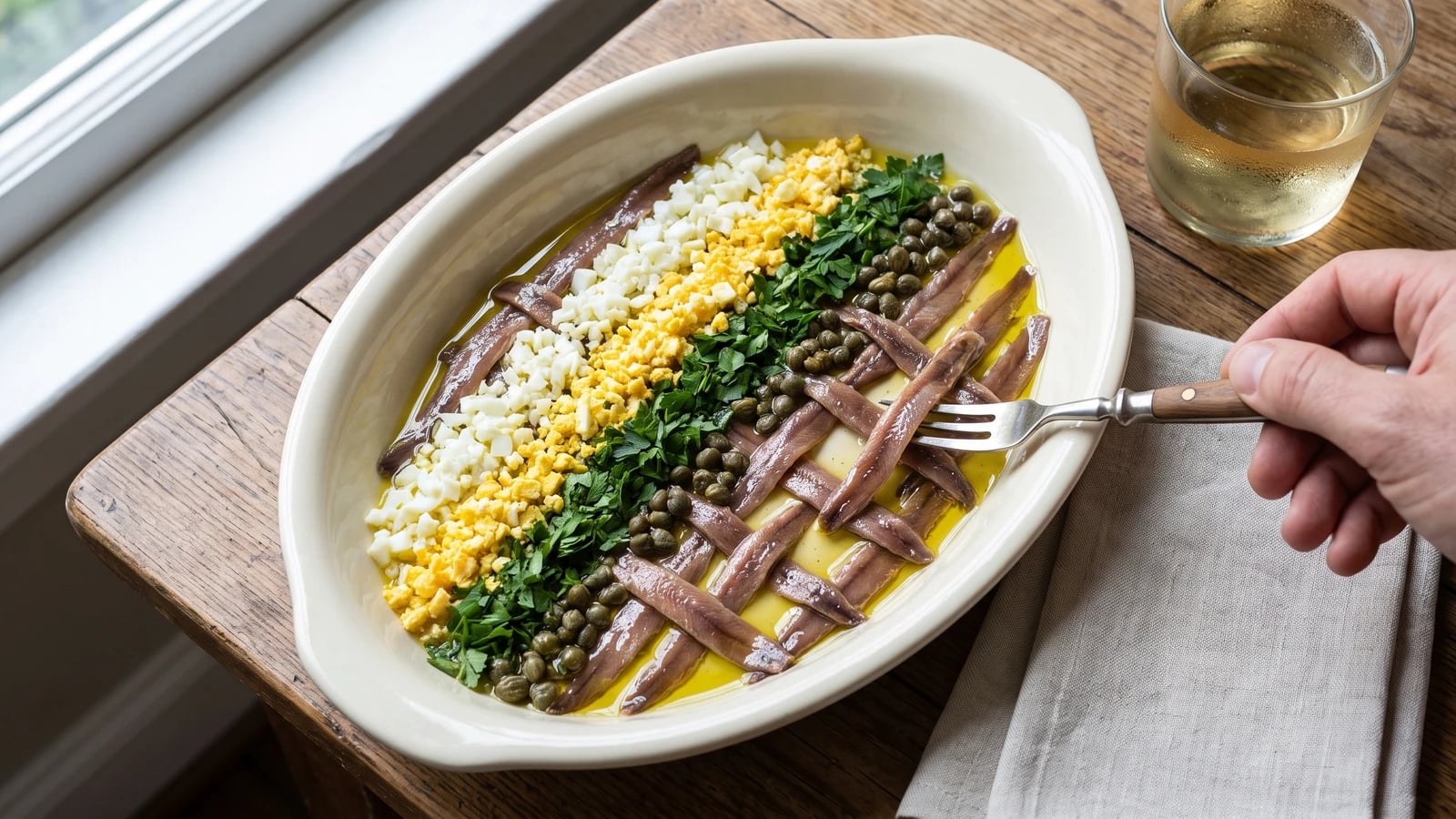
Filets d’Anchois turn a jar of oil-cured fish into a proper cold hors-d’œuvre: slender fillets crossed in a lattice, bright capers, parsley, and alternating gold and white egg.
Filets d’Anchois (anchovy fillets) teach the discipline of the cold table: salt, oil, colour, and exact arrangement can make a proper first course without heat. Before you touch a pan, know this: the lattice is the dish. It gives every serving anchovy, egg, parsley, caper, and just enough oil in one sharp, handsome bite.
The original assumed a garde-manger station, not a saucier: anchovy halves already softened in oil, eggs cooked and separated, parsley chopped, and a shelf of hors-d’œuvre dishes waiting for service. At home, one jar, one egg, a sharp knife, and a shallow dish do the same work. The brigade quantities disappear, while the narrow fillets, alternating colours, capers, and moderate oil stay because they are the dish. One cook, one stove, one evening.
Keep the anchovies supple with their oil and cut them lengthwise without sawing. If a strip tears, don't discard it. Ça se rattrape: hide the break beneath a crossing strip and continue the pattern. The patient lattice is the one step that matters most.
Filets d’anchois belong to the French hors-d’œuvre table, particularly the Parisian bourgeois dining room and the professional garde-manger that supplied its composed cold dishes. Oil-cured anchovies traveled north from Mediterranean curing ports such as Collioure, turning a durable pantry fish into a carefully arranged first course. The lattice and alternating egg belong to garde-manger discipline, not to a generalized Provençal style, even though the preserved fish itself comes from the Mediterranean larder.
Quantity
16 halves (about 2 ounces / 60 g drained)
drained, with the oil reserved
Quantity
1
Quantity
2 tablespoons (30 ml / 8 g)
finely chopped
Quantity
2 teaspoons (10 ml / 6 g)
drained and dried
Quantity
1 tablespoon (15 ml / 14 g)
Quantity
2 packed cups (475 ml / 75 g)
cut using cisel for the salad variation
Quantity
1 teaspoon (5 ml / 5 g) Cooked Marinade for Venison (No. 168)
cooled
| Ingredient | Quantity |
|---|---|
| oil-marinated anchovy halvesdrained, with the oil reserved | 16 halves (about 2 ounces / 60 g drained) |
| large egg | 1 |
| flat-leaf parsleyfinely chopped | 2 tablespoons (30 ml / 8 g) |
| small capersdrained and dried | 2 teaspoons (10 ml / 6 g) |
| reserved anchovy oil or mild olive oil | 1 tablespoon (15 ml / 14 g) |
| tender lettuce leaves (optional)cut using cisel for the salad variation | 2 packed cups (475 ml / 75 g) |
| Cooked Marinade for Venison (optional)cooled | 1 teaspoon (5 ml / 5 g) Cooked Marinade for Venison (No. 168) |
Put the egg in a small saucepan and cover it with cold water by 1 inch. Bring the water just to a boil, cover the pan, remove it from the heat, and leave the egg for 10 minutes. Cool it immediately in cold water, peel it, and pat it dry. If the yolk carries a thin grey edge, shave that edge away before chopping. Ça se rattrape, and the clean gold colour is worth preserving.
Drain the anchovies without wiping away their protective film of oil. Lay each half flat and cut it lengthwise into two or three slender fillets, drawing a sharp knife through in one smooth movement. Keep the strips broad enough to lift without breaking. If the anchovies are stiff from the cold, leave them at room temperature for 5 minutes before cutting; forcing cold fillets is how they tear.
If serving the salad variation, use cisel, cutting the lettuce crosswise into fine, even ribbons. Toss it lightly with the cooled Cooked Marinade for Venison (No. 168) and 1 teaspoon of the reserved oil, then spread it in the hors-d’œuvre dish. The referenced marinade remains a finished preparation from its own entry and is not rebuilt here. Dress sparingly, because wet lettuce will soften the lattice.
Separate the cooked white from the yolk. Chop them finely on different parts of the board so the white stays white and the yolk remains a clear gold. Keep both separate from the parsley. This division may look fussy, but it is not brigade scaffolding: alternating the colours is part of the finished dish.
Arrange half the anchovy strips in parallel lines across the shallow dish, about ½ inch apart. Cross them at right angles with the remaining strips, lifting every other line so the crossings alternate. Work from the centre outward and handle the fillets by their ends. If one breaks, place the damaged section beneath a crossing strip and carry on; the lattice will hold it neatly.
Arrange the chopped egg white, yolk, and parsley in alternating little bands around the lattice, keeping the colours distinct rather than scattering them into confetti. Set the capers directly on the anchovy strips and drizzle the remaining oil moderately over everything. Let the dish settle for 10 minutes, then serve cool rather than refrigerator-numb. À table!
1 serving (about 55g)
Culinary guides, cultural storytelling, and the editorial depth that makes cooking meaningful.
Discover Culinary ExplorerChef Juliette
Tiny éperlans, lightly floured and fried until their tails stand crisp, arrive in a generous heap on a napkin with fried parsley and grooved lemon, a weeknight lesson in heat and restraint.

Chef Juliette
Brandade de Morue turns salt cod, warm olive oil, and milk into a pale, silky emulsion: keep everything warm and add the oil slowly, then crown the generous dome with butter-fried bread.

Chef Juliette
Salt cod worked warm with cream, one patient spoonful at a time, until the rough flakes become a glossy Nîmes paste, domed generously and ringed with butter-fried croutons for the table.

Chef Juliette
Wine-poached char packed in its earthenware crock beneath butter gold: a make-ahead first course that turns careful cooling, thorough boning, and one unbroken seal into quiet abundance.