Culinary Explorer

A cooking platform built around craft, culture, and the stories behind what we eat.
Discover Culinary Explorer
Rhubarb Jam

Rhubarb Jam

Created by Chef Juliette

Based on No. 2961, Rhubarb Jam, from Le Guide Culinaire (1907) by Auguste Escoffier

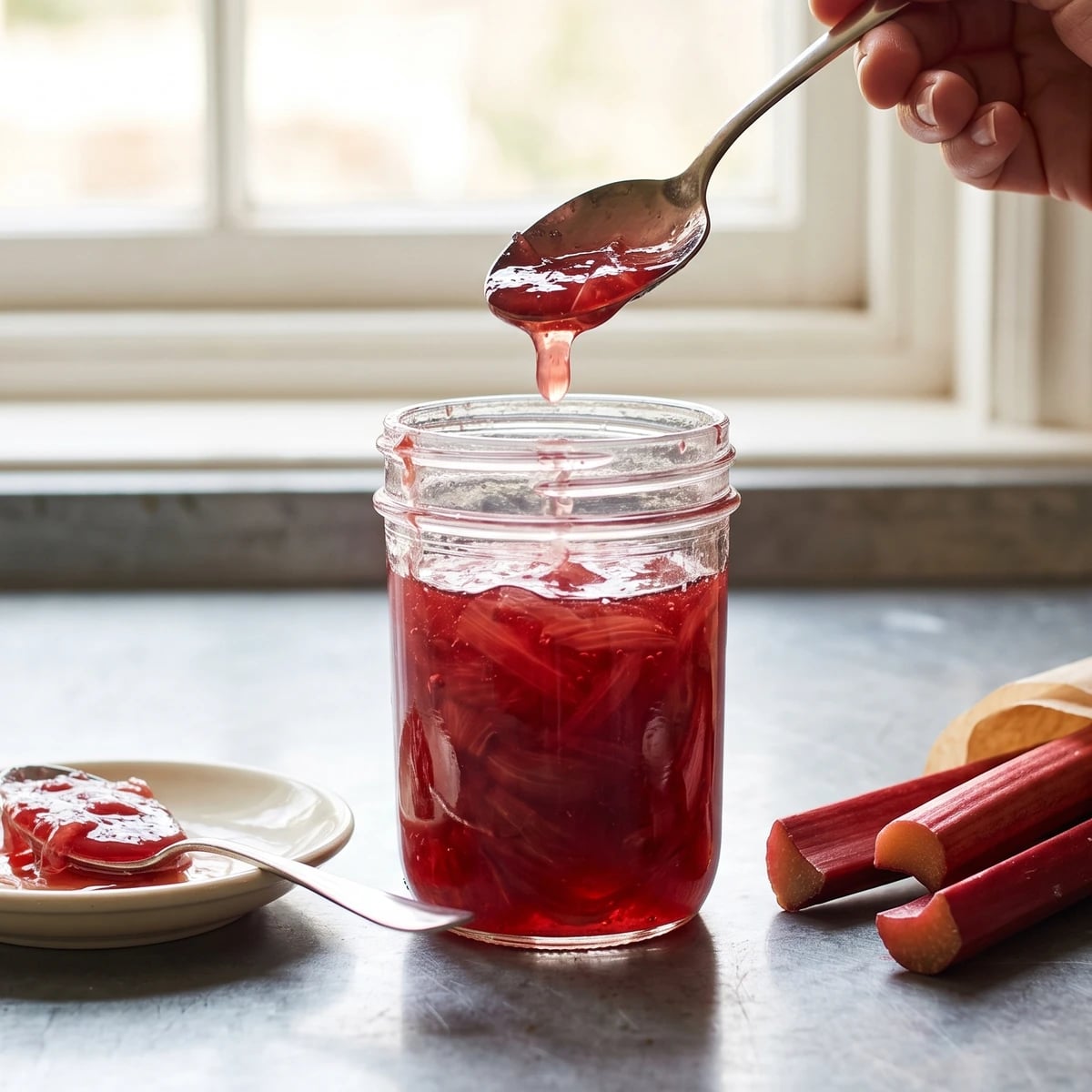
Confiture de rhubarbe transforms a water-heavy stalk through discipline, not additions: soften the fibres under cover, then boil fiercely and stir without stopping until bright strands fall from the spoon at nappe.

Sauces & Condiments
French
Make Ahead
Batch Cooking
25 min
Active Time
50 min cook1 hr 15 min total
YieldAbout 4 cups (950 ml), enough for four half-pint jars

Confiture de rhubarbe (rhubarb jam) teaches one true thing before you touch the pan: moisture must leave quickly, but rhubarb must soften before fierce heat can drive it away. The stalks first slacken under cover until their fibres resemble fine vermicelli, then the jam boils uncovered to nappe, the coating stage when it falls from a spoon in slow, broad drops.

The original assumed a broad preserving pan, a range with a cool side and a fierce centre, and a cook free to stir without interruption. Your honest equivalent is a wide, heavy stainless steel pan, the smallest burner for the covered softening and the strongest burner for the finish. This batch uses 2 pounds of rhubarb rather than the professional limit of 5 or 6, while keeping the book's exact ratio of 13 ounces of sugar per pound. Loaf sugar becomes ordinary white granulated sugar, a change of form only, and a measured little water supplies the clear syrup the source assumes when it says to dissolve the sugar. One cook, one stove, one evening.

The glycerine paper and tied covers are obsolete sealing scaffolding, so clean preserving jars, two-piece lids, and a boiling-water process take their place. What must stay is the dish itself: syrup first, twelve minutes under cover, then a fierce reduction to nappe. That final boil is the step that matters. Stir across the entire pan floor without stopping, because rhubarb catches the instant your attention wanders.

Confiture de rhubarbe belongs most naturally to preserving cupboards in northern and eastern France, especially Alsace, where cooler gardens favour sturdy, acidic stalks. From household kitchens it passed into the classical repertory, which formalized a clear syrup, covered softening, and the nappe finish rather than masking the fruit with spice. Its colour is not proof of ripeness: naturally green stalks produce a sound green conserve, while central red-bordered or forced stalks give the prized pink.

The technique, the tradition, and the story behind every dish.

Discover Culinary Explorer

Ingredients

rhubarb stalks

Quantity

About 7½ cups (1.8 L / 2 lb / 907 g), trimmed weight

ends removed, adhering skin scraped away, cut into 3-inch (7.5 cm) lengths

white granulated sugar

Quantity

3⅔ cups (870 ml / 26 oz / 737 g)

water

Quantity

¾ cup plus up to 1 tablespoon (180 to 195 ml / 180 to 195 g)

180 ml for the syrup, with the remainder reserved for rescuing crystallization

The Cooking, Potting, and Sealing of Jams

Quantity

1 use (No. 2955)

cross-referenced finishing method

Equipment Needed

  • Wide 5 to 6-quart heavy stainless steel preserving pan
  • Flat-edged wooden spoon or heatproof silicone spatula
  • Four half-pint preserving jars with new lids and rings
  • Boiling-water canner or deep stockpot with rack and lid
  • Jar lifter and preserving funnel
  • Digital scale

Instructions

  1. 1

    Ready the jars

    Wash four half-pint preserving jars, their rings, and the tools that will touch the finished jam. Keep the jars hot in barely simmering water while you cook, and prepare a boiling-water canner with enough water to cover the filled jars by at least 1 inch (2.5 cm). Warm or prepare the lids as their maker directs. Hot jam meeting cold glass is an invitation to a cracked jar, so keep everything ready and warm.

    Set the jars on a folded towel when filling them. A cold stone or metal counter can shock hot glass.
  2. 2

    Prepare the rhubarb

    Cut away both ends of every stalk. Use a small knife to scrape off only the skin already adhering or lifting from the surface, without stripping the stalks bare, then cut them into 3-inch (7.5 cm) lengths. Weigh out exactly 2 pounds (907 g) after trimming. Choose naturally green rhubarb for a green conserve or central red-bordered and forced stalks for pink; technique preserves the colour, but it cannot invent one the stalk never had.

  3. 3

    Cook the syrup

    Put the sugar and ¾ cup (180 ml / 180 g) water into a wide, heavy, nonreactive pan. Warm gently, stirring only until every grain dissolves, then bring the clear syrup to a full boil and cook it for 7 to 8 minutes without stirring. It should remain clear, never caramel-coloured. If crystals gather around the sides, lower the heat, add the reserved 1 tablespoon (15 ml / 15 g) water, and dissolve them gently before continuing. Ça se rattrape.

  4. 4

    Soften under cover

    Lower the rhubarb carefully into the hot syrup and cover the pan at once. Move it to your gentlest burner and cook for about 12 minutes, giving the pan one careful shake midway rather than stirring the stalks to pulp. Lift the lid and look: the pieces should have collapsed, with their fibres separated into fine strands like vermicelli. If the centres remain rigid, cover them for another 2 or 3 minutes. The clock guides you, but the fibres decide.

  5. 5

    Drive to nappe

    Uncover the pan, move it to your strongest burner, and bring the jam to a fierce boil. Stir constantly with a flat-edged spoon or spatula, sweeping the centre, corners, and entire pan floor on every pass. As moisture leaves, the boiling becomes heavier and the jam clings to the spoon; at nappe, it gathers toward the spoon's centre and falls at long intervals in large, slow drops. Remove it from the heat immediately. If you smell scorching or feel the spoon drag over a caught patch, do not scrape the floor. Pour the unburnt jam at once into a clean pan, leave the scorched layer behind, and finish over slightly gentler heat while stirring without pause. Ça se rattrape, provided the burnt part stays where it is.

  6. 6

    Rest and fill

    The finishing reference, The Cooking, Potting, and Sealing of Jams (No. 2955), directs a 7 to 8 minute rest before potting. Keep that pause, because the fierce bubbling settles and the fibres remain evenly suspended instead of floating upward. Ladle the jam into the hot jars, leaving ¼ inch (6 mm) headspace. Remove trapped air with a clean nonmetallic utensil, wipe the rims, centre the lids, and tighten the rings only until fingertip firm.

  7. 7

    Process and cool

    Lower the jars upright into the canner, cover them with at least 1 inch (2.5 cm) of water, return the water to a full boil, and process for 10 minutes at elevations up to 1,000 feet. Above that, follow your local preserving authority's altitude schedule. Lift the jars upright and leave them undisturbed for 12 to 24 hours before checking the seals. Refrigerate any jar that fails to seal and use it within 3 weeks. The sealed jars are your batch for the cupboard; the open one belongs with bread and butter. À table!

Chef Tips

  • Colour begins in the market. Naturally green stalks make a green-gold conserve, while slender central stalks bordered in red or forced rhubarb give a clearer pink. Do not peel away sound skin in pursuit of tenderness; the covered softening handles the fibres.
  • Use a wide 5 to 6-quart stainless steel pan. The broad floor accelerates evaporation, while the pale interior lets you see whether the syrup is colouring. Avoid reactive aluminium, and never double the batch on an ordinary home burner; slower evaporation gives the rhubarb more time to dull and catch.
  • There is no lemon, vanilla, or added pectin in this entry. The clear sugar syrup and tart rhubarb are the flavour, and nappe gives a soft, spoonable conserve rather than a rigid jelly. Cooking well is not cooking fancy.
  • If the cooled jam is looser than you want, return it to a clean wide pan and boil it briefly back to nappe. If it has become too stiff, warm it gently with 1 tablespoon (15 ml / 15 g) water per cup of jam, stirring until it relaxes.

Advance Preparation

  • The jars and equipment can be washed the day before. Reheat the jars in simmering water before filling; never ladle hot jam into cold glass.
  • Trim the rhubarb up to one day ahead and keep it covered in the refrigerator, but do not mix it with the sugar. The syrup-first sequence and covered softening belong to this method.
  • Leave processed jars untouched for 12 to 24 hours, then remove the rings, check the seals, label the jars, and store them in a cool, dark cupboard. Refrigerate after opening.

Frequently Asked Questions

Nutrition Information

1 serving (about 20g)

Calories
50 calories
Total Fat
0 g
Saturated Fat
0 g
Trans Fat
0 g
Unsaturated Fat
0 g
Cholesterol
0 mg
Sodium
1 mg
Total Carbohydrates
13 g
Dietary Fiber
0 g
Sugars
12 g
Protein
0 g

Note: Chef personas and recipes are created with AI assistance. Cook with care: follow safe food-handling practices, check doneness with a thermometer when needed, and adapt for allergies and your kitchen.

Where cooking meets culture.

Culinary guides, cultural storytelling, and the editorial depth that makes cooking meaningful.

Discover Culinary Explorer

More from Fruit-stews and Jams

Browse the full collection