Culinary Explorer

A cooking platform built around craft, culture, and the stories behind what we eat.
Discover Culinary Explorer
Spooms

Spooms

Created by Chef Juliette

Based on No. 2933, Spooms, from Le Guide Culinaire (1907) by Auguste Escoffier

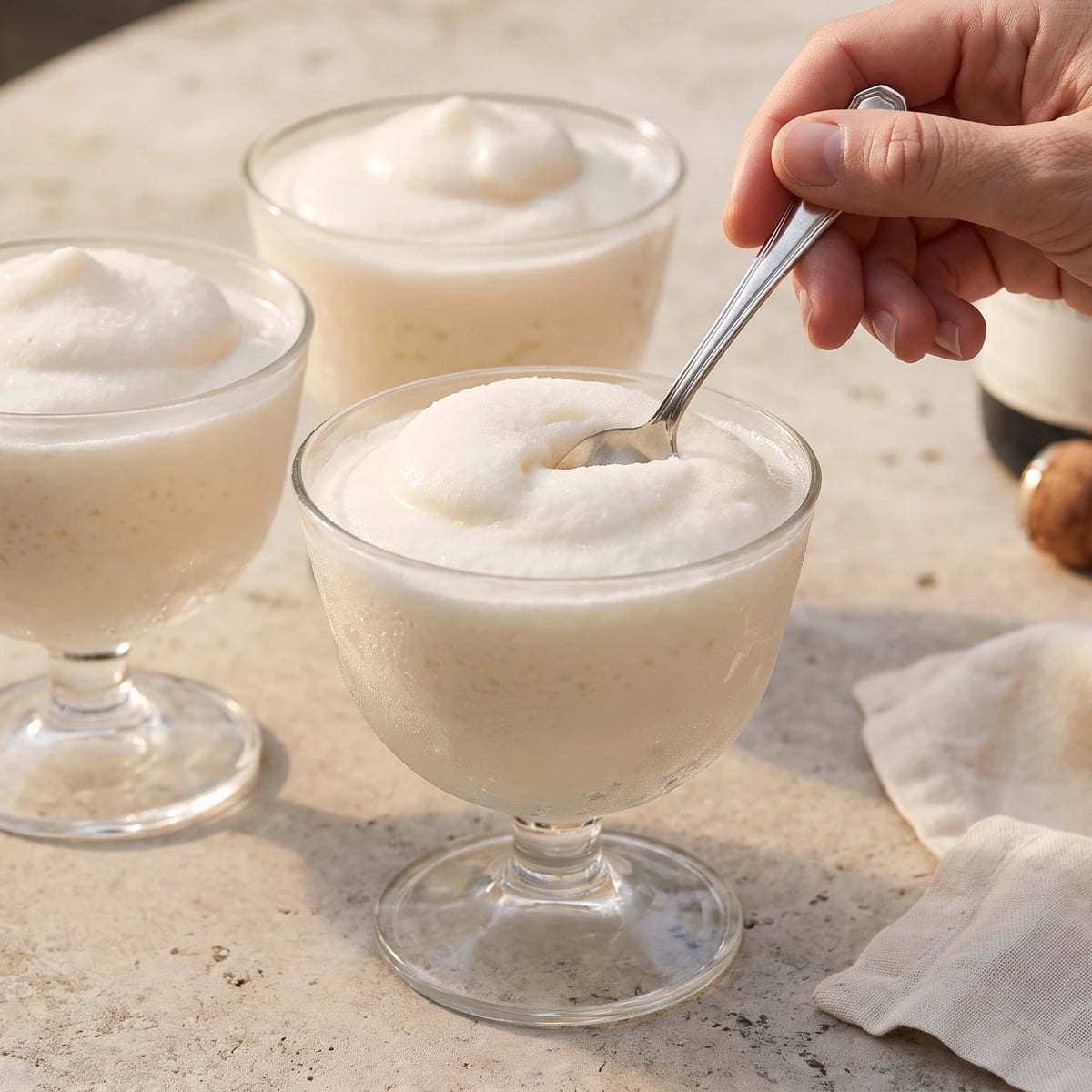
Spoom is frozen restraint: Champagne syrup and a doubled measure of Italian meringue, worked just enough to hold a pale, airy froth that settles softly into a chilled glass.

Desserts
French
Dinner Party
Celebration
Outdoor Dining
30 min
Active Time
5 min cook5 hr total
Yield6 small glasses (about 1 quart / 1 liter)

Spoom au Champagne (Champagne frozen froth) teaches restraint: the air is the dish, and every hard stroke throws some of it away. It begins like a sorbet, but twice the usual allowance of meringue turns that frozen base into something lighter, softer, and almost foamy on the spoon.

The original formula assumed a syrup gauge, a freezing pail packed with salt and ice, and a pastry station handing over a brigade batch of finished meringue. Those are scaffolding. For one cook, one stove, one evening, weighed sugar and water reproduce the 20° Baumé syrup, a home ice-cream machine replaces the freezing pail, and 2 cups of Meringue à l’Italienne (No. 2383) give the book's doubled allowance at a useful table scale. The concentration, the generous meringue, and the gentle handling remain untouched because those three things are the spoom.

When it is right, the surface is pale Champagne gold and softly billowed, with tiny ice crystals at the edge and a spoonful that seems to dissolve before it quite melts. Freeze the wine base only to wet snow before folding, then put away the whisk. A broad spatula and a light hand decide the dish.

Spoom belongs to the French grande cuisine repertory of frozen entremets, the sweet courses, rather than to any single province. It traveled through formal dining rooms in sherbet glasses, flavored with fruit juice or, more often, wines such as Champagne, Samos, Muscat, and Zucco. What distinguishes it from ordinary sorbet is not the wine but the doubled Italian meringue and deliberately gentle working, which leave it frothier and less densely frozen.

The technique, the tradition, and the story behind every dish.

Discover Culinary Explorer

Ingredients

superfine sugar

Quantity

3/4 cup (180 ml / 150 g)

cold water

Quantity

1 1/8 cups (270 ml / 270 g)

brut Champagne

Quantity

1 1/2 cups (360 ml / 360 g)

well chilled

Meringue à l’Italienne

Quantity

2 cups (475 ml / 180 g) Meringue à l’Italienne (No. 2383)

completely cool

Equipment Needed

  • 1-quart (1-liter) ice-cream machine with a fully frozen bowl
  • Small heavy-bottomed saucepan
  • Digital kitchen scale
  • Wide chilled mixing bowl
  • Large flexible spatula
  • Shallow 1 1/2-quart (1.5-liter) lidded freezer container
  • Six small stemmed sherbet glasses

Instructions

  1. 1

    Make the 20° syrup

    Combine the sugar and water in a small saucepan and warm over medium-low heat, stirring only until every grain has dissolved. Bring the clear syrup to its first quiet simmer, then remove it at once; the weighed ratio gives approximately 20° Baumé without asking you to keep a syrup gauge in the drawer. Do not boil it down, because a stronger syrup would make the finished spoom heavy and slow to freeze. If crystals collect at the edge, cover the pan for thirty seconds so condensation washes them down, then uncover and heat gently until the syrup is clear again. Ça se rattrape.

    Once the sugar has dissolved, swirl the pan instead of stirring. A spoon carried around the sides can drag stray crystals back into the syrup.
  2. 2

    Chill the wine base

    Cool the syrup completely, then pour in the cold Champagne and stir slowly until evenly combined. Do not cook the wine; its fresh aroma is the flavoring, and heat would flatten it. Cover and refrigerate for at least 2 hours, until the base is thoroughly cold. A lukewarm base melts the air from the meringue before the freezer can preserve it.

  3. 3

    Freeze to wet snow

    Pour the chilled Champagne base into the running ice-cream machine and churn until it resembles loose, evenly frozen wet snow, usually 12 to 18 minutes. Stop before it becomes a firm sorbet. The base must be cold enough to support the meringue but soft enough to accept it without vigorous mixing.

    Without a machine, pour the base into a shallow metal pan and freeze for about 45 minutes. Scrape it with a fork every 20 minutes until evenly slushy. This scraping freezes the base; it stops completely once the meringue enters.
  4. 4

    Fold in the meringue

    Transfer the slushy base to a wide chilled bowl. Hold back about 1/4 cup of the measured Meringue à l’Italienne (No. 2383), then fold the rest through in three additions with a broad spatula, cutting down through the center, sweeping along the bottom, and turning the bowl after each stroke. Fold in the reserved portion last. Do not whisk and do not chase every fine white ribbon; beat a spoom hard and you drive out the air that is the dish. If the mixture loosens into soup, it was too warm. Set the bowl over ice for 5 minutes, then resume with slow folds. If it looks dense from overworking, use the reserved meringue to restore some lightness.

  5. 5

    Set without stirring

    Spoon the mixture into a shallow lidded freezer container, leaving its soft billows intact. Cover and freeze for 2 to 3 hours, just until softly set. Do not stir it again. If it becomes firm after a longer hold, move it to the refrigerator for 10 to 15 minutes rather than attacking it with a spoon; it should relax to a soft mound while keeping its air.

  6. 6

    Mound into glasses

    Chill six small stemmed sherbet glasses for 20 minutes. Using a large spoon, lift the spoom into each glass in soft, irregular mounds rather than compact scoops. Serve immediately, plain and very cold. It needs no garnish and no theater, only a small spoon and people ready to eat it. À table!

Chef Tips

  • Use a clean, dry brut Champagne. A grand bottle gains nothing here because sugar and cold mute its finest detail; the important thing is lively acidity and no stale, bruised flavor.
  • The 20° Baumé syrup is a concentration, not a serving temperature. Weighing 150 g sugar against 270 g water gives the home cook the intended light syrup without specialized measuring equipment.
  • The 2 cups of finished meringue are deliberately abundant, twice the allowance used for a sherbet at this scale. It is not decoration or extra sweetness. It supplies the frothy structure that makes this a spoom.
  • Spoon the finished dessert lightly into its glasses. Pressing and smoothing compact the air, and a neat, dense scoop misses the point entirely.
  • For an outdoor dinner, keep the covered container in the freezer until the glasses are ready. Even in shade, this delicate mixture waits for no speech and no second opening of the wine.

Advance Preparation

  • Freeze the ice-cream machine bowl for the full time required by its manufacturer, commonly 24 hours. A half-frozen bowl gives a melted base before the meringue ever enters.
  • The syrup and Champagne base can be combined and refrigerated, tightly covered, up to 1 day ahead.
  • Prepare the Meringue à l’Italienne (No. 2383) up to 4 hours ahead and keep it covered until completely cool. Fold it once gently if it has settled, but do not rewhisk it.
  • The finished spoom is at its lightest within 6 hours of folding. It can remain frozen overnight, but the texture becomes a little closer and the wine aroma less vivid.

Frequently Asked Questions

Nutrition Information

1 serving (about 155g)

Calories
230 calories
Total Fat
0 g
Saturated Fat
0 g
Trans Fat
0 g
Unsaturated Fat
0 g
Cholesterol
0 mg
Sodium
20 mg
Total Carbohydrates
46 g
Dietary Fiber
0 g
Sugars
46 g
Protein
1 g

Note: Chef personas and recipes are created with AI assistance. Cook with care: follow safe food-handling practices, check doneness with a thermometer when needed, and adapt for allergies and your kitchen.

Where cooking meets culture.

Culinary guides, cultural storytelling, and the editorial depth that makes cooking meaningful.

Discover Culinary Explorer

More from Ices and Sherbets - Iced Mousses

Browse the full collection