
Chef Juliette
Various Almond Preparations
Five almond preparations, one discipline: remove the skins cleanly, dry every kernel through, then cut, toast, or cloak it in pale caramel without letting its fragrant oils escape.
A cooking platform built around craft, culture, and the stories behind what we eat.
Created by Chef Juliette
Based on No. 2930, Granités, from Le Guide Culinaire (1907) by Auguste Escoffier
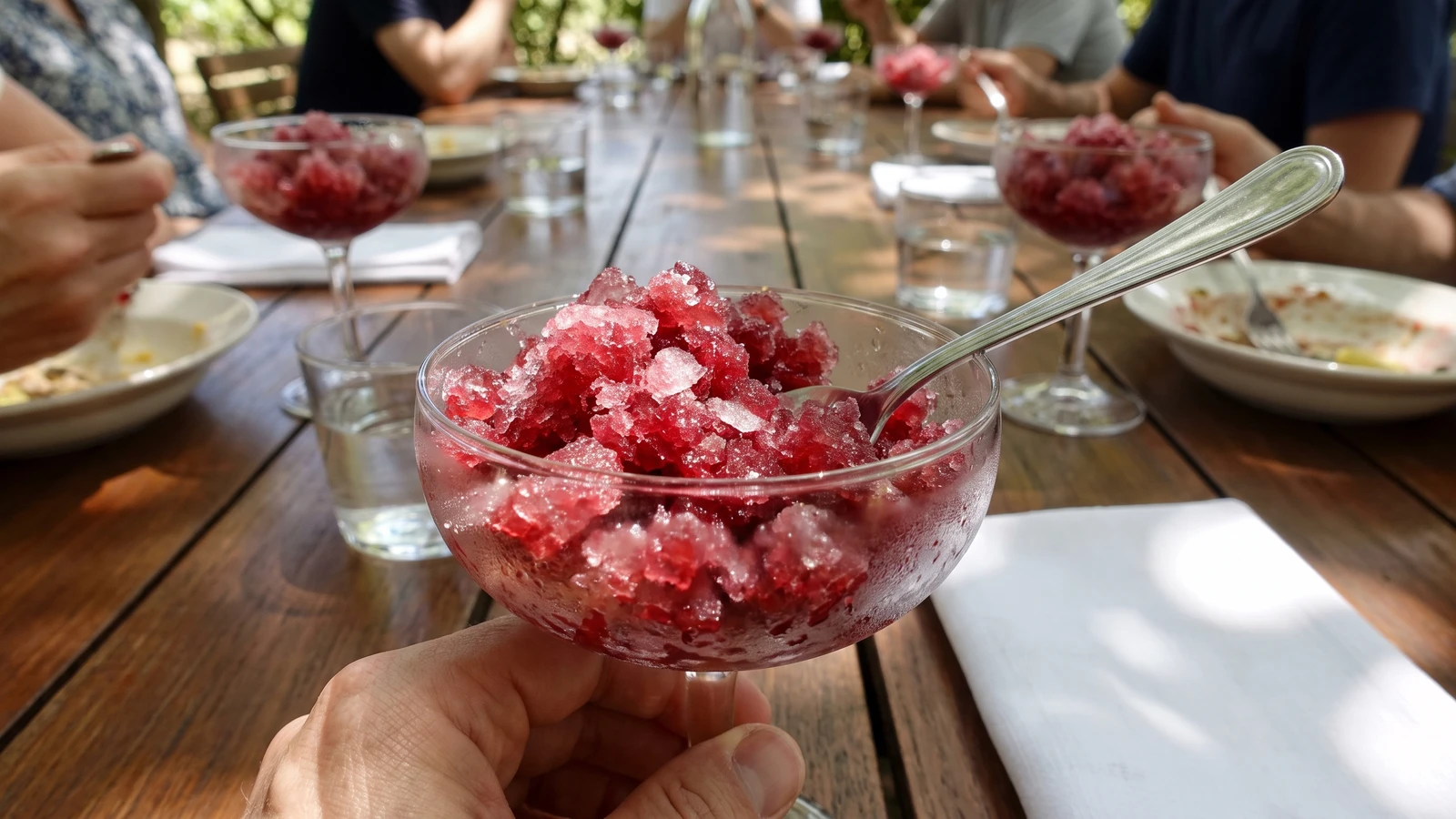
Granités teach the discipline of leaving well enough alone: a thin fruit syrup freezes untouched into bright, loose crystals, then breaks under the fork with no cream, no meringue, and no fuss.
Granités (granulated fruit ices) teach one discipline: leave the syrup alone. A thin, bright fruit syrup becomes loose, irregular grains only when its forming crystals aren't churned, whisked, or fussed with. Stir it during freezing and you erase the texture that gives the dish its name.
The original formula was a master preparation for a large kitchen. It assumed an ice-packed freezing vessel, a saccharometer to keep the syrup below fourteen degrees, and enough hands to manage service quantities. A digital scale, a shallow metal tray, and the coldest shelf of a home freezer are the honest equivalents. The brigade quantity and specialized gauge are scaffolding, so they can go. The thin syrup and undisturbed freeze are the dish, so they stay. One cook, one stove, one evening.
Warm only enough juice to dissolve the sugar, then chill the mixture completely and pour it shallow. Once the tray enters the freezer, don't touch it until the syrup is congealed. That stillness is the step that matters.
Granités entered the French classical canon through Parisian grand kitchens, which brought the Mediterranean family of fruit ices under the measured discipline of the syrup gauge. At the grand table they answered the same purpose as sherbets and could also become part of composed preparations, but their identity remained precise: thin fruit syrup, no meringue, and no agitation during freezing. Many modern methods call for repeated scraping, while the classical French preparation asks for stillness first and a single raking only after the ice has congealed.
Quantity
2 cups (480 ml / 500 g)
cold and finely strained
Quantity
⅓ cup (80 ml / 65 g)
| Ingredient | Quantity |
|---|---|
| unsweetened tart fruit juicecold and finely strained | 2 cups (480 ml / 500 g) |
| granulated sugar | ⅓ cup (80 ml / 65 g) |
| Ordinary Meringuedeliberately omitted | 0 cups (0 ml / 0 g) Ordinary Meringue (No. 2382) |
Set aside Ordinary Meringue (No. 2382). It is the contrasting preparation that defines what granités are not, and none of it enters this syrup. There is no cream or egg white either. Fruit juice and sugar are the whole preparation; added air would soften the crystals, and here the crystals are the point.
Pour ½ cup (120 ml / 125 g) of the fruit juice into a small saucepan and add the sugar. Warm it over low heat, stirring only until every grain dissolves and the liquid turns clear, about 2 minutes. Don't let it simmer or reduce, since concentration makes the finished ice sticky rather than granular. If sugar remains on the pan floor, ça se rattrape: take the pan off the heat, add another spoonful of the measured juice, and stir until clear.
Pour the warm sweetened juice into the remaining cold juice and mix thoroughly. The syrup should run as freely as the original juice, not cling to the spoon. If you own a refractometer, aim for about 20 to 23 degrees Brix and never exceed 24 degrees Brix, the practical equivalent of the old fourteen-degree saccharometer ceiling. Strain the syrup once more, then chill it for 30 minutes.
Pour the cold syrup into a shallow metal tray, making a layer no deeper than ½ inch (1.25 cm). Divide it between two trays if necessary; a deep pool freezes hard at the edges while remaining soft in the middle. Cover the tray without letting the cover touch the liquid, then place it level in the coldest part of the freezer.
Leave the syrup entirely undisturbed for 3½ to 4 hours, until it is opaque and firmly congealed. Don't stir, whisk, or scrape it as it freezes. If someone has disturbed it and the surface turns finely slushy, stop working it and let it freeze solid before proceeding; the crystals will be smaller, but the dessert is saved. Ça se rattrape.
Once the syrup is fully frozen, draw the tines of a sturdy fork across its surface in short strokes. Rake only now, lifting rather than crushing, until the sheet separates into light, irregular granules. If it is too hard to enter, let the tray stand for 5 minutes and try again; don't attack it with a food processor, which turns the open crystals into packed snow.
Loosely spoon the granité into chilled glasses without pressing it down. Serve immediately, while the grains remain separate and the fruit tastes sharp and clean. À table!
1 serving (about 141g)
Culinary guides, cultural storytelling, and the editorial depth that makes cooking meaningful.
Discover Culinary ExplorerChef Juliette
Five almond preparations, one discipline: remove the skins cleanly, dry every kernel through, then cut, toast, or cloak it in pale caramel without letting its fragrant oils escape.

Chef Juliette
A pastry pantry lesson in one tray: filberts warmed only until their red skins release, rubbed clean, cooled, and chopped into a fragrant mise-en-place for cakes, creams, pralines, and petits fours.

Chef Juliette
The smallest pâtisserie discipline decides whether a cake leaves its mould intact: clarified butter in every corner, followed by the lightest veil of dry flour or fécule.

Chef Juliette
Four whites, one spotless bowl, and a patient change of speed: whisk gently until loosened, then briskly to glossy stiffness, with powdered sugar waiting if the foam begins to granulate.