
Chef Juliette
Smelt (Éperlans)
Tiny éperlans, lightly floured and fried until their tails stand crisp, arrive in a generous heap on a napkin with fried parsley and grooved lemon, a weeknight lesson in heat and restraint.
A cooking platform built around craft, culture, and the stories behind what we eat.
Created by Chef Juliette
Based on No. 292, Paprika Butter, from Le Guide Culinaire (1907) by Auguste Escoffier
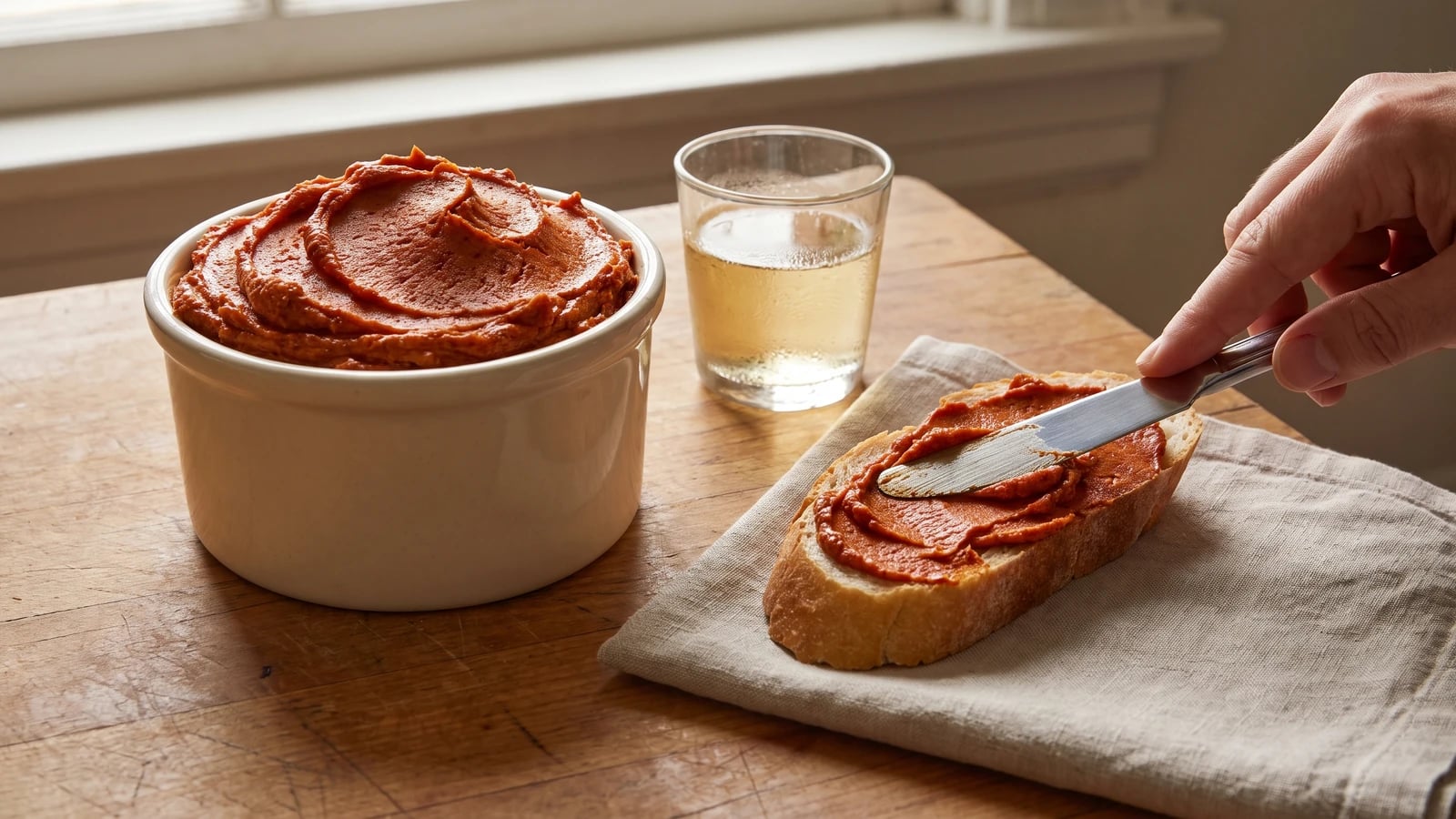
Sweet paprika is briefly awakened in warm white wine or consommé, then worked into soft butter until red-gold and fragrant, a three-ingredient lesson in why infusion comes before mixing.
Beurre au paprika (paprika butter) teaches a small but decisive lesson: dry spice must be awakened before fat closes around it. A scant spoonful of paprika meets a few warm drops of white wine or consommé first, deepening to brick red and losing its dusty edge. Only then does the butter take it in. That order is the dish.
The original assumed a saucier could reach for consommé from a stockpot never off the fire. At home, a measured spoon-tip of prepared consommé or dry white wine does the same work. The source quantity is four ounces, already right for a dinner table, so it stays intact. A standing stockpot is brigade scaffolding and can go; the paprika infusion is the dish and must stay. One cook, one stove, one evening.
Keep the butter soft but never melted, then work the infusion through it until the color is even and the texture satin-smooth. Before the butter joins it, make the paprika paste completely smooth. That is the one step that decides whether this tastes fragrant or merely powdery.
Beurre au paprika belongs to the Parisian classical repertoire of beurres composés, finished butters prepared at the sauce station rather than the cooking of a single French region. Paprika came into that repertoire from Central European kitchens and was valued for flavor as well as color; moistening it in wine or consommé before mixing distinguishes this formula from butter merely tinted red. From the saucier's bench, such butters moved naturally to canapé trays, cold buffets, and the home aperitif table.
Quantity
1/2 cup (118 ml / 113 g)
softened to 18 to 20°C
Quantity
1 scant teaspoon (4 ml / 2 g)
Quantity
1/4 teaspoon (1.25 ml / 1.2 g)
warmed just to body temperature
| Ingredient | Quantity |
|---|---|
| unsalted buttersoftened to 18 to 20°C | 1/2 cup (118 ml / 113 g) |
| sweet paprika | 1 scant teaspoon (4 ml / 2 g) |
| dry white wine or clear unsalted consomméwarmed just to body temperature | 1/4 teaspoon (1.25 ml / 1.2 g) |
Put the butter in a small mixing bowl and press it against the sides with a flexible spatula until it reaches beurre pommade, butter softened to a spreadable cream. It should yield easily while remaining opaque and cool. If it looks glossy or leaves a pool around its edges, chill it for 5 minutes before continuing; melted butter cannot hold the infusion evenly.
Place the paprika in a second small bowl and stir in the warm wine or consommé. Press the mixture firmly with the back of a teaspoon until every dry knot disappears, then leave it for 2 minutes. It should darken to brick red and form a stiff, smooth paste. If too much liquid slips in and the paste becomes runny, ça se rattrape: work in 1 tablespoon of the measured soft butter until it becomes a thick red cream, then proceed.
Work 1 tablespoon of the beurre pommade into the paprika paste, smearing it repeatedly against the bowl until the color is perfectly even. Add the remaining butter in three portions, fully incorporating each before the next. Stop when the beurre au paprika is uniformly red-gold, with no pale streaks or specks of dry spice. If it turns greasy or sheds droplets, the butter has grown too warm. Chill it for 5 to 10 minutes, then beat it briefly until the emulsion closes and the satin texture returns.
Pack the beurre au paprika into a 125 ml butter crock, smoothing the top with broad, generous strokes, or roll it into a compact log in parchment. Cover and chill for at least 30 minutes so the flavor settles through the butter. Let it stand for 10 minutes before serving; it is ready when a table knife leaves a clean furrow without breaking the butter into cold chips. À table!
1 serving (about 14g)
Culinary guides, cultural storytelling, and the editorial depth that makes cooking meaningful.
Discover Culinary ExplorerChef Juliette
Tiny éperlans, lightly floured and fried until their tails stand crisp, arrive in a generous heap on a napkin with fried parsley and grooved lemon, a weeknight lesson in heat and restraint.

Chef Juliette
Brandade de Morue turns salt cod, warm olive oil, and milk into a pale, silky emulsion: keep everything warm and add the oil slowly, then crown the generous dome with butter-fried bread.

Chef Juliette
Salt cod worked warm with cream, one patient spoonful at a time, until the rough flakes become a glossy Nîmes paste, domed generously and ringed with butter-fried croutons for the table.

Chef Juliette
Wine-poached char packed in its earthenware crock beneath butter gold: a make-ahead first course that turns careful cooling, thorough boning, and one unbroken seal into quiet abundance.