
Chef Juliette
Smelt (Éperlans)
Tiny éperlans, lightly floured and fried until their tails stand crisp, arrive in a generous heap on a napkin with fried parsley and grooved lemon, a weeknight lesson in heat and restraint.
A cooking platform built around craft, culture, and the stories behind what we eat.
Created by Chef Juliette
Based on No. 285, Crayfish Butter, from Le Guide Culinaire (1907) by Auguste Escoffier
Beurre d’écrevisses turns what looks like waste into the rose-red heart of sauce Nantua: crayfish shells pounded fine with real butter, then passed twice until all perfume remains and every fragment is gone.
Beurre d’écrevisses (crayfish butter) teaches a central truth of the sauce pantry: the meat is not where all the flavour lives. The shells carry the scarlet colour and deep crustacean perfume, and butter captures both, provided those shells are crushed almost to powder before the two meet.
The original assumed a saucier on staff, prepared Mirepoix (No. 228) waiting nearby, a heavy mortar, a fine tamis, and strong hands for the muslin. Your kitchen gets a food processor, a fine-mesh sieve, and a square of butter muslin. We scale the formula to 4 ounces of cooked shells and 8 ounces of butter, preserving its exact two-to-one ratio. Only the labour and quantity have changed. Cooking the crayfish with mirepoix, pounding the shells, and passing the butter twice are the dish; the brigade surrounding them was scaffolding. One cook, one stove, one evening.
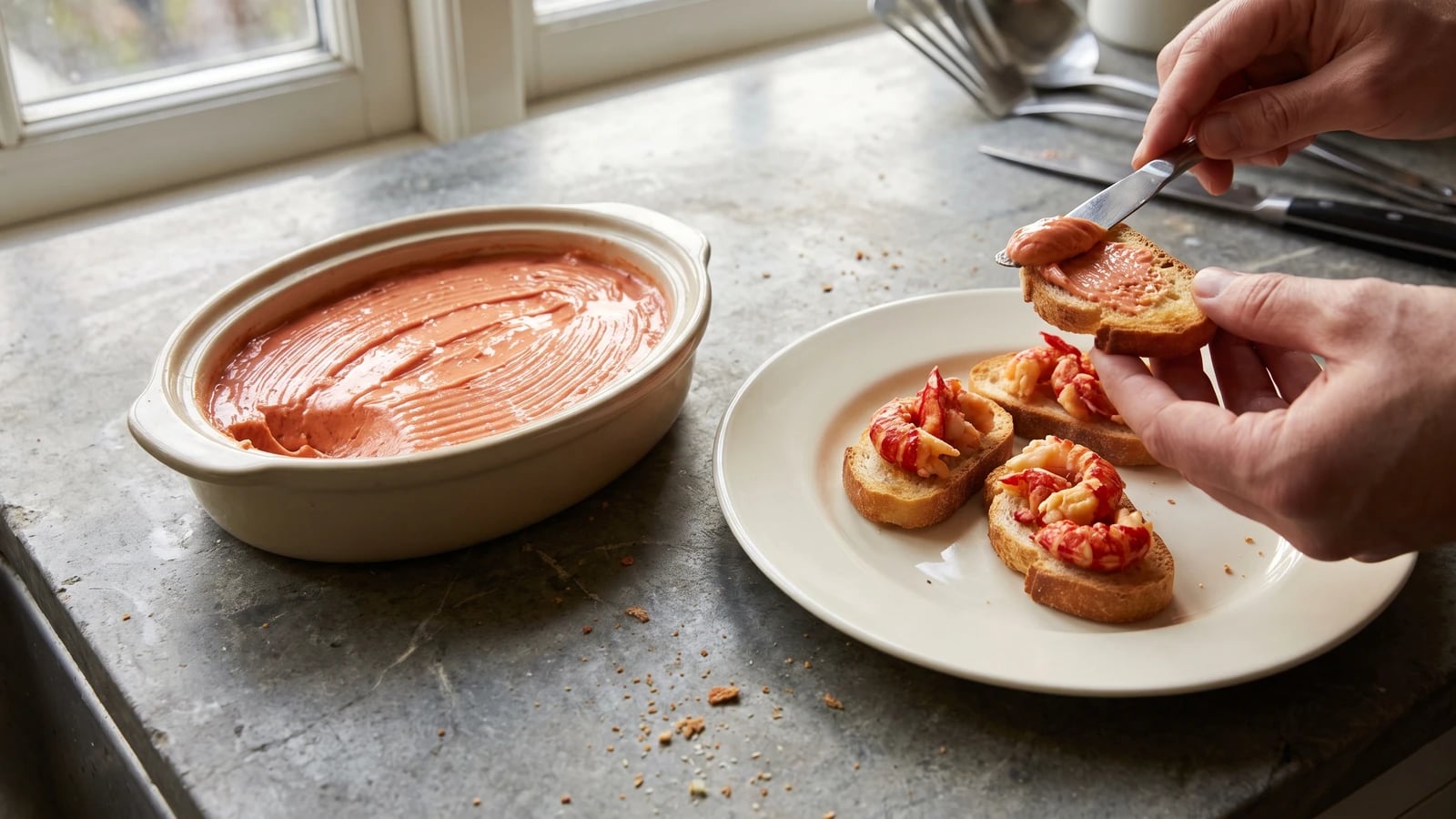
When it is right, the butter is rose-red, satin-smooth, and emphatically of crayfish without a grain of shell under the teeth. Crush the shells finer than seems reasonable before adding the butter. That is the one step that decides whether you extract their colour or merely trap their grit.
Beurre d’écrevisses belongs to the classical sauce pantry, but its strongest regional tie runs to Nantua in the Ain, where crayfish from nearby waters gave their colour and perfume to the sauce served with quenelles. Regional cooks understood what the grand kitchen later formalized: the tail meat makes the garnish, while the shells hold the red pigment that blooms in butter. From the tables around Lyon and Nantua, this thrifty shell butter entered the national canon as the defining finish of sauce Nantua.
Quantity
12 ounces (340 g), about 8 to 12
rinsed and scrubbed
Quantity
1 cup (240 ml / 227 g)
softened to a cool, pliable texture
| Ingredient | Quantity |
|---|---|
| whole raw crayfishrinsed and scrubbed | 12 ounces (340 g), about 8 to 12 |
| Mirepoix (No. 228)prepared according to its own entry | ½ cup (120 ml / 90 g) |
| unsalted buttersoftened to a cool, pliable texture | 1 cup (240 ml / 227 g) |
Warm the prepared Mirepoix (No. 228) in a wide, heavy saucepan over medium heat until it sizzles and smells rounded, about 2 minutes. Add the crayfish, turn them through the mirepoix, and cover tightly. Cook for 6 to 8 minutes, shaking the pan twice, until every shell is bright red and the thickest tail is opaque and reaches 145°F (63°C). If the mirepoix begins catching before the crayfish release their liquid, add a tablespoon of water and lower the heat. Ça se rattrape. Let them cool for 5 minutes, just until your fingers can manage them.
Twist off the tails, peel them, and lift away the dark intestinal vein. Cover and chill the tail meat for garnishing toast. Keep the tail shells, claws, and hard body carapaces, but discard the gills, grit, and loose soft matter. Blot the shells and weigh out exactly 4 ounces (113 g). The book permits pounding the whole crayfish, but reserving the tails gives you the garnish it intended and keeps the butter clean-tasting.
Wrap the measured shells in a folded sturdy kitchen towel and crack them firmly with a rolling pin or the base of a small saucepan. Transfer every fragment to a heavy-duty food processor and pulse until the shells resemble coarse sand, stopping to redistribute stubborn pieces. This is the step that decides the butter. Large fragments surrender little colour and make the sieving miserable; patient pounding exposes the rose-red shell beneath the surface.
Add the softened butter to the powdered shells and process for 3 to 4 minutes, scraping the bowl several times, until the mixture is evenly coral-red and smells distinctly of crayfish. The butter should remain creamy, not liquid. If the machine warms it into an oily mass, scrape everything into a metal bowl set over ice water and stir until opaque and creamy again, then continue. Ça se rattrape.
Rub the mixture through a fine-mesh sieve with a firm silicone spatula, pressing hard and scraping the clean butter from beneath the mesh. Discard the dry shell grit. Dampen a square of butter muslin with cold water, wring it thoroughly, and stretch it over a clean bowl. Rub the sieved butter through the cloth in small spoonfuls. If it firms and refuses to pass, warm the spatula in hot water, dry it completely, and continue. The first pass removes shell; the second removes grit. Neither is brigade theater. Both belong to the dish.
Pack the beurre d’écrevisses into a shallow crock while it is still pliable, press parchment directly against the surface, and chill for 1 hour. Let it soften for 10 to 15 minutes before spreading it on crisp toast and topping each piece with reserved tail meat. For sauce Nantua, whisk cold pieces into the finished sauce away from the heat; boiling after the butter goes in dulls its colour and encourages the fat to separate. À table!
1 serving (about 14g)
Culinary guides, cultural storytelling, and the editorial depth that makes cooking meaningful.
Discover Culinary ExplorerChef Juliette
Tiny éperlans, lightly floured and fried until their tails stand crisp, arrive in a generous heap on a napkin with fried parsley and grooved lemon, a weeknight lesson in heat and restraint.

Chef Juliette
Brandade de Morue turns salt cod, warm olive oil, and milk into a pale, silky emulsion: keep everything warm and add the oil slowly, then crown the generous dome with butter-fried bread.

Chef Juliette
Salt cod worked warm with cream, one patient spoonful at a time, until the rough flakes become a glossy Nîmes paste, domed generously and ringed with butter-fried croutons for the table.

Chef Juliette
Wine-poached char packed in its earthenware crock beneath butter gold: a make-ahead first course that turns careful cooling, thorough boning, and one unbroken seal into quiet abundance.