
Chef Juliette
Various Almond Preparations
Five almond preparations, one discipline: remove the skins cleanly, dry every kernel through, then cut, toast, or cloak it in pale caramel without letting its fragrant oils escape.
A cooking platform built around craft, culture, and the stories behind what we eat.
Created by Chef Juliette
Based on No. 2794, Meringues Glacées, from Le Guide Culinaire (1907) by Auguste Escoffier
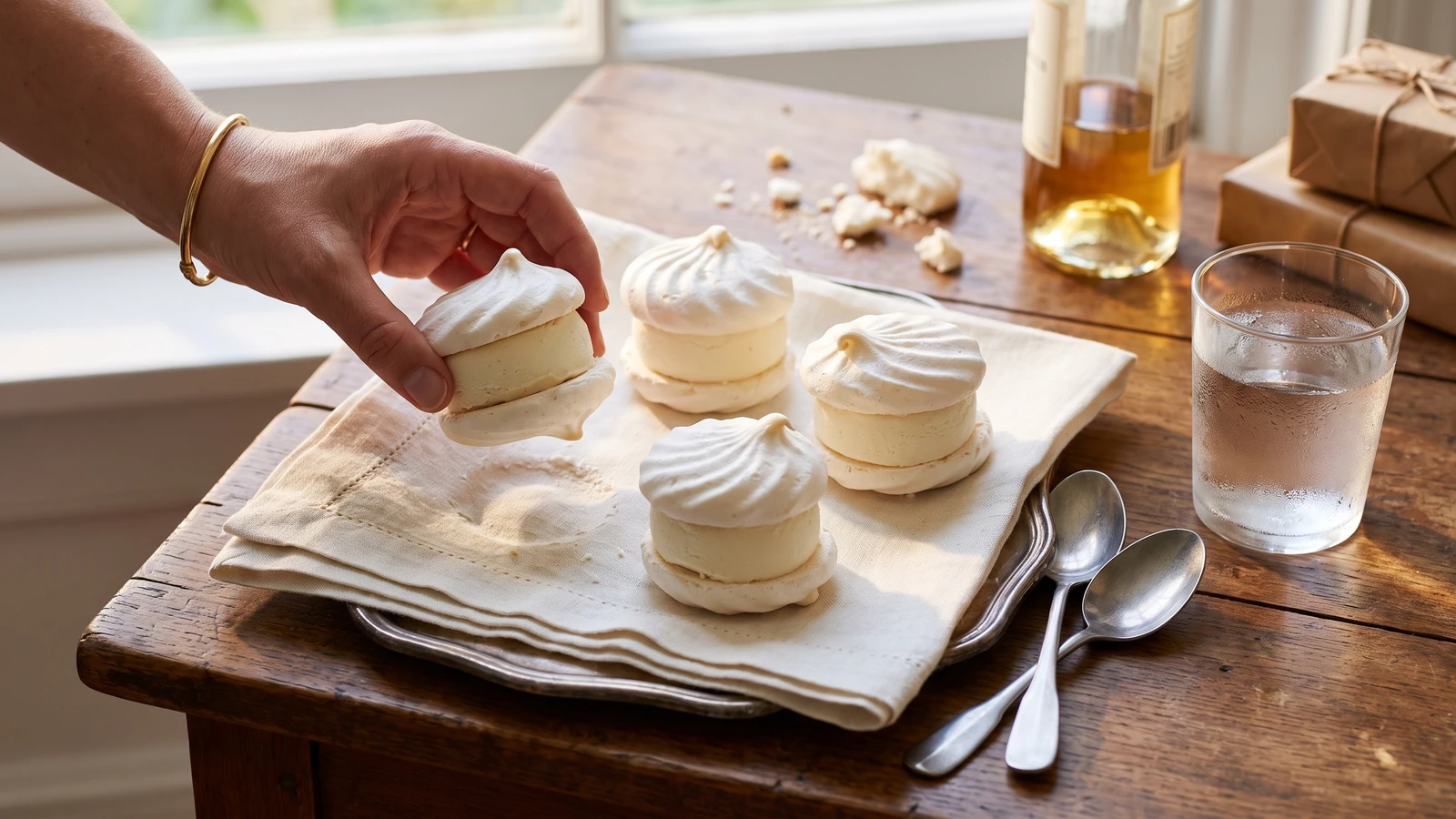
Dry, crisp meringue shells meet spoon-moulded ice only at the last moment, served singly on folded linen or joined in pairs for a celebration dessert built on timing, not fuss.
Meringues glacées (ice-filled meringue shells) teach the discipline of the last moment. The shell must be dry and crisp, the ice firm enough to hold a spooned oval, and the two must not meet until the platter is ready to move. Moisture is the enemy. That is the one true thing to know before you begin.
The original entry assumed a pastry section with Ordinary Meringue (No. 2382) already baked, several ices waiting in the freezer, and enough hands to fill every shell when the dining room called. At home, eight shells and one good ice are plenty for four people. Pre-moulding the ice on a cold tray gives one cook the missing pair of hands. That tray is brigade scaffolding and may change; filling the shells at the last moment is the dish and must stay. One cook, one stove, one evening.
Serve the meringues singly on a folded napkin, two to each guest, or use less filling against each shell and join them in pairs. Both forms belong to the entry. The step that matters is the final one: wait until everyone is seated before the ice touches the meringue.
Meringues glacées belong to the classical French entremets (the composed sweet course), particularly the formal dessert service of Paris, where dry meringue cases and frozen ices waited as separate preparations until the dining room called. The form traveled easily from grand kitchens to pâtisseries and celebration tables because it required no final cooking, only disciplined assembly. It is often confused with vacherin, but vacherin is built as a larger composed frozen dessert; meringues glacées remain individual shells filled at service.
Quantity
8 medium shells, about 3 inches / 7.5 cm each, from Ordinary Meringue (No. 2382)
fully baked, dry, and cooled
Quantity
1¼ cups (300 ml / about 250 g)
one flavor or two compatible flavors
| Ingredient | Quantity |
|---|---|
| Ordinary Meringue shellsfully baked, dry, and cooled | 8 medium shells, about 3 inches / 7.5 cm each, from Ordinary Meringue (No. 2382) |
| firm ice cream or fruit iceone flavor or two compatible flavors | 1¼ cups (300 ml / about 250 g) |
Line a small metal tray with parchment and freeze it for fifteen minutes. Arrange a clean, completely dry linen napkin on the serving platter and match the shells into pairs if you intend to join them. Keep the meringue at room temperature, sealed until needed; the refrigerator brings humidity, and humidity turns a crisp shell tacky.
Take the ice cream or fruit ice from the freezer and leave it at room temperature for three to eight minutes. It is ready when a spoon enters cleanly but the cut surface remains firm and holds a ridge. If it is too hard, wait another minute rather than forcing it; if it becomes glossy and begins to slump, ça se rattrape. Return it to the freezer for ten minutes, then try again.
Dip two deep oval spoons into hot water and wipe them completely dry. Scoop the ice with one spoon, then pass it between the bowls two or three times to form a compact oval. For single shells, make eight small ovals of about 2½ tablespoons each. For joined pairs, make four larger ovals of about 5 tablespoons each, so every shell carries less filling against its surface. Set the portions on the frozen tray and return them to the freezer for ten to fifteen minutes. Work briskly and stop once the shapes hold; overworked ice melts at the surface and refreezes coarse.
Only when the platter is ready to leave the kitchen, uncover the shells of Ordinary Meringue (No. 2382) and bring out the moulded ice. For singles, nest one small oval gently inside each shell and set them on the napkin, two per guest. For pairs, place one larger oval in each of four shells and fit a matching shell over it without pressing. If a shell cracks, place the broken side inward and let the ice support it; the pair will still serve handsomely.
Bring the platter directly to the table. Do not hold the assembled meringues in the refrigerator or return them to the freezer: moisture begins moving from the ice into the shell immediately, and no later drying restores that first crisp bite. This is service measured in minutes, not anxiety. À table!
1 serving (about 103g)
Culinary guides, cultural storytelling, and the editorial depth that makes cooking meaningful.
Discover Culinary ExplorerChef Juliette
Five almond preparations, one discipline: remove the skins cleanly, dry every kernel through, then cut, toast, or cloak it in pale caramel without letting its fragrant oils escape.

Chef Juliette
A pastry pantry lesson in one tray: filberts warmed only until their red skins release, rubbed clean, cooled, and chopped into a fragrant mise-en-place for cakes, creams, pralines, and petits fours.

Chef Juliette
The smallest pâtisserie discipline decides whether a cake leaves its mould intact: clarified butter in every corner, followed by the lightest veil of dry flour or fécule.

Chef Juliette
Four whites, one spotless bowl, and a patient change of speed: whisk gently until loosened, then briskly to glossy stiffness, with powdered sugar waiting if the foam begins to granulate.