
Chef Juliette
Various Almond Preparations
Five almond preparations, one discipline: remove the skins cleanly, dry every kernel through, then cut, toast, or cloak it in pale caramel without letting its fragrant oils escape.
A cooking platform built around craft, culture, and the stories behind what we eat.
Created by Chef Juliette
Based on No. 2755, Pralined Ice-cream, from Le Guide Culinaire (1907) by Auguste Escoffier
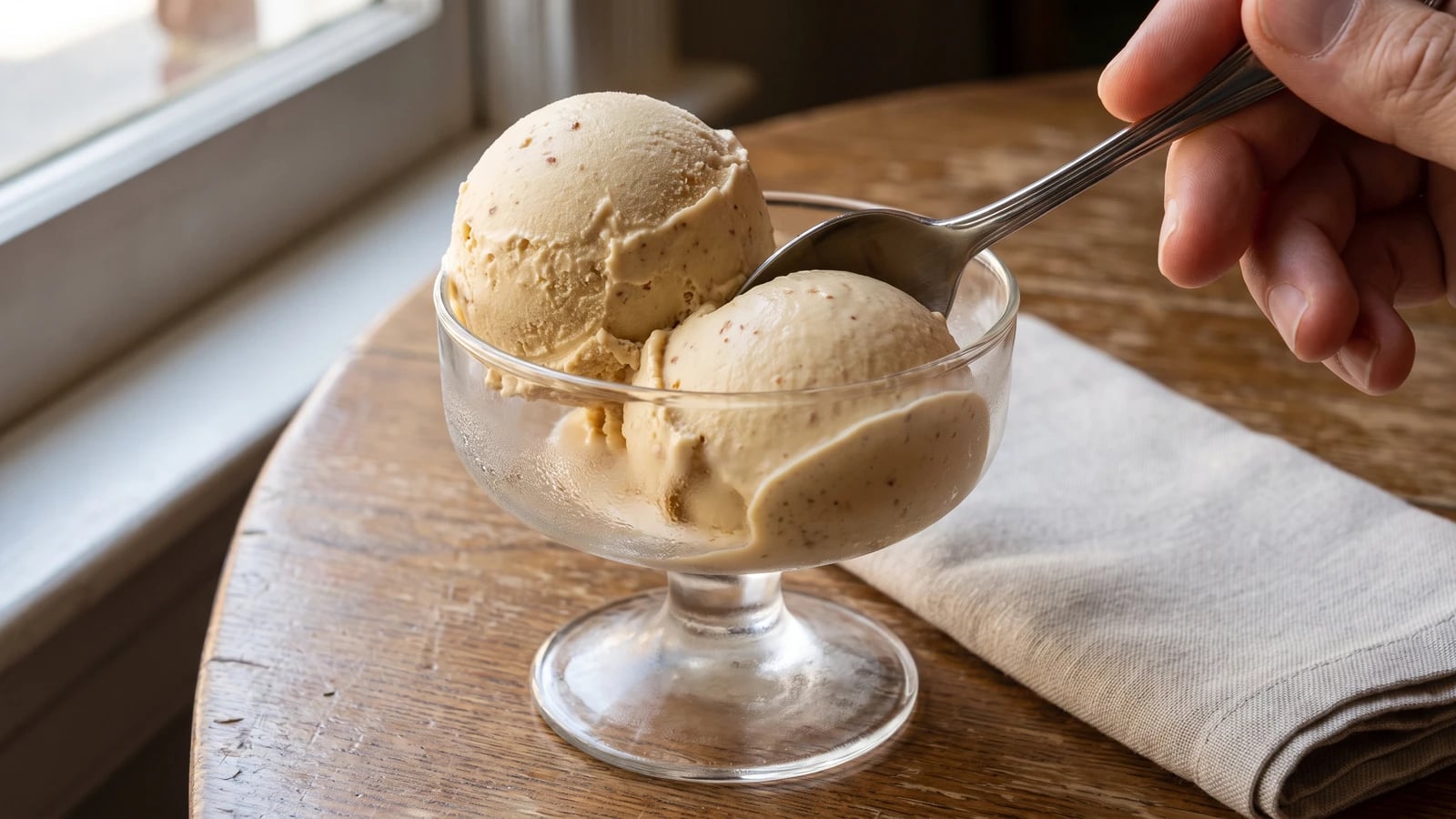
Glace pralinée turns two prepared elements into one exact dessert: old-gold almond pralin powdered fine, stirred through cold vanilla custard, then churned until caramel and cream meet without hard grit.
Glace pralinée teaches a hard, useful restraint: caramel is flavor only until it passes old gold. Beyond that, bitterness takes command, and freezing makes it louder. The pralin must be dry, finely powdered, and warm in color before it ever meets the cold custard.
The original formula assumed pralin waiting at the pastry bench, a mortar and fine sieve, vanilla custard prepared by another pair of hands, and a freezing pail managed through service. Here the formula is halved for six generous servings, the mortar becomes a food processor used in short pulses, and a countertop machine handles the freezing. Only the scale and equipment have changed; the proportion and sequence remain intact. One cook, one stove, one evening, with the freezer doing the waiting.
The food processor replaces the long pounding, which was brigade scaffolding. The fine sieving stays because it is the dish: caramel shards that seem harmless at room temperature become gravel when frozen. Powder the pralin patiently before it touches the custard, and everything afterward becomes simple.
Glace pralinée belongs to the Parisian pâtisserie and grand-kitchen repertoire, where prepared custards and dry nut confections moved freely between the pastry bench and the ice pail. Montargis is closely associated with whole caramel-coated almonds, while the classical pantry's pralin is that confection reduced to powder, not the smooth praliné paste common in filled chocolates. Stirred into vanilla custard, one dry preparation could flavor soufflés, custards, and frozen desserts while keeping its toasted almond character.
Quantity
2 cups (475 ml / 500 g)
thoroughly chilled
| Ingredient | Quantity |
|---|---|
| Pralinfully cold and broken into small pieces | ½ cup (120 ml / 57 g) Pralin (No. 2352) |
| previously prepared vanilla-flavoured custardthoroughly chilled | 2 cups (475 ml / 500 g) |
Freeze the ice-cream machine bowl according to its instructions, then chill a mixing bowl, the sieve, and the storage container. Keep the vanilla-flavoured custard in the cold until the moment you need it. A warm base spends its churning time merely becoming cold and forms coarse crystals before it can take on air; if the custard is not thoroughly chilled, wait.
Pulse the Pralin (No. 2352) in a small food processor until it resembles fine, dry sand. Work in short bursts because continuous grinding warms the almonds and releases their oil. Rub the powder through the fine sieve, return the coarse pieces to the processor, and repeat until nearly all has passed through. If it begins clumping into an oily paste, stop. Whisk two spoonfuls of the measured cold custard into that paste until smooth, then press it through the sieve; ça se rattrape, and no extra liquid has entered the formula.
Put the sieved Pralin (No. 2352) in the chilled mixing bowl. Add about one-quarter of the cold vanilla-flavoured custard and whisk it into a smooth, thick cream, then gradually whisk in the remainder. This staged mixing prevents dry pockets. Let the mixture stand in the cold for ten minutes so the caramel can soften into the custard; if hard specks remain, whisk again and pass the base through the sieve. Do not warm it to chase a lump, since warmth now costs you a fine frozen texture.
Pour the base into the running ice-cream machine and churn until it swells slightly, loses its liquid shine, and holds the soft folds of thick whipped cream, usually twenty to twenty-five minutes. Stop when a spoon drawn through it leaves a clean furrow; churning past that point warms the base and can make the custard grainy. If it remains loose after thirty minutes, the machine bowl has warmed. Transfer the mixture to a shallow metal pan, freeze for thirty minutes, whisk vigorously, and repeat twice. The texture will be a little denser, but the dessert is saved.
Pack the churned glace pralinée into the chilled container, press parchment directly against its surface, cover, and freeze for at least four hours, until scoopable but firm. Let it stand at room temperature for five to ten minutes before serving, just long enough for a spoon to pass through without force. Spoon it generously into chilled coupes and leave it unadorned; vanilla, caramel, and almond have already finished the conversation. À table!
1 serving (about 93g)
Culinary guides, cultural storytelling, and the editorial depth that makes cooking meaningful.
Discover Culinary ExplorerChef Juliette
Five almond preparations, one discipline: remove the skins cleanly, dry every kernel through, then cut, toast, or cloak it in pale caramel without letting its fragrant oils escape.

Chef Juliette
A pastry pantry lesson in one tray: filberts warmed only until their red skins release, rubbed clean, cooled, and chopped into a fragrant mise-en-place for cakes, creams, pralines, and petits fours.

Chef Juliette
The smallest pâtisserie discipline decides whether a cake leaves its mould intact: clarified butter in every corner, followed by the lightest veil of dry flour or fécule.

Chef Juliette
Four whites, one spotless bowl, and a patient change of speed: whisk gently until loosened, then briskly to glossy stiffness, with powdered sugar waiting if the foam begins to granulate.