
Chef Juliette
Various Almond Preparations
Five almond preparations, one discipline: remove the skins cleanly, dry every kernel through, then cut, toast, or cloak it in pale caramel without letting its fragrant oils escape.
A cooking platform built around craft, culture, and the stories behind what we eat.
Created by Chef Juliette
Based on No. 2352, Pralin, from Le Guide Culinaire (1907) by Auguste Escoffier
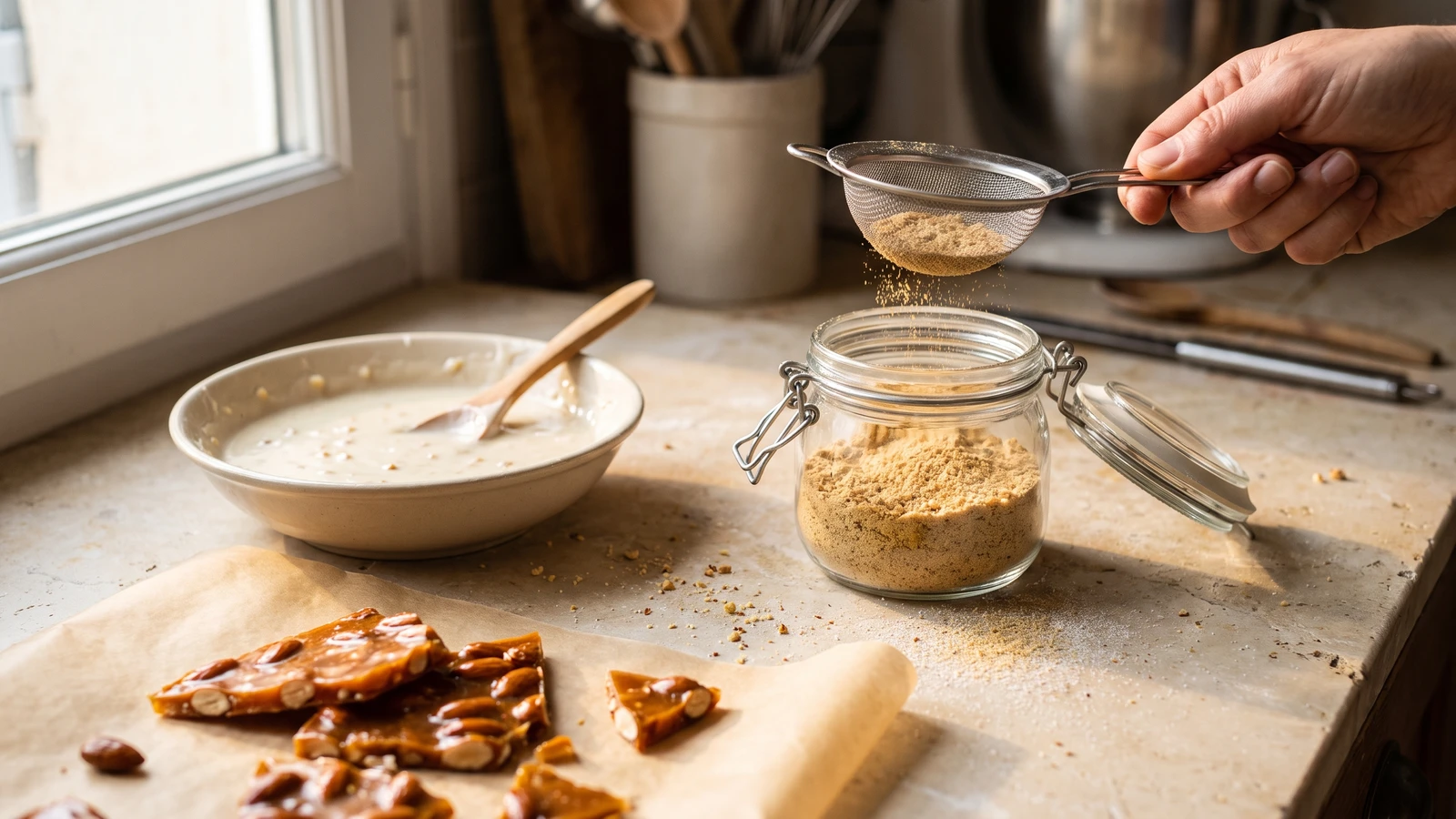
Pralin in its two classical forms: a supple almond glaze for cakes and fruit entremets, or old-gold almond nougat ground fine for soufflés, custards, and ices.
Pralin (almond glaze or powdered almond nougat) teaches that sugar colour is flavour. The uncooked form depends on vigorous mixing and the measured addition of almonds; the cooked form depends on stopping the caramel at old gold. Pale sugar lacks character, while dark brown sugar turns bitter. There is no seasoning or cream to conceal the mistake.
The source formula assumed a pastry bench with an oiled marble corner, a mortar, a sieve, and enough hands to pound more than a kilogram of nougat. At home, a silicone-lined tray and food processor take over, and the powder batch comes down to 450 grams while keeping the exact four-parts-sugar to five-parts-almond ratio. Oiled marble and repeated mortar work were brigade scaffolding. Dry almonds, complete cooling, careful grinding, and the final sieve are the dish, so they stay. For the glaze, pasteurized egg white and film pressed directly onto the surface replace egg-white-moistened paper, which lets a small batch rest safely.
These are two separate preparations, not stages of one recipe. Make the soft pralin when a cake or fruit entremet needs a textured coating; make the powdered pralin for a soufflé, omelette soufflée, ice preparation, or custard. One cook, one stove, one evening. When the saucepan comes out, guard the colour above everything else: old gold, then off the heat.
Pralin belongs to the French confiserie and pâtisserie bench, with its almond-and-caramel lineage especially associated with Montargis and its whole almond pralines. In the working vocabulary, whole coated nuts are pralines, crushed caramelized nuts become pralin, and longer grinding releases almond oil to make praliné, a smooth paste. Classical kitchens also used pralin for the egg-white almond coating preserved here, which is why the entry moves between cake glaze and a dry powder for soufflé, omelette soufflée, ice preparations, and custard.
Quantity
1 large (2 tablespoons / 30 ml / 30 g)
Quantity
1½ tablespoons (22 ml / 12 g)
Quantity
½ to 1 cup (120 to 240 ml / 60 to 120 g)
finely chopped
Quantity
1 cup (240 ml / 200 g)
Quantity
1¾ cups (420 ml / 250 g)
brought to room temperature
Quantity
½ teaspoon (2.5 ml / 2 g)
for a bare metal cooling tray
| Ingredient | Quantity |
|---|---|
| pasteurized egg white, for the almond glaze | 1 large (2 tablespoons / 30 ml / 30 g) |
| icing sugar, for the almond glaze | 1½ tablespoons (22 ml / 12 g) |
| almonds, for the almond glazefinely chopped | ½ to 1 cup (120 to 240 ml / 60 to 120 g) |
| superfine granulated sugar, for the nougat powder | 1 cup (240 ml / 200 g) |
| whole dried almonds, for the nougat powderbrought to room temperature | 1¾ cups (420 ml / 250 g) |
| neutral oil (optional)for a bare metal cooling tray | ½ teaspoon (2.5 ml / 2 g) |
Treat the glaze and powder as two independent preparations. For the glaze, set out a small bowl and wooden spoon. For the powder, place a silicone mat on a sturdy tray before the sugar meets the heat; if using bare metal instead, wipe it with the thinnest possible film of neutral oil. Caramel waits for nobody, and arranging the landing place first is simple good sense.
For the glaze, put the pasteurized egg white and icing sugar in the bowl. Stir briskly with the wooden spoon for 2 to 3 minutes, pressing and beating rather than whisking in air, until the mixture becomes smooth, cohesive, and noticeably thicker. It should fall from the spoon in a heavy ribbon rather than run like unbeaten white.
Stir in ½ cup of the chopped almonds, then add the remainder a spoonful at a time according to the intended use. Stop while the pralin still spreads in a slow, textured ribbon for a fruit entremet; continue until it holds the spoon's ridges for a thicker cake covering. If it becomes too stiff, ça se rattrape: beat in a few drops of pasteurized egg white, no more than needed to restore movement. Spread it promptly, or press food-safe film directly against its surface and refrigerate so it cannot crust.
For the powder, spread the superfine sugar evenly in a clean, dry saucepan and set it over medium-low heat. As the edges liquefy, gently draw the melted sugar over the dry patches with a dry wooden spoon, disturbing it as little as possible. It may form hard pale lumps. Lower the heat and keep turning them through the liquid caramel; ça se rattrape, and they will melt. The instant the caramel is uniformly old gold and smells rounded rather than sharp, take it off the heat. If it reaches dark mahogany or smells acrid, let it cool safely and begin again. Burnt caramel cannot be rescued.
Immediately add the dry, room-temperature almonds and turn them through the caramel until every nut is coated. If the caramel hardens before the last almonds are covered, return the pan to low heat for a few seconds and keep folding until it loosens. Scrape the nougat onto the prepared tray and spread it into a shallow layer. Do not touch or taste it while hot. Leave it undisturbed for about 30 minutes, until completely cold, rigid, and crisp under the knuckles.
Break the cold nougat into small pieces and pulse it in a food processor in short bursts, working in batches, until it resembles coarse sand. Pass it through a fine-mesh sieve, then return only the larger pieces to the next batch and repeat until everything passes. This preserves the source method's even powder without the long mortar work. If the mixture warms and begins clumping, stop. Ça se rattrape: spread it on the tray, chill it for 10 minutes, and resume with shorter pulses. Grind past that point and the almonds release their oil, giving praliné rather than powdered pralin.
Transfer the powdered pralin to a completely dry, airtight jar as soon as it is cool from grinding. Keep it away from humidity, which turns caramel sticky, and spoon it out only with a dry utensil. Fold it into a soufflé, omelette soufflée, ice preparation, or custard in the amount required by that preparation. The glaze is best used the day it is mixed; the powder waits patiently for the next dessert.
1 serving (about 15g)
Culinary guides, cultural storytelling, and the editorial depth that makes cooking meaningful.
Discover Culinary ExplorerChef Juliette
Five almond preparations, one discipline: remove the skins cleanly, dry every kernel through, then cut, toast, or cloak it in pale caramel without letting its fragrant oils escape.

Chef Juliette
A pastry pantry lesson in one tray: filberts warmed only until their red skins release, rubbed clean, cooled, and chopped into a fragrant mise-en-place for cakes, creams, pralines, and petits fours.

Chef Juliette
The smallest pâtisserie discipline decides whether a cake leaves its mould intact: clarified butter in every corner, followed by the lightest veil of dry flour or fécule.

Chef Juliette
Four whites, one spotless bowl, and a patient change of speed: whisk gently until loosened, then briskly to glossy stiffness, with powdered sugar waiting if the foam begins to granulate.