
Chef Juliette
Smelt (Éperlans)
Tiny éperlans, lightly floured and fried until their tails stand crisp, arrive in a generous heap on a napkin with fried parsley and grooved lemon, a weeknight lesson in heat and restraint.
A cooking platform built around craft, culture, and the stories behind what we eat.
Created by Chef Juliette
Based on No. 264, The Various Degrees of Heat Reached by the Frying Medium, and their Application, from Le Guide Culinaire (1907) by Auguste Escoffier
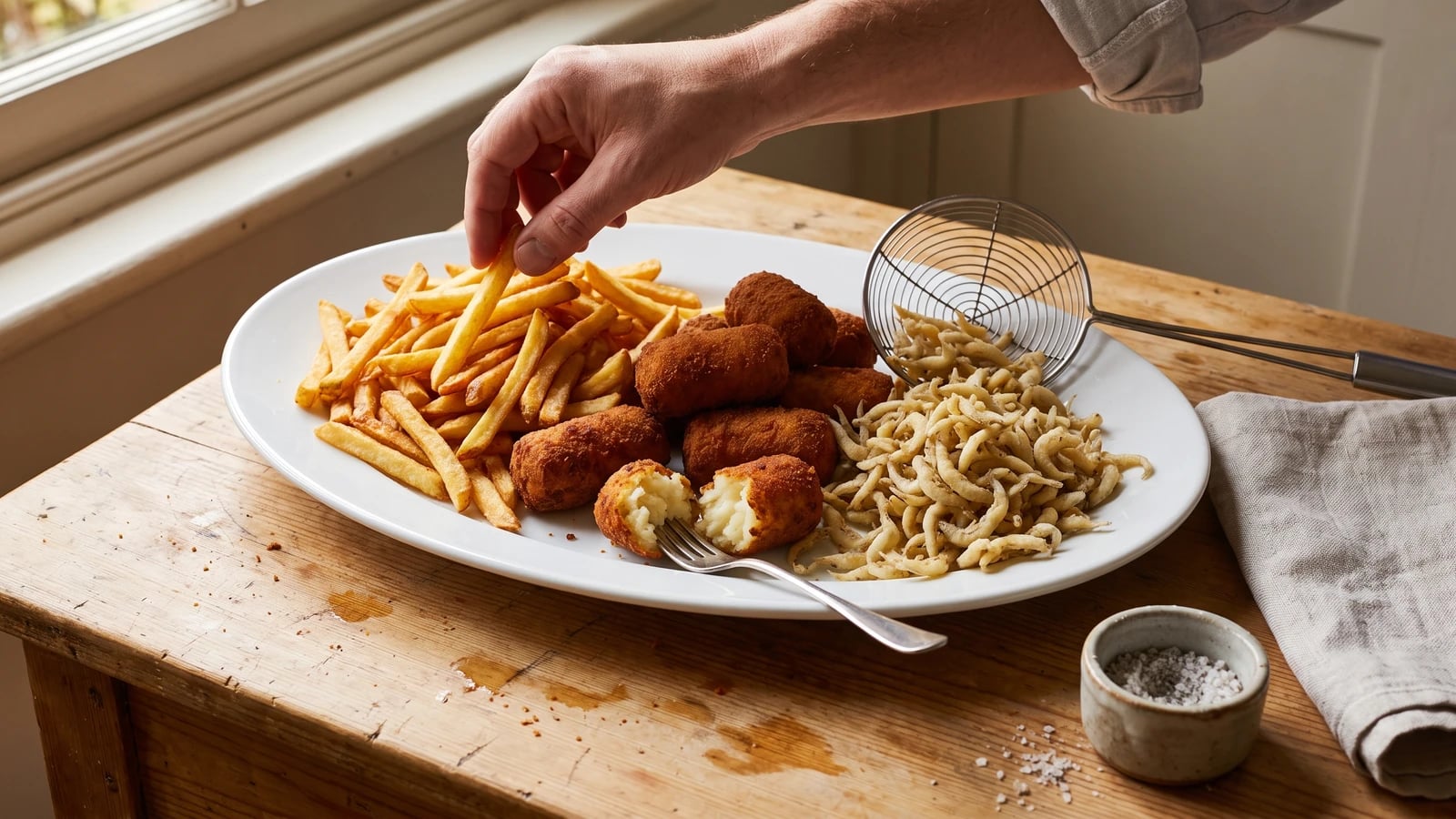
Three foods, three heats, one principle: moderate fat cooks inward, hot fat sets a coating, and very hot fat fixes tiny fish before they can drink the frying medium.
Les Trois Degrés de Chaleur de la Friture (Three Degrees of Frying Heat) teaches one true thing before you touch the pan: fat never boils, it climbs through useful temperatures. Moderately hot fat penetrates and removes water, hot fat finishes that first cooking or sets a coating, and very hot fat fixes a firm crust around small food before the interior can escape.
The old entry assumed a broad service kettle of house frying fat, brigade-sized quantities, and a cook who judged heat from a crust of bread, a crackle, and the first scent of smoke. Your honest equivalent is a heavy home pot, two quarts of predictable refined oil, and a clipped thermometer. A permanent fryer and the great batch are scaffolding and can go; the ascending sequence of temperatures must stay. One cook, one stove, one evening.
You will watch the whole grammar unfold in three foods: potatoes cooked first by penetration and then crisped, croquettes panées à l’anglaise whose shell must set instantly, and tiny whitebait finished in moments. Wait for the fat to return to its exact temperature before every batch. That pause is the step that decides everything.
The three-degree classification of friture belongs to the professional kitchens of Paris, where a shared frying kettle had to serve wet vegetables, coated croquettes, and tiny fish in careful succession. From the grand kitchen it passed into bistros and home manuals as a practical grammar: lower heat cooks inward, while higher heat sets the surface. Its enduring correction is simple: fat does not boil, and calling it boiling hot conceals the temperature choice that determines the crust.
Quantity
2 large (about 1 lb / 454 g)
cut into ¼-inch / 6-mm batons
Quantity
8 small (about 10 oz / 280 g)
thoroughly chilled
Quantity
1 cup (240 ml / 120 g)
divided
Quantity
¾ cup (180 ml / 180 g) Anglaise (for Egg-and-bread-crumbing) (No. 174)
Quantity
1½ cups (360 ml / 150 g)
Quantity
8 oz (225 g)
fresh or thawed and dried thoroughly
Quantity
2 qt (1.9 L / 1.75 kg)
Quantity
2 tsp (10 ml / 12 g)
divided
Quantity
½ tsp (2.5 ml / 1 g)
| Ingredient | Quantity |
|---|---|
| russet potatoescut into ¼-inch / 6-mm batons | 2 large (about 1 lb / 454 g) |
| fully cooked potato croquettesthoroughly chilled | 8 small (about 10 oz / 280 g) |
| plain flourdivided | 1 cup (240 ml / 120 g) |
| Anglaise (for Egg-and-bread-crumbing) | ¾ cup (180 ml / 180 g) Anglaise (for Egg-and-bread-crumbing) (No. 174) |
| fine dry breadcrumbs | 1½ cups (360 ml / 150 g) |
| cleaned whitebaitfresh or thawed and dried thoroughly | 8 oz (225 g) |
| refined high-oleic sunflower or peanut oil | 2 qt (1.9 L / 1.75 kg) |
| fine saltdivided | 2 tsp (10 ml / 12 g) |
| ground white pepper | ½ tsp (2.5 ml / 1 g) |
Put ½ cup of the flour in a shallow dish and reserve the rest for the fish. Set the finished Anglaise (for Egg-and-bread-crumbing) (No. 174) in a second dish and the breadcrumbs in a third. Roll each cold croquette lightly in flour, pass it completely through the Anglaise, then press it into the crumbs. Chill the coated croquettes for 15 minutes. If you see a bare patch or crack, cover it now with a little more Anglaise and crumbs; the crust must be continuous before it meets the fat.
Rinse the potato batons under cold water until the water runs nearly clear, then drain and dry them with towels until no moisture remains. Dry the whitebait just as carefully and keep it cold. Water cools the fat and makes it spit; a dry surface gives the heat direct access to the food.
Pour the oil into a heavy 5 to 6-quart pot, making certain the pot is no more than half full, and clip the thermometer where its tip sits in the oil without touching the bottom. Set a wire rack over a sheet pan and keep a heavy lid within reach. Heat the oil gradually to 280°F / 138°C. Fat never boils, and smoke is not a target; the thermometer tells you which work the fat is ready to do.
Lower half the potatoes into the oil at 280°F / 138°C and fry for 7 to 9 minutes, stirring gently, until the batons are tender and flexible with little or no colour. Lift them to the rack and repeat with the remaining potatoes, allowing the oil to recover before the second batch. This moderate heat is a preparatory cooking: it drives out vegetable water and cooks by penetration. If the potatoes colour quickly, the oil is too hot; lift them out, lower the heat, and resume when the thermometer returns to 280°F. Ça se rattrape.
Raise the oil to 320°F / 160°C. Return the potatoes in two batches and fry for 4 to 6 minutes, until the surfaces turn crisp and evenly golden. The first heat cooked the centres; this hot second stage finishes them and sets the outside. Drain on the rack and season immediately with some of the salt. If a crowded batch comes out soft, let the oil recover fully and give those potatoes one more short frying before seasoning.
Raise the oil to 355°F / 179°C. Fry the croquettes four at a time for 1½ to 2½ minutes, turning once, until their Anglaise (for Egg-and-bread-crumbing) (No. 174) coating is firm and deep gold. The filling is already cooked, so the work here is instantaneous setting and reheating. If the first croquette leaks, remove it at once and skim out the escaped crumbs; patch or double-coat any thin places on the remaining croquettes, then wait for the fat to return to 355°F before continuing.
Season the reserved flour with the white pepper, toss the dry whitebait through it, and shake away every excess. With the oil steady at 355°F / 179°C, fry the fish in two loose batches for 1½ to 2 minutes, until curled, crisp, and lightly golden. Drain, salt at once, and bring all three applications to the table together. If a batch turns limp because the temperature fell, return the cooked fish to fully recovered oil for 15 seconds. Very small food needs a sharp setting, not a long bath. À table!
1 serving (about 255g)
Culinary guides, cultural storytelling, and the editorial depth that makes cooking meaningful.
Discover Culinary ExplorerChef Juliette
Tiny éperlans, lightly floured and fried until their tails stand crisp, arrive in a generous heap on a napkin with fried parsley and grooved lemon, a weeknight lesson in heat and restraint.

Chef Juliette
Brandade de Morue turns salt cod, warm olive oil, and milk into a pale, silky emulsion: keep everything warm and add the oil slowly, then crown the generous dome with butter-fried bread.

Chef Juliette
Salt cod worked warm with cream, one patient spoonful at a time, until the rough flakes become a glossy Nîmes paste, domed generously and ringed with butter-fried croutons for the table.

Chef Juliette
Wine-poached char packed in its earthenware crock beneath butter gold: a make-ahead first course that turns careful cooling, thorough boning, and one unbroken seal into quiet abundance.