
Chef Juliette
Cherry Sauce
Sauce aux Cerises balances lush cherry sweetness with red currant, blood orange, ginger, and Kirsch. Melt the jelly gently, keep the fruit bright, and the sauce holds its gloss and edge.
A cooking platform built around craft, culture, and the stories behind what we eat.
Created by Chef Juliette
Based on No. 2612, Sauces and Accompaniments of Cold Sweets, from Le Guide Culinaire (1907) by Auguste Escoffier
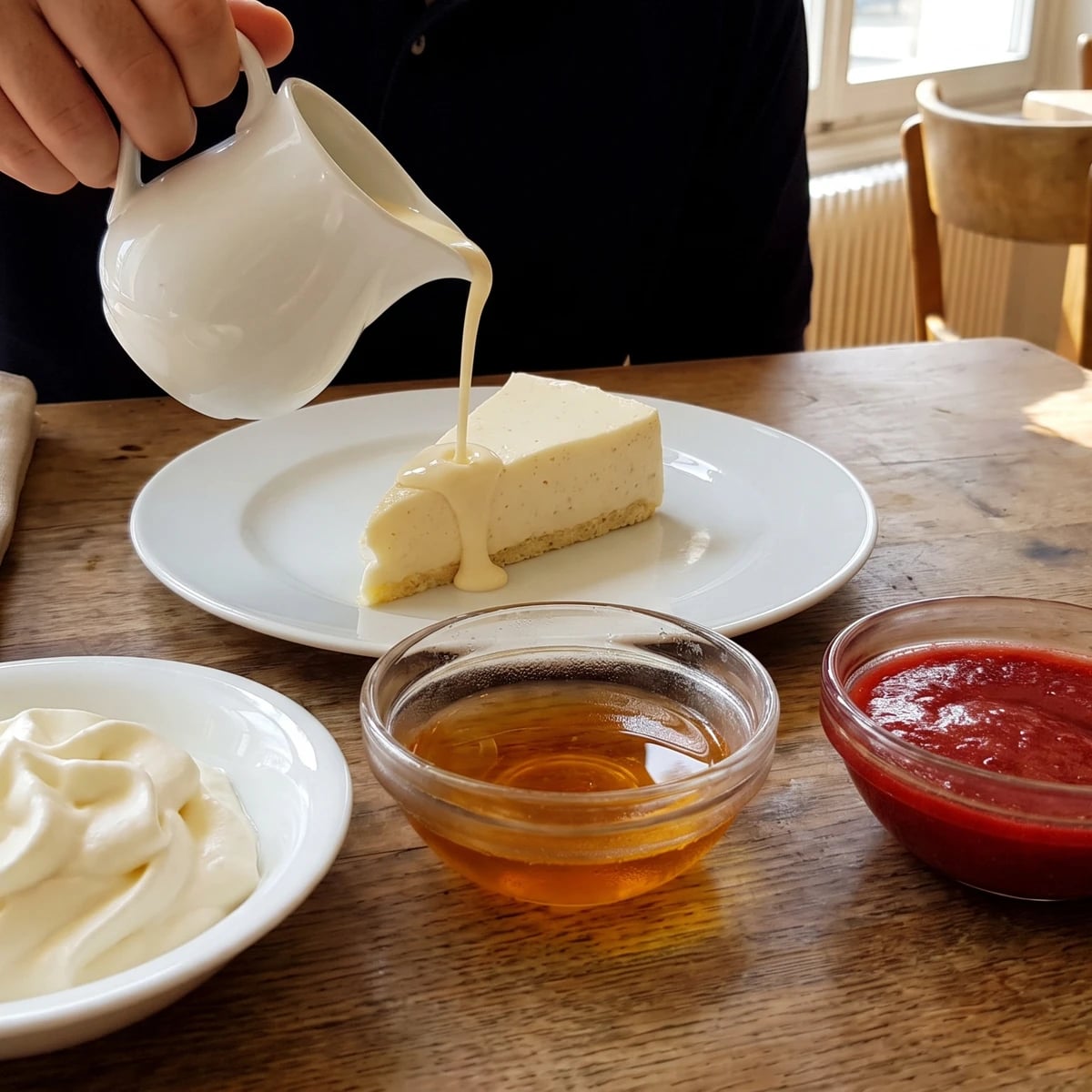
Four cold sauces, one grammar: silken custard, fruit syrup brightened with kirsch, raw strawberry purée, and softly whipped Chantilly, each balanced after chilling so the entremets remains the point.
Sauces et accompagnements des entremets froids (sauces for cold sweets) teach one clean principle: a cold dessert sauce must be judged cold. Chilling quiets sweetness, changes texture, and draws perfume inward, so the final balance happens after the bowls leave the refrigerator, not while the syrup is warm or the cream is under the whisk. Four families cover the table: custard, fruit syrup, raw fruit purée, and crème Chantilly (sweetened whipped cream). C'est la même grammaire: silk, perfume, freshness, air.
The original service assumed a pastry section with finished custard ready, fruit syrups bottled, purées passed through sieves, and cream whipped close to service. Your honest equivalent is four bowls of about two cups each, made with one saucepan, one sieve, and a hand mixer. Bulk quantities and constant service holding were brigade scaffolding, so they go. The matched liqueur, uncooked fruit, gentle custard, and softly whipped cream are the sauces themselves, so they stay. One cook, one stove, one evening.
The finished set gives you ivory custard, clear amber syrup scented with kirsch, crimson strawberry purée, and Chantilly that falls from the spoon in soft folds. Chill every component completely before correcting it. That final cold tasting is the step that decides the whole set.
This quartet belongs to the classical Paris pâtisserie and dining-room service of entremets, where a cold sweet arrived with a sauce chosen for contrast rather than buried beneath decoration. Crème anglaise carries a French name pointing toward English-style stirred custards, while fruit syrups and raw purées brought the preserving pantry and market basket into the formal repertoire. Chantilly evokes the tables of Chantilly, north of Paris, but the tale of one dramatic invention there is folklore; sweetened whipped cream was practiced widely before the place-name settled onto it.
Quantity
2 cups (480 ml / about 500 g) Crème Anglaise (No. 2397)
vanilla-flavoured and chilled
Quantity
8 medium fresh apricots or 1 lb (450 g) frozen
pitted and quartered
Quantity
2 cups plus up to 1/4 cup (540 ml / 540 g)
divided
Quantity
3/4 cup (180 ml by volume / 150 g)
Quantity
2 tablespoons (30 ml / 28 g)
Quantity
about 24 medium berries (1 lb / 450 g)
hulled
Quantity
1/2 cup (120 ml by volume / 60 g)
divided
Quantity
1 cup plus 2 tablespoons (270 ml / 270 g)
divided
Quantity
2 tablespoons (30 ml by volume / 15 g)
Quantity
1 teaspoon (5 ml / 5 g)
Quantity
up to 2 tablespoons (30 ml / 30 g)
for adjusting the custard
| Ingredient | Quantity |
|---|---|
| finished Crème Anglaisevanilla-flavoured and chilled | 2 cups (480 ml / about 500 g) Crème Anglaise (No. 2397) |
| ripe apricots or frozen unsweetened apricot halvespitted and quartered | 8 medium fresh apricots or 1 lb (450 g) frozen |
| cold waterdivided | 2 cups plus up to 1/4 cup (540 ml / 540 g) |
| granulated sugar | 3/4 cup (180 ml by volume / 150 g) |
| kirsch | 2 tablespoons (30 ml / 28 g) |
| ripe strawberrieshulled | about 24 medium berries (1 lb / 450 g) |
| powdered sugar for the puréedivided | 1/2 cup (120 ml by volume / 60 g) |
| cold heavy creamdivided | 1 cup plus 2 tablespoons (270 ml / 270 g) |
| powdered sugar for the Chantilly | 2 tablespoons (30 ml by volume / 15 g) |
| vanilla extract | 1 teaspoon (5 ml / 5 g) |
| cold whole milk (optional)for adjusting the custard | up to 2 tablespoons (30 ml / 30 g) |
Reach for the finished Crème Anglaise (No. 2397), prepared and chilled according to its own entry. Do not cook it again here; the cross-reference is deliberate, and the custard remains a finished component. If a light skin formed during chilling, whisk gently or pass the sauce once through the fine sieve. Cover it and return it to the refrigerator. Put a mixing bowl and the mixer beaters beside it to chill for the Chantilly.
For the sirop d'abricot au kirsch (apricot syrup with kirsch), combine the apricots, 2 cups of the water, and the granulated sugar in a medium saucepan. Bring them slowly to a bare simmer, stirring only until the sugar dissolves. Cook gently for 15 to 20 minutes, until the fruit is completely tender and the liquid tastes distinctly of apricot. A hard boil muddies the syrup and cooks away its fresh perfume, so keep the surface at a quiet tremble.
Pour the apricots and liquid through a fine sieve into a clean bowl, letting the syrup drain without pressing the fruit. Return the clear liquid to the saucepan and reduce it gently to 1 7/8 cups (450 ml). If it falls below that mark, ça se rattrape: add reserved cold water a spoonful at a time. Cool the syrup over an ice bath, stirring occasionally, then add the kirsch once it is below 100°F (38°C). Boiling the liqueur would throw away the aroma it was added to provide. Cover and chill.
For the purée de fraises (raw strawberry purée), blend the strawberries with three quarters of the powdered sugar until completely smooth. Pass the purée through the fine sieve, pressing firmly to leave the seeds behind, then cover and chill it for at least 1 hour. Keep it raw. Cooking would give you another syrup and erase the bright edge that makes this sauce useful. If the chilled purée is too thick to pour, loosen it with cold water one teaspoon at a time; reserve the remaining sugar for the final cold tasting.
Set aside 2 tablespoons of the cold cream. Pour the remaining 1 cup into the chilled bowl with the Chantilly sugar and vanilla. Whip at medium speed until the cream holds rounded ridges but still falls softly from the beaters. Stiff peaks are too far for a sauce. If the cream begins to look grainy, stop immediately and fold in the reserved liquid cream a teaspoon at a time; ça se rattrape. If it remains smooth, fold in enough reserved cream to give it a soft, spoonable fall. Cover and chill.
After every sauce has chilled for at least 1 hour, taste them in their serving condition. The custard should coat a spoon yet pour freely; if it has tightened too far, whisk in cold whole milk one teaspoon at a time. The syrup should taste first of apricot and then of kirsch. Add the reserved powdered sugar to the strawberry purée only if the cold fruit needs it. Serve the four sauces separately in chilled vessels: custard with molded or poached entremets, apricot syrup with vanilla or almond sweets, strawberry purée with pale cream desserts, and Chantilly with fruit. A spoonful of purée may be folded into a little Chantilly at the table, as the canon permits, but keep the main bowls distinct. Match the sauce, then stop. À table!
1 serving (about 60g)
Culinary guides, cultural storytelling, and the editorial depth that makes cooking meaningful.
Discover Culinary Explorer
Chef Juliette
Sauce aux Cerises balances lush cherry sweetness with red currant, blood orange, ginger, and Kirsch. Melt the jelly gently, keep the fruit bright, and the sauce holds its gloss and edge.

Chef Juliette
Bavarois à la crème turns one careful crème anglaise into the mother of cold moulded sweets, set just enough to tremble and folded with cream only when both mixtures share the same body.

Chef Juliette
A fruit-first bavarois with no custard and no egg, only vivid berry purée, measured syrup, lemon, gelatin, and softly whipped cream, chilled until it unmolds in one tender, gleaming piece.

Chef Juliette
Shape dictates strength: mould a delicate Bavarois firmly enough to stand, or give it a chilled dish and use less gelatine for a softer spoonful, with a clean release and no ceremony wasted.