
Chef Juliette
Various Almond Preparations
Five almond preparations, one discipline: remove the skins cleanly, dry every kernel through, then cut, toast, or cloak it in pale caramel without letting its fragrant oils escape.
A cooking platform built around craft, culture, and the stories behind what we eat.
Created by Chef Juliette
Based on No. 2599, Pommes à la Parisienne, from Le Guide Culinaire (1907) by Auguste Escoffier
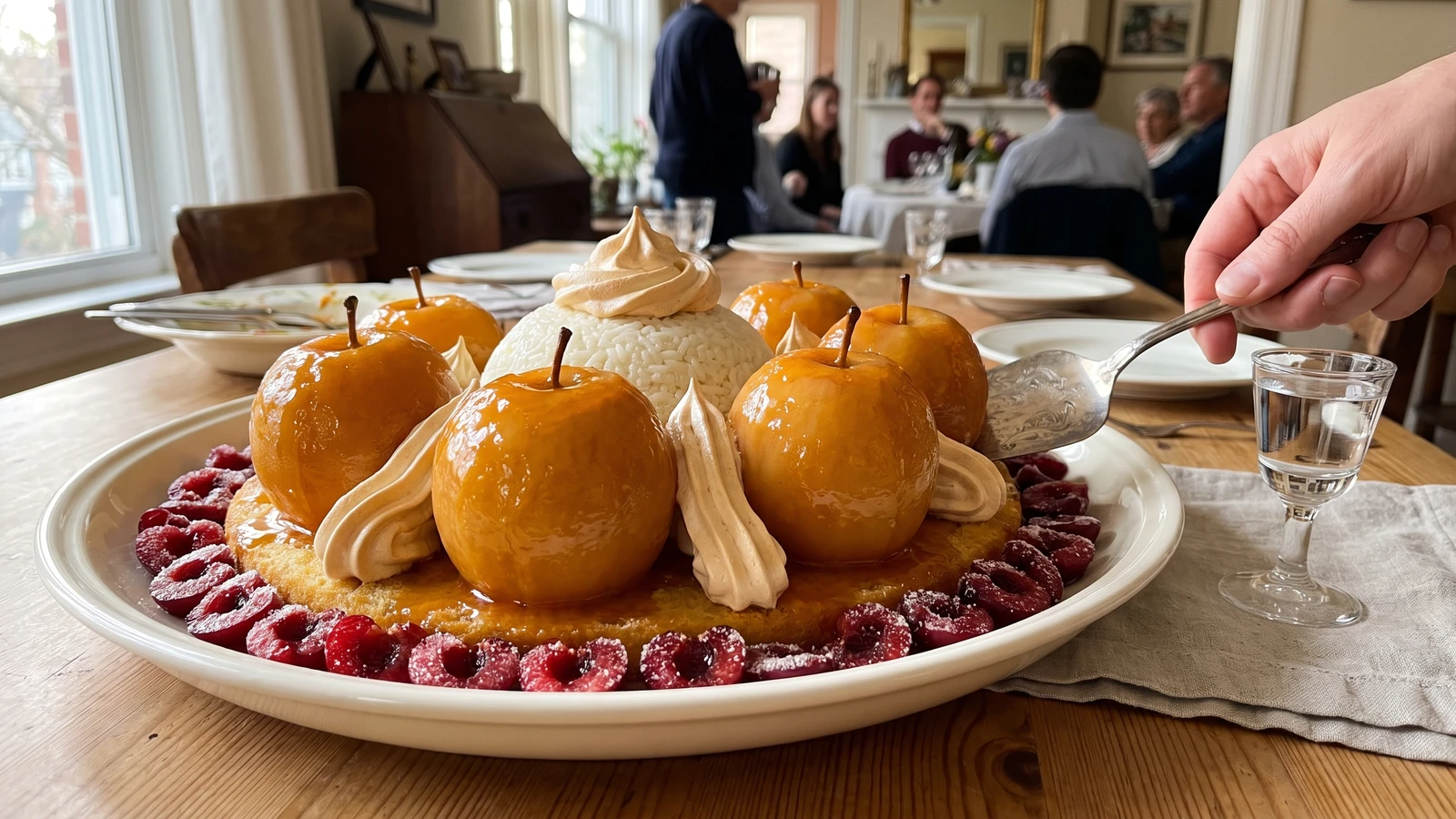
Upright syrup-poached apples circle a vanilla rice dome on kirsch-soaked Génoise, laced with baked meringue and brushed with apricot glaze as they leave the oven.
Pommes à la Parisienne (Parisian-style apples) teaches the discipline of a composed entremets, a formal dessert whose separate parts must arrive at assembly with the right texture. The one true thing to know before touching a pan is this: every component must be cold and every apple well drained before the meringue is piped. Warm rice softens the Génoise, wet fruit makes the meringue slide, and neither problem improves in the oven.
The source assumed a pastry brigade with Génoise, poached fruit, vanilla rice, and apricot syrup ready on separate benches, plus a flawn ring, a bottomless tart ring, and a grooved piping tube. At home, one 20 cm cake tin, one saucepan washed between preparations, and a large star tip do the same work. The brigade's trays of waiting components are scaffolding and can go. The kirsch-soaked Génoise, rice dome, upright apples, ordinary meringue, stiff apricot syrup, and half-sugared cherries are the dish and stay intact. Only the scale and equipment have changed. One cook, one stove, one evening.
When it lands on the table, the apples stand glossy and amber around the ivory rice, the meringue holds pale-gold ridges, and the red cherries mark the border like little seals. The step that decides it all is the draining before assembly: give the syrup time to leave the fruit, and the whole construction stands proudly.
Pommes à la Parisienne belongs to the Parisian grand-kitchen repertoire of composed entremets, where cake, cooked fruit, rice, meringue, and glaze were arranged as one architectural dessert. The apple entry inherits its complete method from Poires à la Parisienne (No. 2584), showing how the classical canon could transfer a fixed construction from one fruit to another. The name does not describe a special Paris apple; à la Parisienne here signals the polished assembly and service associated with the capital's formal table.
Quantity
1 governing preparation (No. 2584)
used as the assembly sequence, with apples replacing pears at home scale
Quantity
2
Quantity
1/3 cup (80 ml / 65 g)
Quantity
1/2 cup (120 ml / 60 g)
sifted
Quantity
1 tablespoon (15 ml / 14 g)
melted and cooled until warm
Quantity
5 (about 1 3/4 lb / 800 g)
peeled and cored but left whole
Quantity
3 cups (720 ml / 720 g)
Quantity
1 1/2 cups (360 ml / 300 g)
Quantity
1 1/4 cups (300 ml / 310 g)
Quantity
1/3 cup (80 ml / 65 g)
Quantity
2 tablespoons (30 ml / 25 g)
Quantity
1/2
split lengthwise
Quantity
2 tablespoons (30 ml / 28 g)
Quantity
1/2 cup (120 ml / 160 g)
Quantity
2 tablespoons (30 ml / 30 g)
Quantity
2
Quantity
1/2 cup (120 ml / 100 g)
Quantity
16 (about 1/2 cup / 120 ml / 100 g)
drained
| Ingredient | Quantity |
|---|---|
| Poires à la Parisienneused as the assembly sequence, with apples replacing pears at home scale | 1 governing preparation (No. 2584) |
| large eggs | 2 |
| granulated sugar for the Génoise | 1/3 cup (80 ml / 65 g) |
| all-purpose floursifted | 1/2 cup (120 ml / 60 g) |
| unsalted buttermelted and cooled until warm | 1 tablespoon (15 ml / 14 g) |
| small firm applespeeled and cored but left whole | 5 (about 1 3/4 lb / 800 g) |
| water for poaching | 3 cups (720 ml / 720 g) |
| granulated sugar for poaching | 1 1/2 cups (360 ml / 300 g) |
| whole milk | 1 1/4 cups (300 ml / 310 g) |
| short-grain white rice | 1/3 cup (80 ml / 65 g) |
| granulated sugar for the rice | 2 tablespoons (30 ml / 25 g) |
| vanilla beansplit lengthwise | 1/2 |
| dry Kirsch | 2 tablespoons (30 ml / 28 g) |
| smooth apricot preserves | 1/2 cup (120 ml / 160 g) |
| water for the apricot syrup | 2 tablespoons (30 ml / 30 g) |
| large egg whites | 2 |
| superfine sugar for the meringue | 1/2 cup (120 ml / 100 g) |
| half-sugared cherries, demi-confitesdrained | 16 (about 1/2 cup / 120 ml / 100 g) |
Combine the poaching water and sugar in a saucepan, bring them to a boil, and stir only until the sugar dissolves. Lower in the peeled, cored apples and cover them with a round of parchment so their exposed surfaces stay wet. Hold the syrup at the barest tremble, turning the fruit carefully once or twice, until a thin skewer enters with slight resistance, 12 to 20 minutes depending on the apples. Lift each apple out as soon as it is ready and cool it upright on a tray. If a skinless surface begins to split, remove that apple immediately; ça se rattrape. Stand the cracked side toward the rice dome later and support it with the piped meringue.
Wash the saucepan, add the milk and split vanilla bean, and bring the milk just to a simmer. Stir in the rice and cook over very gentle heat for 25 to 35 minutes, stirring often near the end so the milk does not catch. Add the rice sugar during the final five minutes. The rice is ready when the grains are tender and a spoon drawn through it leaves a furrow that closes slowly. If it becomes stiff before the grains soften, add a spoonful of milk; if it remains loose, cook it a few minutes longer. Remove the vanilla bean, spread the rice in a shallow bowl, cover its surface, and chill until firm enough to hold a dome.
Heat the oven to 350°F (180°C). Butter and line the base of an 8-inch (20 cm) round cake tin. Whisk the whole eggs and Génoise sugar in a heatproof bowl set over barely simmering water until lukewarm, then remove the bowl and beat until the mixture is pale, tripled in volume, and falls from the whisk in a ribbon that remains visible for several seconds. Fold in the sifted flour with broad turns, then fold in the warm melted butter. Stop as soon as no streaks remain. Spread the batter in the tin and bake for 10 to 13 minutes, until golden and springy at the centre. Cool for five minutes, turn it out, and let it become almost cold.
Strain 1/2 cup (120 ml) of the cooled apple-poaching syrup and stir in the Kirsch. In a small saucepan, warm the apricot preserves with the glaze water, press the mixture through a fine sieve, and return it to the pan. Simmer until it coats the pastry brush thickly and a stroke across the pan floor remains open for a moment. Keep this stiff apricot syrup warm. If it sets before the dessert leaves the oven, loosen it over gentle heat with a teaspoon of water.
Set the almost-cold Génoise on a flat ovenproof serving platter. Brush it repeatedly with the Kirsch-flavoured syrup, pausing after each pass so the cake drinks evenly. Use nearly all the syrup, but stop if liquid begins pooling underneath. Saturated means tender throughout, not collapsing at the rim.
Follow the governing arrangement of Poires à la Parisienne (No. 2584). Pack the cold vanilla rice into a lightly dampened 4-inch (10 cm) round bowl, invert it onto the middle of the soaked Génoise, and lift away the bowl to leave a neat dome. Blot the apples thoroughly, including their core cavities, then stand them upright around the rice. This drying is the step that holds the dessert together; if syrup appears beneath an apple, lift it, blot both surfaces, and replace it before piping.
Lower the oven to 325°F (160°C). Beat the egg whites in a spotless bowl until they form soft peaks, then add the superfine sugar gradually and continue beating until the ordinary meringue is glossy and holds a firm point. Fit a piping bag with a fair-sized star tip. Pipe a ridged thread around the apples and between their bases, then pipe a fine rosette on top of the rice dome. Bake in the mild oven for 10 to 14 minutes, until the ridges are set and lightly golden. Use the oven, not the broiler; fierce top heat colours the sugar before the meringue can set.
As soon as the dessert leaves the oven, brush the exposed apples with the warm, stiff apricot syrup. Work gently so their skins of glaze remain smooth and the meringue stays clean. Arrange the drained half-sugared cherries in a close border around the Génoise. Let the dessert settle for 10 minutes, then serve warm or at room temperature, cutting through apple, rice, and cake in each portion. À table!
1 serving (about 280g)
Culinary guides, cultural storytelling, and the editorial depth that makes cooking meaningful.
Discover Culinary ExplorerChef Juliette
Five almond preparations, one discipline: remove the skins cleanly, dry every kernel through, then cut, toast, or cloak it in pale caramel without letting its fragrant oils escape.

Chef Juliette
A pastry pantry lesson in one tray: filberts warmed only until their red skins release, rubbed clean, cooled, and chopped into a fragrant mise-en-place for cakes, creams, pralines, and petits fours.

Chef Juliette
The smallest pâtisserie discipline decides whether a cake leaves its mould intact: clarified butter in every corner, followed by the lightest veil of dry flour or fécule.

Chef Juliette
Four whites, one spotless bowl, and a patient change of speed: whisk gently until loosened, then briskly to glossy stiffness, with powdered sugar waiting if the foam begins to granulate.